


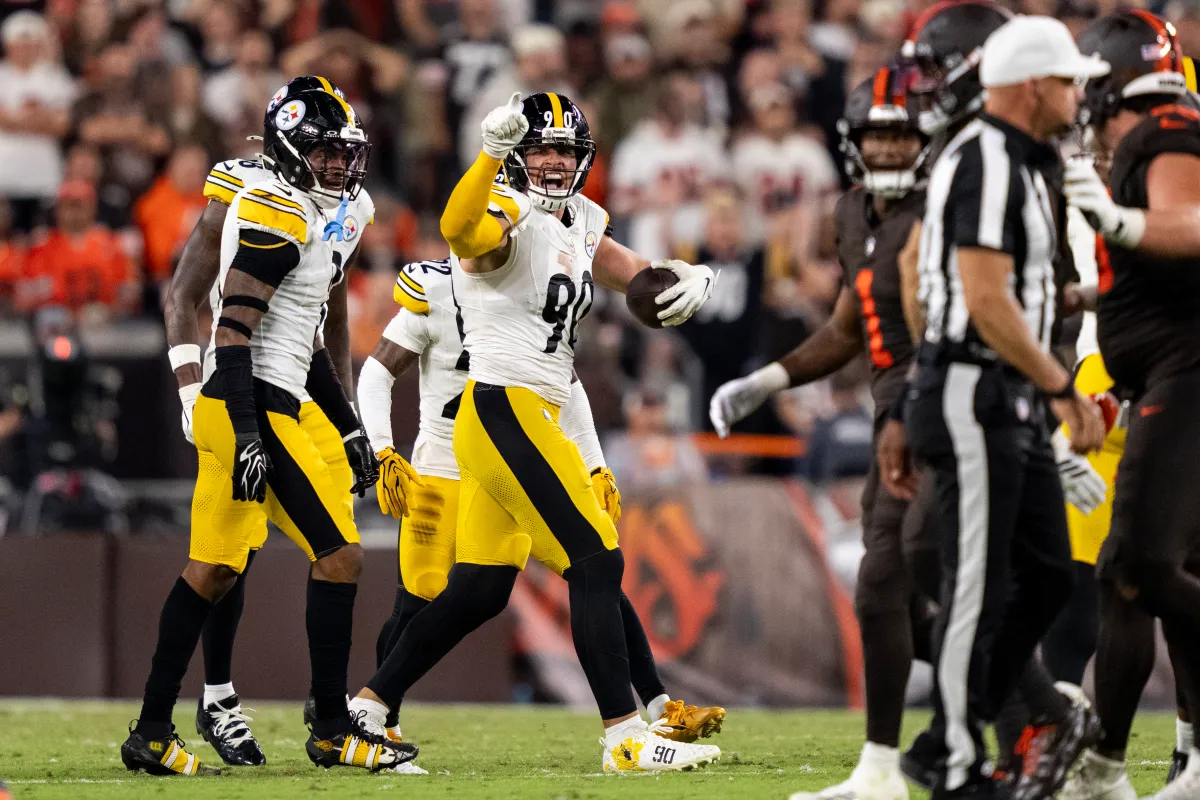
On a gray and bitter Sunday in Cleveland, the frustration that had been simmering inside the Pittsburgh Steelers’ locker room finally spilled out onto the sideline in full view of everyone. The object of the moment wasn’t a dropped pass or a blown assignment by an offensive lineman, but something far more revealing: T.J. Watt, the face of Pittsburgh’s defense alert, the relentless edge rusher who has made a career out of turning raw aggression into chaos for opposing quarterbacks, was caught on video grabbing a headset, his face full of fire, seemingly trying to communicate directly with the defensive coordinator. It was the kind of image that makes people stop and ask what has gone wrong. The Steelers had just taken another gut punch from the Browns, their fiercest rivals, and Watt, a player who normally prefers to speak with his body rather than his words, could no longer keep his emotions locked away. Every sack, every pressure, every shot of adrenaline he had poured into that game had been swallowed by a defensive performance that left him visibly uneasy. The cameras captured a person who loves football too much to pretend everything was fine, and in that single gesture, all of the tension building inside the team seemed to pour out at once.
For those who have never been in an NFL huddle, the image of a superstar grabbing a headset might look like a small rebellion, a player stepping outside his lane and challenging the authority of the coaching staff. But for those who understand the sport, it was something much deeper. The headset on the sideline is the conduit between the players on the field and the coaches in the booth, the brainstem of defensive communication. To reach for it is not just to take part in a conversation; it is to demand a voice in the conversation. Watt, whose eyes always look like they are scanning for something to hit, was clearly not offering a polite suggestion. This was a man who had watched things happen on the field that he did not agree with, and with each passing series, the frustration had built like a storm. The fact that the confrontation seemed to be aimed at the defensive coordinator made it even more significant, because it suggested that Watt’s dissatisfaction was not with one teammate or one play but with the overall strategy, the decisions being made above him, the shape and direction of a defense that was supposed to be one of the best in the league. It would have been easy to call it disrespectful, evidence of a player who had lost control. But it would also miss the point entirely, because in those seconds, Watt was not acting like a spoiled superstar; he was acting like somebody who cared so deeply that he could not stand to watch the thing he built his life around slip away without a fight.
Ben Roethlisberger, who saw more than his share of heated moments in Pittsburgh, watched the video with a knowing eye. On his podcast, the two-time Super Bowl champion did not rush to judgment. He did not condemn Watt. Instead, he defended him, and his defense carried the weight of someone who has stood in the same fire. “When it doesn’t happen that often,” Roethlisberger explained, “when T.J. Watt grabs that thing, it’s probably like, ‘Okay, something is going on.’” His point was simple but powerful: a player’s reputation matters, and Watt has spent his entire career building a reputation for measured intensity, not loud complaining. If every week, every game, every bad series drove Watt to the headset, the message would lose its meaning. It would become just noisecars, another entitled athlete throwing a tantrum. But because Watt is not that person, because he has shown time and time again that he is the first to work, the last to leave, and the one who leads by example, his rare outburst carries a special kind of authority. Roethlisberger continued, “He has got every right to do it. He’s a leader, he’s a captain. I assume he’s a captain, he should be. If not, he’s a Hall of Fame guy making plays. He’s a bright spot for this team. Because he doesn’t do it that often, it’s going to create headway.” Those words matter, because Roethlisberger is not just another talking head; he is a man who lived inside the pressures of the Steelers’ organization for nearly two decades Bernstein knows what it means to watch a game spiral away and feel powerless from the sidelines. He knows that the greatest players, the ones who truly define a franchise, sometimes have to risk uncomfortable moments to protect the standards that made them great.
What is perhaps most interesting about the entire scene is what it says about the relationship between the soul of a defense and the structures that surround it. Football is often described as a game of obedience, a sport where players are expected to swallow their emotions and execute their assignments without question. But the reality is far more human. Great players are not robots; they are driven by a ferocious belief in themselves and in the way the game should be played. When that belief is challenged by what they see in front of them, the feeling cannot simply be turned off. Watt has earned the right, through years of impossible plays and constant effort, to have his opinion taken seriously. He has been a bright spot for a team that has sometimes struggled to find warmth in the darkness of difficult seasons. He has been a Hall of Fame talent, a person who changes games with a single twist of his body and a unique second sense for the football. In that context, the headset moment becomes less a revolt and more a call for clarity. It is the voice of a leader who feels that something important is being lost in translation, that the people in the coaching boxes and on the sidelines need to see what the players are seeing, feel what the players are feeling, and understand that defensive success is not just about drawing up clever schemes. It is about electricity, connection, and the confidence that comes from knowing everyone is rowing in the same direction.
The question now is how the team will respond to that call. There are always two ways these moments can go. A team can treat the star’s frustration as a symptom of disrespect, punish him behind closed doors, and let the fracture grow wider. Or a team can recognize that the passion of a player like Watt is a precious resource, something to be protected and channeled, not squashed by ego. The best organizations, the ones with history and dignity, tend to understand that moments like these are invitations to look in the mirror. The Steelers are one of those organizations. They have seen leaders raise their voices before; they have watched strong-minded players push back against the comfortable ways of doing thingsall. And they have usually come out stronger because of it. Watt’s frustration should not be treated as a scandal. It should be treated as the sound of a person who refuses to accept mediocrity, a person who knows that every rep, every snap, every opportunity to make a difference is precious and can never be recovered once it slips away. The video of the headset is not the story; the story is what happens next, whether the coaching staff listens, whether the message translates into adjustments, and whether the Steelers defense finds new life in the days ahead.
That revival will have to happen quickly, because the schedule waits for no one. Pittsburgh will return to the friendly walls of Acrisure Stadium for a Week 5 matchup against the Indianapolis Colts, a team that is feeling good about itself after back-to-back wins over the Houston Texans and the Washington Commanders. The Colts will arrive with confidence, with a running game that can punish sloppy defenses, and with no sympathy for a Steelers team trying to find its footing. But perhaps that is exactly why this game is so important. In football, frustration can go one of two ways. It can poison a locker room, spreading like a disease and turning the season into a crawl toward the finish line. Or it can become fuel, a fire that burns away excuses and forces people to see themselves clearly. Watt has already thrown the first spark. The headset moment was not an act of disrespect, but an act of urgency. It was a Hall of Fame player saying, in the only way he knew how, that he still believes in what this team can be. The Colts are not just another opponent; they are a chance for the Steelers to prove that the loss in Cleveland was not a breaking point but a turning point. If the defense can find its rhythm, if the communication is better, if the passion that spilled over on the sideline can be transformed into discipline between the lines, then this moment might be remembered not as a troubled scene but as the wake-up call that saved a season. Because at the end of it, football is not about silent obedience. It is about people, about believing in something bigger than yourself, and about refusing to let go, even when your hands are wrapped around a headset and your heart is screaming. That is what T.J. Watt showed us. And maybe that is exactly what the Steelers needed to see.