

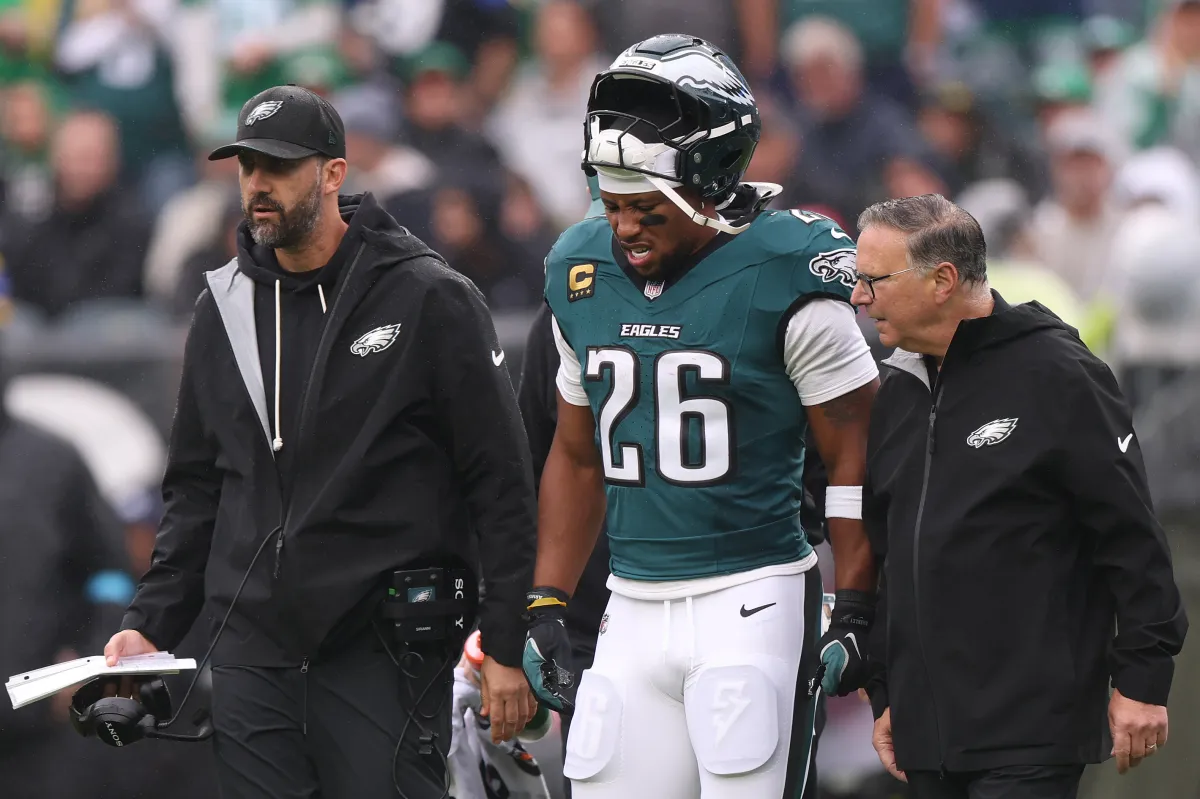
Sunday at Lincoln Financial Field was supposed to feel like a turning point. The Philadelphia Eagles had spent the opening weeks of the season searching for an identity, and with the home crowd behind them, there was a genuine hope that they might finally resemble the team that had rolled through the league a season before. That hope lasted about as long as the first few minutes of the game. Early in the first quarter, Saquon Barkley took a handoff, planted his foot, and tried to get around the left side. He gained six yards, but he also felt something wrong—a sharp grab in his hamstring that had him limping almost immediately. He made his way to the sideline, surrounded by trainers, and though he stayed there for a while, it quickly became clear that his afternoon was over. The stadium seemed to deflate with him. The scoreboard would later show a 24-20 loss to the Los Angeles Rams, and that defeat had real consequences for a team now sitting at 2-2. But the most vivid image of the day was not the final pass or the fourth-quarter collapse. It was Barkley, walking off the turf with a hesitation in his step, unable to do the thing he does best. For a franchise built on his shoulders, for a city that had come to believe every play was possible when he touched the ball, it was a sickening moment. The trainers hovered around him, the sideline grew quiet, and television cameras caught the same worried faces that had been screaming with joy just minutes before. There was no immediate diagnosis, no official word, just a star running back standing on the sideline with his hands on his hips, trying to stretch out a muscle that refused to cooperate. Many in the stands didn’t know exactly what had happened, only that Barkley wasn’t coming back. The rumblings moved through the crowd like weather. People checked their phones, refreshed their timelines, and looked for the replay that would tell them whether it was a cramp or something worse. The game continued, but the focus had shifted. Games are lost all the time, but losing a player of Barkley’s caliber is the kind of thing that changes a season. And in that first quarter, the season suddenly felt more fragile than it had at kickoff.
With Barkley out, the Eagles had to improvise, and for a while the improvisation worked. Tank Bigsby stepped into the lead role and gave the offense something to lean on, carrying the ball 14 times for 55 yards with a physicality that belied his sudden opportunity. Will Shipley handled the complementary carries and chipped in 23 yards on six attempts, providing a slightly different look. They were not Saquon Barkley, but they kept the offense moving, and Jalen Hurts took it from there. In the second quarter, Hurts found Darius Cooper for two touchdowns, and for a beautiful stretch the Eagles looked like the team everyone had been waiting to see. The offensive line was winning at the point of attack. The receivers were separating. The crowd was chanting and waving towels and feeling that familiar rhythm of a Philadelphia football afternoon. Cooper was running routes with a newfound precision, and Hurts was standing tall in the pocket, spreading the ball around and giving the home faithful every reason to believe the game was under control. The mood on the sideline was still tense because of Barkley, but the football itself was humming. Then came the second half, and everything shifted. The Eagles were held scoreless over the final two quarters. The drives stalled. The calls became cautious. The confidence seemed to drain out of the huddle. Matthew Stafford, meanwhile, began to operate with the calm expertise of a vintage quarterback, picking apart the defense and keeping the Rams within striking distance. His receivers found soft spots in the coverage, his offensive line gave him just enough time, and the entire Rams attack started to look inevitable. In the fourth quarter, Los Angeles scored two touchdowns, the second of which proved decisive, and the Eagles walked off the field with another loss on their record. The game had been winnable. That was the worst part. They had done enough to beat a team like the Rams, but they had not done enough to finish the job. And once again, the story was the same: a promising start undone by a listless finish, a defense that couldn’t get the stop when it mattered, an offense that disappeared at the worst possible moment.
By Monday evening, the message from the Eagles’ medical staff was about as encouraging as it could be under the circumstances. NFL insiders Ian Rapoport and Mike Garafolo reported that Barkley’s hamstring injury is considered week-to-week, but it is not considered a long-term issue. In a sport where one bad twist can end a season, that news was welcomed with open arms. It does not mean Barkley will be on the field this Sunday, and it does not mean he will be ready to play through the kind of high-volume workload he handled last season. It means that the injury is manageable, that with rest and treatment and a little bit of caution, the Eagles could have their star back before the season gets completely away from them. The numbers so far do not tell the full story. Barkley has 36 carries for 182 yards and has not yet scored a touchdown, but his influence cannot be captured in fantasy stats or box score columns. He is the gravitational force of the Philadelphia offense. Defenses game-plan for him. Linebackers creep toward the line of scrimmage. Safeties hesitate for a half-second before reacting to run or pass, and that half-second is all Hurts needs. Even when he doesn’t have the ball, Barkley makes the offense more dangerous. The week-to-week status gives the Eagles a chance, a sliver of hope that this injury, unlike so many others around the league, will not become a season-defining catastrophe. There will be tests. There will be limits. But the most important words in the report were the ones that promised this was not a long-term injury. For a franchise that has already been through so much this season, that was a small victory. The relief was visible in the voices of fans, in cautious tweets from former players, in the way the local talk radio shifted from panic to patience. Barkley may miss a game or two, but he hasn’t lost his season. And for now, that is enough.
To truly understand why Barkley’s health matters so much, you have to go back to the beginning of this Eagles chapter. He arrived in Philadelphia in 2024 after years of carrying the New York Giants on a roster that never seemed to give him enough help. There was talent and resilience and a reputation for being one of the most extraordinary athletes in the sport, but there were also questions about whether he could stay healthy and whether any running back could justify a significant investment. Barkley answered those questions in the most emphatic way possible. He played in 16 games in each of the past two seasons, an achievement in itself for a running back, and in 2024 he posted a career-best 2,001 rushing yards to go along with 13 touchdowns. That season was not just a statistical masterpiece. It was a title run. The Eagles won the Super Bowl, and Barkley was the driving force, the player who wore down opponents, broke their spirit, and gave the defense a rest by keeping the clock moving. He is not a traditional running back. He is a threat to score from anywhere on the field, a man who can run through a tackle, stop on a dime, and accelerate through a hole before the secondary has time to react. Watching him is exhilarating, and the joy he plays with is contagious. That is why losing him, even for a game or two, feels so significant. The Eagles are a different team without him. They are more predictable, less explosive, more reliant on Hurts to carry a passing game that is still searching for its identity. The offensive line misses him. The play-action misses him. The entire rhythm of the offense belongs to him in a way that is rare in the modern NFL. A week-to-week injury is manageable. The alternative was unthinkable. Maybe it took a scare like this to remind everyone how much he means, not just to the stat sheet but to the soul of the franchise. He is the reason the Eagles have a championship. He is also the reason they still believe they can get another one.
The season as a whole has been a lesson in the difficulty of staying on top. The Eagles are 2-2, and while that record looks tolerable at first glance, the context is less forgiving. They defeated the Washington Commanders and the Tennessee Titans, two teams that are also in the middle of their own early-season struggles. Then they lost to the Chicago Bears and the Los Angeles Rams, two teams that entered those games with doubts but found enough to beat a Philadelphia squad that used to find these wins easily. In both losses, the Eagles had chances. In both losses, they found a way to let victory slip away. The offense has been inconsistent, the defense has allowed too many critical conversions, and the coaching staff has made decisions that invite second-guessing. There is no single culprit, no one issue to point to. Instead, there is a pervasive sense that the team has lost something intangible, the sharpness and confidence that defined the championship run. Part of that is the natural cost of success. Every week, opponents bring their best against the defending champs. Every game is a Super Bowl for the other side. But the Eagles have not responded with the kind of maturity that champions are supposed to show. They have looked tight late in games. They have made uncharacteristic mistakes. They have let the moment get too big. The fans in Philadelphia are not known for endless patience; they have seen great teams and bad teams, and they know the difference between a rough patch and a collapse. Right now, the evidence is mixed, but the trend is concerning. Another month of this, and the season could spiral. The talent is still there, the pieces are still in place, but talent doesn’t matter much if it doesn’t show up in the fourth quarter. There are also the little things, the turnovers at bad times, the penalties that erase positive plays, the missed assignments on defense that turn ordinary throws into explosive gains. Those are the details that made the Eagles special last season, and those are the details that have been missing recently. Championship teams find ways to win these games. Right now, the Eagles are still trying to find themselves.
Now the Eagles have to find a way to stop the slide before it becomes something worse. Their next stop is Jacksonville, where the Jaguars are waiting after a victory over the Cincinnati Bengals that lifted them to 3-1. Trevor Lawrence is playing with the kind of confidence that the Jaguars have been waiting to see, and he has enough weapons around him to make life miserable for a secondary that has had some rough moments. This is not a gimme game. This is a serious test, especially on the road, with the pressure building and the noise getting louder. The Eagles know that a loss would send them to 2-3 and turn the conversation into something much more urgent. They also know that a win would reset the narrative, at least temporarily. If Barkley is available, the offense gets its identity back. If he is not available, they have to conjure the same spirit they showed in the second quarter against the Rams, but they have to sustain it for four quarters this time. There is still time to turn this season around. The NFC is not so deep that a 2-2 team with championship history should be counted out. But time is a limited resource in football, and the Eagles have already burned through their grace period. The next few weeks will reveal what kind of team they really are, whether they are the champions who know how to dig deep or a talented group that let success slip away. The answer is somewhere on the field in Jacksonville, in the treatment room where Barkley’s hamstring is healing, in the huddle when everything is on the line. Every season has a moment when it can go one way or the other. For this team, that moment has arrived. The city is watching, the doubters are loud, and the only way to silence them is by finding a way to win. For more about the Philadelphia Eagles and the NFL, visit Newsweek Sports.