


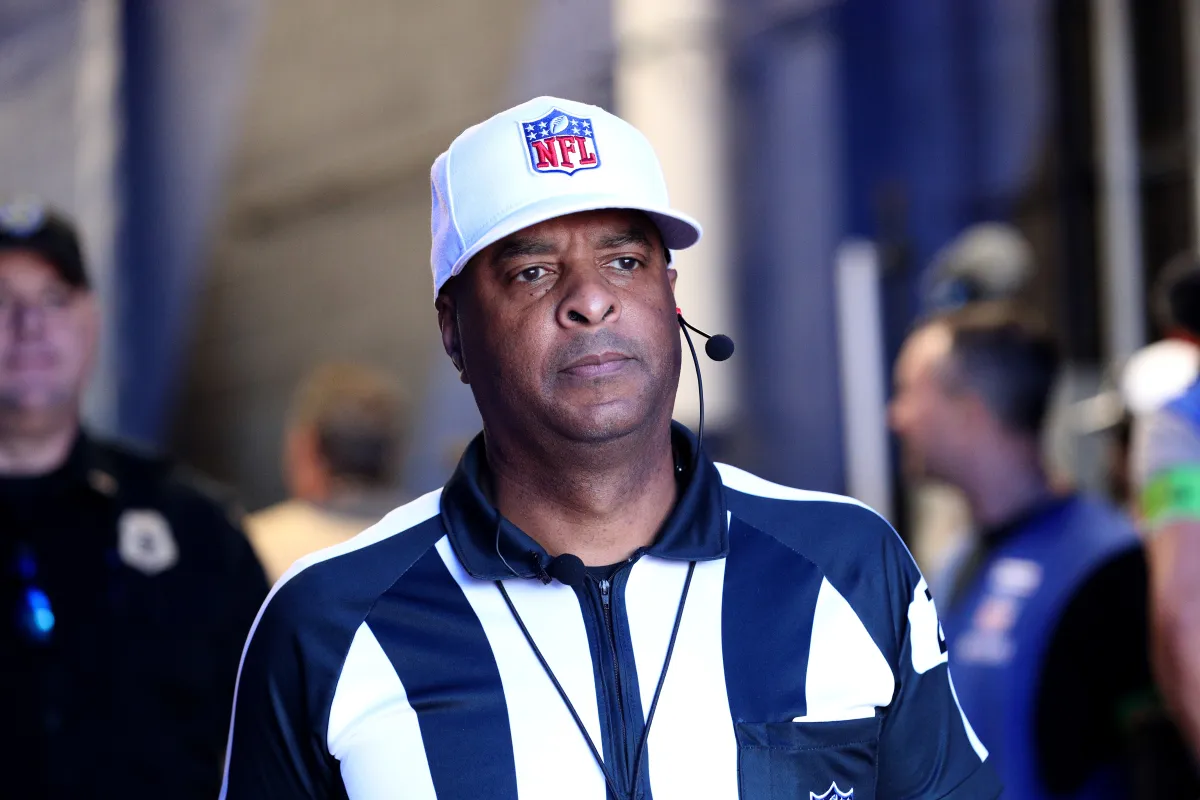
Sunday’s game between the Minnesota Vikings and the Miami Dolphins was supposed to be remembered as another statement by one of the NFL’s most intimidating defenses. The Vikings came into the afternoon with a 3-0 record, having bullied everyone in their path, and they left with a 15-10 victory and a perfect 4-0 mark. The Dolphins, a team with its own explosive potential, were held to just one touchdown and a field goal. It was the kind of performance that makes a defense proud and sends a message to the rest of the league. But the moment that set phones buzzing and forced the league office to pay attention had nothing to do with a sack, a turnover, or a touchdown. It came on a seemingly harmless play near the end of a whistle, when a referee ended up flat on the grass. Vikings linebacker Eric Wilson, chasing Miami quarterback Malik Willis with single-minded intensity, was trying to fight through a blocker. The blocker pushed him off balance, and Wilson’s momentum carried him directly into NFL referee Adrian Hill. The collision sent Hill tumbling to the turf. The play had already been blown dead, which made the sight of an official on the ground all the more jarring. Wilson, realizing what had happened, walked over and offered a hand. Hill was having none of it. He brushed off the attempt, climbed to his feet, and let the linebacker know exactly how he felt, shouting as the moment turned from accidental to awkward. It was a brief, human flashpoint in a game that usually tries to keep its emotions contained.
To understand how this happened, you have to understand the way Wilson plays the game. He is a linebacker who attacks everything in front of him. On Sunday, his focus was on Willis, and he did not want to let the quarterback slip away. That kind of tunnel vision is celebrated in football, until it runs into something unexpected. Wilson was not looking for the official. He was looking through him, trying to get past a blocker and make a play. The push from the blocker redirected his path, and in that fraction of a second, there was no time to stop. The whistle may have been blown, but Wilson’s brain was still in full pursuit mode. It is a strange and uncomfortable thing when a player realizes he has made contact with an official. There is no manual for it. Your first instinct is to apologize, to make sure the person is okay, to show that it was not intentional. Wilson did exactly that. He walked over with his hand extended, perhaps expecting a quick “I’m fine” and a handshake. Instead, he got a glare and a verbal dressing-down. The referee’s reaction was understandable in its own way. Being knocked to the ground in front of tens of thousands of people is embarrassing, and officials carry an authority that gets tested on every single snap. Hill’s pride was wounded, and his anger came out. Wilson, meanwhile, had to stand there and take it. He is a professional, and he knows better than to argue with an official, especially after an incident like this. So he nodded, backed away, and tried to get back to the game. It was not the last time he would make an impact. He finished the afternoon with four total tackles, the third-highest total on the Vikings defense, and helped a unit that has become the identity of this Minnesota team.
The NFL took notice. According to ESPN’s Adam Schefter, the league said it is reviewing the play, and Schefter noted that it was “at least the second today involving an interaction between a player and an official.” That is an important detail, because it means this was not a standalone incident. It was part of a larger, more troubling pattern that emerged on a single Sunday. The league’s review will likely focus on two things: first, whether Wilson did anything beyond what was accidental, and second, whether Hill’s reaction crossed a line. The initial video suggests Wilson was an innocent bystander in his own collision. He was pushed into the official, and he immediately tried to help. But the league does not like to see officials on the ground, and it has a history of penalizing even inadvertent contact in certain situations. It is possible that Wilson will be fined anyway, simply because the contact happened and the league wants to send a message. It is also possible that the league will look at the way Hill responded, yelling at a player who was trying to help, and decide that the official was out of line. Referees are human, but they are expected to maintain a certain composure. The fact that the league is reviewing the play at all suggests that the review is about more than just Wilson’s actions. It is about the interaction as a whole, and about the tone of officiating across the league.
The broader context makes this review even more significant. Sunday was a day of friction between players, coaches, and officials across the NFL. In Arizona, the league is investigating an official who allegedly hurled obscenities at Cardinals tight end Trey McBride. That is a serious accusation, because it suggests that the people in striped shirts are not always neutral voices of reason. It suggests that officials, like the players they police, can lose their cool and say things they should not say. In New England, Patriots head coach Mike Vrabel was flagged for unsportsmanlike conduct after he screamed at an official that a call was an “(expletive) terrible call.” Vrabel’s frustration was raw and audible, and it got him a penalty. These moments all happened on the same day, and together they paint a picture of a sport that is becoming increasingly tense in its interactions with authority. Players are faster and stronger than ever. Coaches are desperate to win. Officials are trying to keep control of a game that moves at speeds the human eye can barely process. It is not surprising that collisions, both physical and verbal, happen. But it is still a problem for the NFL, which has spent years trying to balance the intensity of the game with the need for respect and safety. Every time a player knocks over an official, or an official curses at a player, or a coach screams at the wrong moment, the league has to step in. It is a delicate dance, and Sunday’s games showed just how easily it can fall apart.
At the center of it all is a simple truth: the people on the field are all human. Wilson did not wake up on Sunday morning hoping to run over a referee. He woke up hoping to make plays, to help his team win, to prove that the Vikings are one of the best teams in the NFL. Hill did not wake up hoping to get knocked down and then lose his temper. He woke up hoping to officiate a clean game and stay invisible. Neither of them set out to be part of a controversy. But football is a game of violent emotion and split-second decisions, and sometimes those decisions go wrong. The whistle is supposed to be the signal that everything stops. But for a player like Wilson, running at full speed, the whistle is a sound that arrives a fraction of a second after the brain has already committed to a path. The blocker’s push made it worse. By the time Wilson saw the official, it was too late. And once he was on the ground, Hill had to deal with the indignity of being the man who got run over by a linebacker. He lashed out, perhaps because that is what the moment called for in his mind. It is not hard to imagine the exchange: Wilson saying “Sorry, ref,” and Hill responding with something like “Get away from me.” The interaction lasted only a few seconds, but it has become a case study in the strange, fragile relationships that exist on an NFL field.
The league’s review will not change what happened on Sunday. It will not take away the Vikings’ win or the Dolphins’ loss. It will not erase the image of Hill picking himself up off the turf or Wilson’s awkward attempt to make amends. What it might do is establish a precedent. If the NFL decides Wilson was at fault, it will be sending a message that players must be absolutely aware of their surroundings, even when they are being pushed from behind. If the league decides Hill was the problem, it will be admitting that officials need to hold themselves to a higher standard. Either way, the Vikings will move on. They are 4-0, they have one of the most ferocious defenses in football, and they travel to New Orleans in Week 5 to face a Saints team that is always dangerous at home. Wilson will be on that plane, preparing for the next game, probably trying to forget this strange afternoon. But he will not forget it entirely. No player forgets the time he knocked over a referee, even by accident. And no referee forgets the time he was knocked down and caught himself screaming at a player. The NFL wants to review the play because it needs to understand why these moments happen and how to prevent them. But the truth is, they will happen again. Football is too fast, too intense, and too human for perfect control. The best the league can do is review, fine, and move forward, hoping that the next Sunday brings fewer collisions and more composure. For the Vikings, the focus is already on New Orleans. For the rest of the league, the focus is on a play that lasted only a few seconds but said so much about the state of the game.