


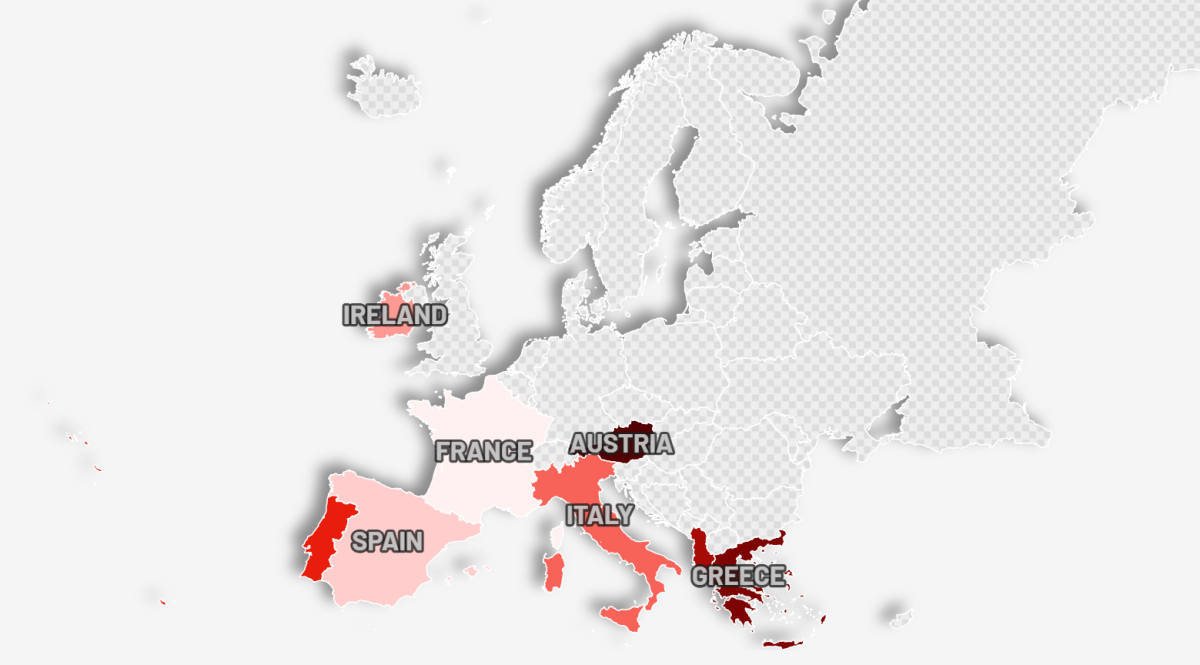
This weekend, Europe holds its breath. After weeks of mass demonstrations and smaller, angrier flashes of frustration, authorities across the continent are bracing for another round of public unrest, one that feels less like a passing moment and more like a tide that will not recede. The grievances are not simple, and they are not confined to one country or one political camp. They are tangled and deeply human: rising costs of living that quietly erase paychecks, wages that seem frozen in another decade, housing markets that have transformed from shelter into speculation, and a weariness with governments that appear more concerned with order than with listening. There is also anger about the conflict in the Middle East, spilling into streets from Dublin to Vienna, and a broader sense that institutions have lost touch with the people they are meant to serve. For many, this is not politics in the abstract. It is the decision between paying a heating bill and buying groceries. It is the young graduate living with parents because rent has become impossible. It is the elderly tenant watching their neighborhood become a collection of short-term rentals. When people take to the streets, they carry these stories with them. And when governments respond with police lines, emergency powers, and soldiers, the gap between those in power and those on the pavement only grows wider. This weekend, the police, the soldiers, and the protesters will once again face each other, but the real fight is not between them. It is for the future of a Europe that many feel has quietly left them behind.
France is bracing for the most volatile weekend of all. Around 70,000 police officers, including elite anti-terror units, have been deployed across the country in an effort to prevent a repeat of the scenes that erupted last weekend. Hundreds of thousands of protesters had filled the streets to denounce soaring living costs and chronic underfunding in education, and what began as student-and-union-led demonstrations spiraled into bursts of violence, looting, and fires in France’s worst unrest in decades. Clothes stores, food markets, and technology shops were ransacked, leaving streets strewn with debris and a country shaken by its own reflection. French officials have imposed broad restrictions and blamed far-left organizations, anti-government movements, and what they call “criminals” for inflaming what had originally been protests about bread-and-butter issues. Interior Minister Laurent Nuñez struck a hard line on Friday, warning, “We will be extremely vigilant, extremely firm, and we will let absolutely nothing pass.” The planned demonstrations come at a painful moment, a day after a drive-by shooting on the outskirts of Paris killed one person and injured several others, described by authorities as a racially motivated terror attack. A 39-year-old suspect was later detained in Coignières, just west of La Verrière, but the shock of the violence still hangs in the air. The American embassy has warned visitors heading to Paris for Sunday’s NFL game between Pittsburgh and New Orleans to avoid crowded areas and stay alert. Former President Donald Trump, speaking to reporters, did little to ease tensions, saying, “It’s looking like tomorrow is going to be a bad day in France… France is really in trouble.” Behind the official press conferences and the heavy security, there is a quieter, more anxious reality: shopkeepers boarding up their windows, families canceling weekend plans, and ordinary citizens wondering whether their city has become a battlefield. The fear is real, but so is the frustration that brought people out in the first place. The French government is determined to show strength, but strength alone rarely answers the deeper question of why so many people now believe that peace can only be found in protest.
Italy is also bracing for another wave of demonstrations, and the state is cracking down hard. Protests are planned in Rome, Milan, and several other cities under the banner of the so-called “October 17 Movement,” a grassroots coalition that has captured the anger of those who feel the system is no longer working for them. Around 300 Italian police officers have been deployed to monitor demonstrations and redirect traffic in the capital through the weekend, on top of hundreds of additional local officers taking to the streets. In Milan, Mayor Giuseppe Sala made an unusual and somewhat desperate appeal on Friday, asking local businesses to remain open after last week’s clashes left the city scarred. At least 32 people were arrested and 14 police officers were injured in Milan alone, with hundreds of others taken to police headquarters, according to the Italian news agency Ansa. The violence, vandalism, and property damage that accompanied protests against ballooning living costs prompted the Italian government to send 500 soldiers to Milan earlier this week, pledging a “firm response” to the unrest. Hundreds of soldiers are now thought to be stationed in the city, reinforcing thousands of law enforcement officers already on patrol. Under newly announced security measures, police can now detain children as young as 14 if they are considered dangerous, a move that has alarmed civil rights groups and parents alike. Interior Minister Matteo Piantedosi described the involvement of young people, including teenagers, in the disturbances as a “new and complex phenomenon.” That complexity is easy to understand. Milan police estimate that around 2,000 very young protesters took part in last week’s chaos, many of them “naturalized, second-generation Italians.” These are not hardened revolutionaries. They are teenagers who grew up in Italy, who went to Italian schools, who speak the language and carry the passport, yet still feel like outsiders in a country that seems unable to offer them a stable future. They see the gap between their parents’ hard work and their own prospects, and they are furious. The image of a 14-year-old handcuffed by soldiers in the streets of Milan is a startling one, and it raises difficult questions about how far a society will go to protect its public order, and at what cost. There is no easy answer, but there is also no denying that a generation is shouting into a void.
In Spain and Portugal, the protests have taken on a different tone, less about immediate violence and more about a deep, simmering anger over housing. Spanish authorities have warned that traffic will be slowed by demonstrations in several parts of Madrid this weekend, urging residents to use public transport as the General Confederation of Labour, one of the country’s largest trade unions, organizes a march through the city center to defend public pensions. But the larger issue that has brought thousands into the streets is housing, particularly the unaffordable rent that has become a nightly horror story for so many. The moment that captured the country’s heart was the eviction of an 87-year-old woman from her Madrid apartment last month. The image of an elderly woman, stripped of the home where she had lived for years, sparked a wave of outrage that swept across Spain. Protests erupted in city after city as residents denounced rental prices that have climbed far beyond what ordinary salaries can support. They are angry, too, about short-term rental platforms that turn apartment buildings into tourist hotels, pushing long-time inhabitants out of their own neighborhoods. In Barcelona, Madrid, and dozens of smaller communities, people who grew up in a city can no longer afford to live there. The feeling is one of betrayal, of being priced out of belonging. Similar scenes have unfolded in Portugal. Demonstrations have hit Lisbon and Porto, and more are expected this weekend as tent encampments spring up in public squares, a desperate symbol of the housing crisis. It is one thing to hear about homelessness and another to see a small colony of tents erected by families, students, and teachers in the center of a European capital. What makes these protests so human is the quiet desperation behind them. The grandmother carried out of her apartment is not a political symbol; she is a reminder that society has forgotten how to care for its own. The government, for its part, has promised measures, but the protesters are not waiting. They want bedrooms, not promises. They want homes, not housing stock. And until that changes, the squares of Spain and Portugal will remain filled with people who simply want a place to call their own.
Beyond the headlines of France and Italy, the unrest stretches across the continent in ways that are often overlooked until they explode. In Tirana, Albania, teachers, doctors, young people, and creative professionals converged for another day of demonstrations, their anger directed at a government they believe has failed them. The protests were triggered earlier this summer by news that Jared Kushner, former President Trump’s son-in-law, was part of a group planning to build a high-end hotel in an Albanian nature reserve, a decision many saw as a symbol of corruption and disregard for the country’s natural treasures. But the anger runs deeper, touching on government corruption and the crumbling state of education. Police fired what appeared to be rubber bullets at protesters on Saturday; reporters on the ground found the pellets scattered in the streets. In recent days, the scene has grown increasingly confrontational, with protesters burning government buildings and throwing rocks at local law enforcement, who responded with tear gas. Around 1,500 police officers were sent into the streets of Tirana to contain the escalation, but the underlying tensions remain unresolved. In Greece, thousands of people marched in Athens earlier this week over education funding, and a prominent trade union has called for fresh demonstrations amid deep dissatisfaction with living conditions. In Vienna, smaller events were advertised in support of gender equality, with authorities preparing temporary road closures and diversions for demonstrators. In Ireland, pro-Palestine gatherings organized by the volunteer-run “Ireland Palestine Solidarity Campaign” took place in Dublin and other cities, reflecting the way the conflict in the Middle East has resonated with European citizens who see their own governments as complicit in suffering. What connects all of these movements is a desire to be heard. The protesters in Albania may not wear the same badge as those in Athens or Dublin, but they share a common language of anger and hope. They are tired of being told that change is impossible, tired of watching their countries slip away from them, tired of living in a world where the powerful make decisions that the ordinary must endure. The streets have become the only place where they feel their presence is truly counted.
If there is a lesson in all of this, it is that Europe is not as stable as it once seemed. Between mid-September and October 23 alone, there were nearly 180 protests across 12 European countries, according to Spain’s El País newspaper. That is not a coincidence or a fluke. It is a pattern, a pulse, a collective cry sent out from every corner of the continent. Governments have responded with security: more police, more soldiers, harsher penalties, and promises of order. But order is not the same as justice, and force cannot replace hope. In France, the government blames extremists and criminals for the violence. In Italy, officials speak about young people as a “complex phenomenon” and prepare to detain teenagers. In Albania, the police fire rubber bullets and chide the public for their lack of patience. Yet the people in the streets are not abstract categories or enemy lists. They are the woman checking the price of milk, the student sleeping on a friend’s couch, the nurse working two shifts, the father watching his children leave the country because there is nothing left for them at home. They are not asking for the world; they are asking for a world that includes them. This is the human center of the story, and it is being buried under tear gas and rhetoric. Europe’s leaders have a choice: they can continue to build walls of soldiers and police, or they can finally sit down and listen to what the streets are saying. The protests may calm for a weekend or two, but the frustration will not vanish. It will wait, grow, and return in new forms. The cost of living may be the spark, but the fuel is deeper: a quiet sense that the future is no longer something to look forward to. Until that changes, the demonstrators will keep coming, and Europe’s squares will keep filling with people whose only hope is that someone, finally, will see them.