

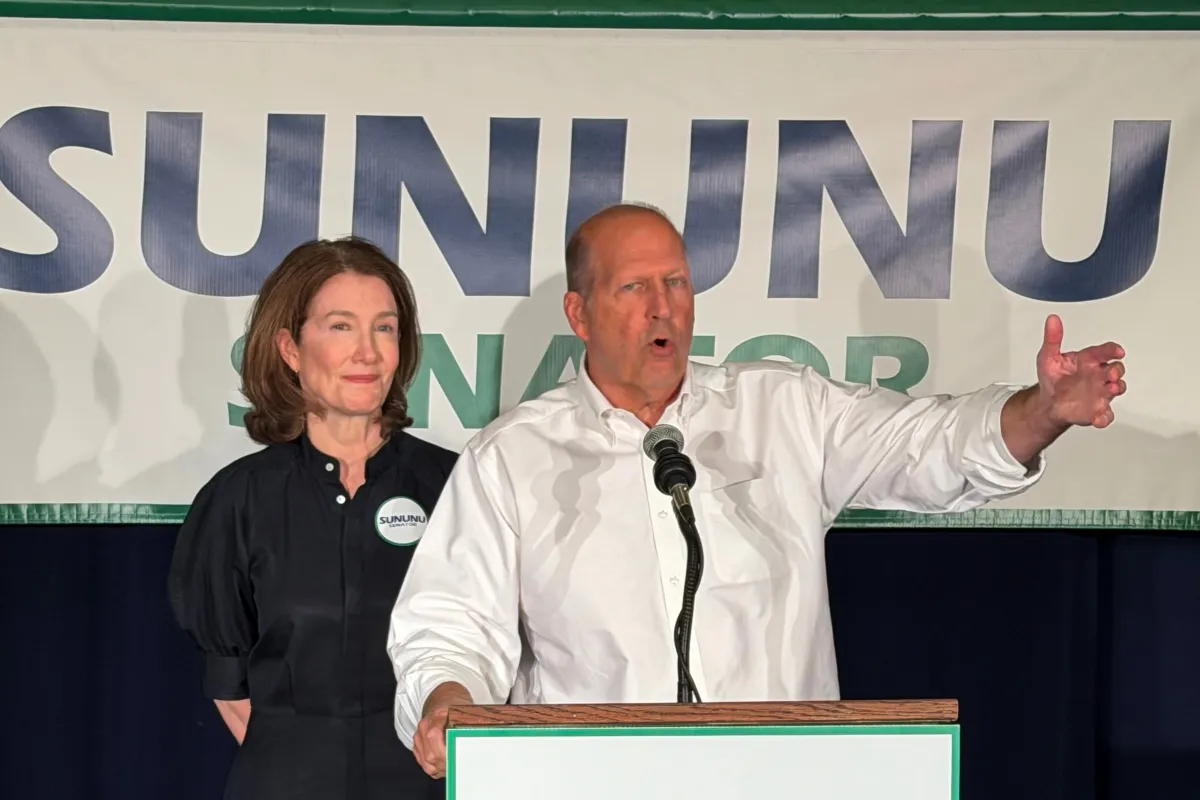
There is something almost poetic about a Senate race in New Hampshire tightening as the leaves begin to turn. With roughly four weeks left before the midterm elections, the contest between Democrat Chris Pappas and Republican John E. Sununu has suddenly become one of the most closely watched political dramas in the country. A new Rasmussen Reports poll shows Pappas leading Sununu by just five points, with 49 percent of likely voters backing the Democrat and 44 percent supporting the Republican. That is a striking shift from a poll released just a month earlier, in which Pappas held a commanding 11-point advantage, 45 percent to 34 percent. The race is open because Democratic Senator Jeanne Shaheen has decided to retire, leaving the Granite State’s seat up for grabs in November. The Cook Political Report currently rates the contest as a toss-up, and both parties know that this seat could help decide which party controls the Senate. For Democrats, the shrinking lead is a warning sign that what once looked like a relatively safe seat is now genuinely competitive. For Republicans, it is a sign that the Sununu name still carries weight in a state that has not sent a Republican to the U.S. Senate in more than fifteen years.
The new Rasmussen survey, conducted from October 2 to October 4 among 979 likely New Hampshire voters, carries a margin of error of three percentage points, which means the race is even closer than the top-line numbers suggest. The poll also shows that 3 percent of voters would support Constitution Party candidate Edmond Laplante, while 4 percent remain unsure. Beneath the surface, the demographic divides are sharp and revealing. Pappas holds the loyalty of 89 percent of Democrats, but he also attracts 15 percent of Republicans and 40 percent of non-affiliated voters. Sununu, meanwhile, enjoys 84 percent support from his own party, 8 percent from Democrats, and 44 percent from independent voters. Gender is perhaps the most striking fault line: Pappas leads decisively among women, with 53 percent favoring him compared to 33 percent for Sununu, while Sununu dominates among men, taking 53 percent of their support against Pappas’ 42 percent. Age also tells a story. Pappas, who is 46, runs strongest among voters 65 and older, leading 58 percent to 39 percent in that group. Sununu, who is 62 and served in the Senate from 2003 to 2009, performs best with voters under 40. For a state that often prides itself on independence and unpredictability, these numbers offer a snapshot of a deeply fragmented electorate. It is worth noting that Rasmussen Reports is rated as “Lean Right” by the media watchdog AllSides, which means its polls may tilt conservative in methodology or emphasis. But the trend it captures, a double-digit lead shrinking to five points, cannot be dismissed entirely, especially when other surveys tell a similar story of a race that is far from settled.
Political strategists see this as a narrow but real opportunity for Republicans, and they are quick to point out that New Hampshire has a long history of ticket-splitting. Craig Agranoff, a political professor at Florida Atlantic University, summed up the situation with a mix of caution and optimism for the GOP. “Republicans have an avenue in NH, but it is a narrow one,” he said. “Sununu cutting a double digit Rasmussen lead down to 5 points fits a race Cook already calls a toss up. The Sununu name, ticket splitting, and outside money give the GOP a real shot in a state that often votes one way for governor and another for Senate. A 5 point deficit with a month left is not a win. It is a live race.” Agranoff also stressed that the stakes go far beyond one state. “Holding the Senate is not a NH only story. Republicans need this seat or a similar pickup to offset losses elsewhere. If Sununu keeps closing, it becomes part of the majority math. If the lead holds near five, it is a warning, not a path.” His words capture the strange position of this race: it is simultaneously a local battle over personalities and a national battle over power. The Sununu name, one of the most famous in New Hampshire politics, gives Republicans a candidate who is not seen as a typical partisan warrior. Pappas, a well-known Democratic figure in his own right, must now defend a lead that once seemed secure while also navigating the historic headwinds his party faces in midterm elections.
The polling picture becomes even murkier when other surveys are placed side by side with Rasmussen. A recent survey from the University of New Hampshire found Pappas ahead by a somewhat healthier margin, with 50 percent supporting him and 42 percent backing Sununu. In that poll, 2 percent chose Laplante, 2 percent said they would write in another candidate, and 4 percent were undecided. That survey was conducted from September 17 to September 21 among 1,418 likely general election voters and had a margin of error of 2.6 percentage points. But an earlier UNH poll from August actually showed Sununu in the lead, 45 percent to 43 percent, with 5 percent choosing another candidate and 7 percent undecided. That result fell within the margin of error, making it essentially a statistical tie, but it nevertheless showed that Pappas was not invulnerable. A separate poll from co/efficient, conducted in September, found the race deadlocked at 46 percent for each candidate, with 9 percent undecided. That same survey painted an uncomfortable picture for both men: Pappas’ favorability stood at just 37 percent, while 51 percent viewed him unfavorably and 13 percent had no opinion. Sununu fared only slightly better, with 41 percent favorable, 47 percent unfavorable, and 12 percent uncertain. Taken together, these numbers suggest that neither candidate has fully locked in the support of the state, and that a meaningful share of voters remains open to persuasion, or perhaps simply repelled by both choices. In a race this unsettled, a single debate, a single gaffe, or a single national event could shift the outcome in the final weeks.
New Hampshire’s political history makes this race especially fascinating. Midterm elections are traditionally a referendum on the party in power, and the president’s party has historically lost seats in Congress. Republicans currently hold narrow majorities in both the House and the Senate, so even a small shift could have enormous consequences. Yet New Hampshire is also a state that has resisted easy political categorization. It voted for Democrat Kamala Harris over Republican Donald Trump in the 2024 presidential election, but only by less than three percentage points. It is a place where voters have been willing to elect governors of one party while sending senators of the other to Washington, and where the independent streak runs deep. The last time New Hampshire sent a Republican to the U.S. Senate was more than fifteen years ago, a drought that Sununu is hoping to break. He is not a newcomer to federal office; his previous tenure in the Senate gives him experience and name recognition, but it also makes him a target for Democrats who remember his record and want to tie him to the national Republican brand. Pappas, for his part, represents a newer generation of New Hampshire Democrats, and his campaign has tried to cast itself as focused on practical issues rather than ideological combat. But in a state as closely divided as this one, every vote matters, and both sides know that unaffiliated voters, who make up the largest bloc in New Hampshire, will likely decide the outcome.
With just over four weeks to go, the race remains a knife’s edge, and the campaigns are already shifting into high gear. Both Sununu and Pappas were contacted for comment, and both are clearly aware that this seat could be the difference between a Senate majority and a Senate minority. For Sununu, the path to victory runs through moderates and independents who may be uncomfortable with the national Republican brand but are willing to give a familiar name a second chance. For Pappas, the path runs through women, older voters, and a Democratic base that knows what is at stake. The undecided voters, and the small but potentially decisive group considering Constitution Party candidate Edmond Laplante, are where this race will be won or lost. The latest polls all point to a contest that is close, volatile, and far too early to call. The Rasmussen poll showing a five-point lead is not the same as a five-point lead in every survey, but it is a reminder of how quickly political fortunes can change in a state that takes its independence seriously. If Sununu continues to close the gap, Republicans may find in New Hampshire one of the key wins they need to hold or expand their power. If Pappas stabilizes and maintains his lead, Democrats can breathe a cautious sigh of relief. But no one in either campaign is likely to feel comfortable until the last votes are counted. In the Granite State, as in so many places, the only certainty is uncertainty itself.