


Paragraph 1: The End of the Party
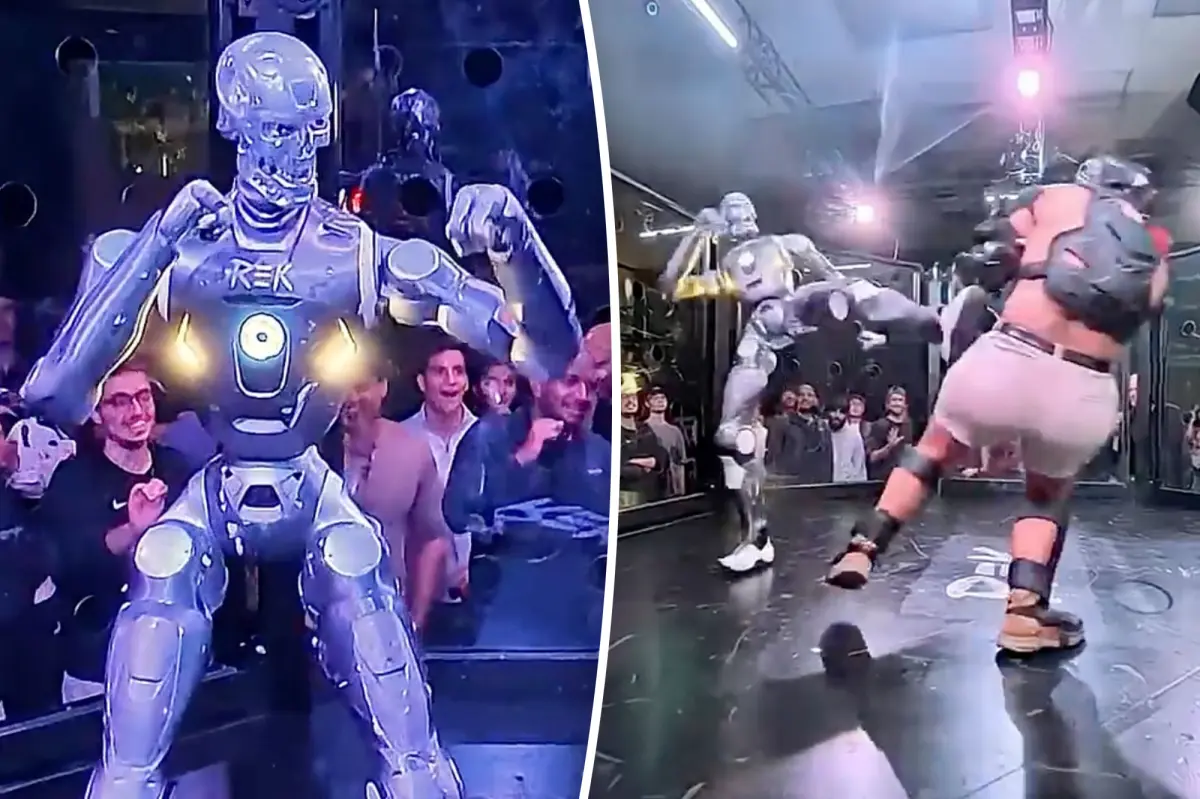
Well, it was fun while it lasted. The spectacle, the carnage, the sheer absurdity of watching a grown man get booted across a cage by a machine—it seems California’s party poopers have officially arrived, and they’ve brought their rulebooks with them. The internet was set ablaze last month when a company called Robot Entertainment Kombat hosted what they boldly, and perhaps foolheartedly, called the “world’s first human-robot fight” right in the heart of San Francisco. The footage, which quickly racked up millions of views, showed a masked YouTuber named Frankie LaPenna stepping into a chain-link cage, his body wrapped in protective headgear, gloves, and kneepads, ready to do battle with a six-foot-tall, bipedal machine that clearly did not have the same emotional investment in the confrontation. The robot, all cold steel and hydraulics, stood there unflinching as LaPenna tried to find his range, and then, with the kind of casual malice one might reserve for stepping on a soda can, it kicked him to the ground. Not once, but several times, in a display that was equal parts hilarious, terrifying, and deeply confusing. The video exploded across social media, earning over eight million YouTube views, and it sparked a global conversation that oscillated wildly between doom-mongering, mockery, and genuine philosophical unease. But while the public was busy picking a side in this new gladiatorial arena, state regulators were already circling the cage, sharpening their pen nibs, and preparing to shut the whole thing down with the bureaucratic equivalent of a referee throwing a red flag.
Paragraph 2: The Fight Heard Around the Internet
Let’s set the scene a little better, because the actual video is a masterpiece of chaotic entertainment. Frankie LaPenna, an influencer known for pushing his luck in feats of absurd physical endurance, looked understandably nervous as he bounced on his toes, trying to psych himself up against an opponent that felt nothing. The robot, meanwhile, stood there like a dystopian tower guard, indifferent to the human nervous system trembling in front of it. The exchange began with some tentative jabs—LaPenna swinging, the robot swatting—but it quickly became apparent that this was not a fair fight. The robot’s legs were hydraulic pistons, and when it decided to kick, it wasn’t a martial arts technique so much as a mechanical demolition. The full force of the blow sent LaPenna sprawling across the canvas, his body crumpling like a discarded piece of paper. He got up, because influencers are nothing if not stubborn, only to be kicked down again. It was a brutal, short, and deeply weird ballet. The internet, as it always does, had a field day. One commenter quipped, “Welp, this is how it all begins,” referencing every science fiction prophecy about robot uprisings. Another ominously predicted, “Some people will come back to this video after 20 or 30 years and will say ‘we could have stopped all this if we wanted to.’” Perhaps the most resonant reaction came from a user who simply noted, “Fighting someone who can’t feel pain is genuinely terrifying.” That line cut to the heart of the matter: robots don’t get tired, they don’t get scared, and they certainly don’t feel a broken rib. Watching a human try to fight that was less like a sport and more like watching a toddler challenge a bulldozer to an arm wrestling match. The video’s popularity, though, made one thing undeniably clear: we, as a species, are utterly fascinated by the very things that scare us the most.
Paragraph 3: The Cease and Desist Lands
But the party didn’t last. The California State Athletic Commission, the same body that regulates professional boxing and mixed martial arts, was not laughing. In fact, they were so unamused that they dispatched a cease and desist letter to Robot Entertainment Kombat with the speed and gravity of a referee throwing a disqualification punch. The letter ordered the company to cease all such fights immediately, under threat of a misdemeanor charge. The company’s CEO, a man named Cix Liv, proudly posted the letter on X (formerly Twitter) with the triumphant caption: “We made it boys. California sent us a Cease and Desist for ‘UNSANCTIONED HUMAN VERSUS HUMANOID ROBOT CAGE FIGHT.’” You have to appreciate the audacity of a man who treats a legal cease and desist like a participation trophy. But here’s the twist that many people missed in the initial wave of dystopian panic: the state wasn’t actually objecting to the concept of humans fighting robots. They weren’t coming from a place of ethical outrage or a desire to protect humanity from the Robot Apocalypse. No, the issue was much more pedestrian, much more bureaucratic. The commission’s letter didn’t cite the moral implications of pitting flesh against steel; instead, it pointed to a simple, dry, but highly enforceable section of the California Business and Professions Code. According to the law, “no full contact martial arts event shall take place without the prior approval of the commission.” That’s it. That’s the whole issue. The company hadn’t filled out the right paperwork, hadn’t obtained the proper permits, and hadn’t submitted an application to hold a live, sanctioned combat event. In the eyes of the state, they might as well have been organizing an underground dogfight with lawnmowers.
Paragraph 4: The Law and the Logistics of Human-Robot Combat
This revelation reframes the entire narrative in a wonderfully anticlimactic way. It wasn’t that California was terrified of a Terminator-style future; it was that Robot Entertainment Kombat tried to host a full-contact combat event without getting the proper stamps on their paperwork. In California, the Athletic Commission oversees all combative sports, from mainstream UFC fights to more obscure combat disciplines. The law exists to ensure things like fighter safety, medical staffing, insurance, and fair officiating. If you want to legally pummel another human being inside a cage, you need to prove you have the right doctors on standby, the right ambulance outside, the right insurance policies in place. The commission’s expectation, presumably, is that you fill out those forms whether your opponent is a human being or a hydraulically-powered hunks of metal. The cease and desist wasn’t a philosophical judgment on robot rights; it was a technical violation of the rules. For all we know, if the company had simply applied and paid the fees, they might have received approval. There is, admittedly, something deeply funny about a government agency having to decide whether a robot is a “fighter” in the legal sense. Does the robot have to pass a physical? Does it need a corner man? These are questions no one intended to ask, but here we are in the future, where bureaucratic infrastructure is being retrofitted to accommodate the concept of a human being kicked into next week by toaster with legs. The commission’s jurisdiction is over venues and events, so they don’t care if the damage is caused by a fist or a piston; they only care that the event was not authorized. This has effectively put Robot Entertainment Kombat on notice, forcing them to recalibrate their ambitious plans for the future of robotic cage fighting.
Paragraph 5: The Future of the Robot Fights
So what’s next for the self-described pioneers of man vs. machine combat? Well, they’re not packing up the robot’s suitcase and heading home, that much is clear. They have a fight scheduled in San Francisco for October 9, but this time, they are taking the safe route, and by safe, I mean they are cutting out the fragile, vulnerable human element entirely. The upcoming event will be robot versus robot. No influencers in headgear, no YouTubers being yeeted across a cage, no humans at all, just two hulking machines duking it out for the entertainment of a crowd that might be part reuniting, part apocalyptic prophet. This is arguably even more intriguing from a purely engineering standpoint. You can make a robot as aggressive as you want, program it to fight without fear, and let it absorb all the punishment a steel fist can dish out. But let’s be honest, it also loses a lot of the visceral, horrifying allure that made the first video go viral. There is something deeply compelling about watching a human being test his fragile body against a machine that doesn’t care. It taps into some ancient part of the brain that loves a David-vs-Goliath story, even when you know David is about to get absolutely flattened. The October event will be much safer, legally and physically, but the risk aversion might also make it more sterile. The company’s CEO still seems determined to push boundaries, and one has to imagine they are already strategizing on how to get the next human-versus-robot event sanctioned properly. Maybe they’ll hire lobbyists. Maybe they’ll argue that the robot is not a “participant” but rather equipment. Maybe they’ll try to classify the fight as an art installation. Whatever they do, the cat is out of the bag. The world has seen a man kicked down by a robot, and we cannot unsee that.
Paragraph 6: The Reflection We Deserve
At the end of the day, the whole saga is less about the specific legal troubles of one niche entertainment company and more about the uncomfortable, hilarious intersection of human curiosity, technological progress, and our limitless capacity for reckless entertainment. We like to pretend that we are deeply concerned about the ethical implications of artificial intelligence, but given the chance, we will absolutely pay good money to watch a robot kick a guy in the chest. The internet proved that with eight million views. California’s regulators proved that the traditional safety nets of society are still trying to catch up with the wild, lawless frontier of content creation. The company, in its quest for viral glory, crossed a line that wasn’t even clearly drawn, and the state had to draw it for them, in pencil, with a note attached that said “ask us next time.” In a way, this small, bizarre incident is a perfect microcosm of our era: a person risking bodily harm for clout, a robot programmed to do harm without any conscience, a company using the spectacle to build a brand, and a government agency stepping in to enforce order with a piece of paper. It’s all a bit ridiculous, deeply unsettling, and yet absolutely fascinating. We shouldn’t look away from these parties too quickly, because they are holding up a mirror to something essential about who we are: we will always test the limits, we will always build things bigger and stronger than ourselves, and we will always find a way to be entertained by the collision. The “fun may be over” in the eyes of California, but the conversation has just begun. Whether this was a one-off stunt or the chaotic birth of a new professional sport remains to be seen. But one thing is certain: the image of a YouTuber being kicked to the ground by a six-foot-tall robot is now permanently tattooed on the collective consciousness of the internet. And give it a few decades, just as that one commenter warned, we might look back at this video and wistfully wonder why we allowed this to happen, or, perhaps more likely, why we ever stopped.