


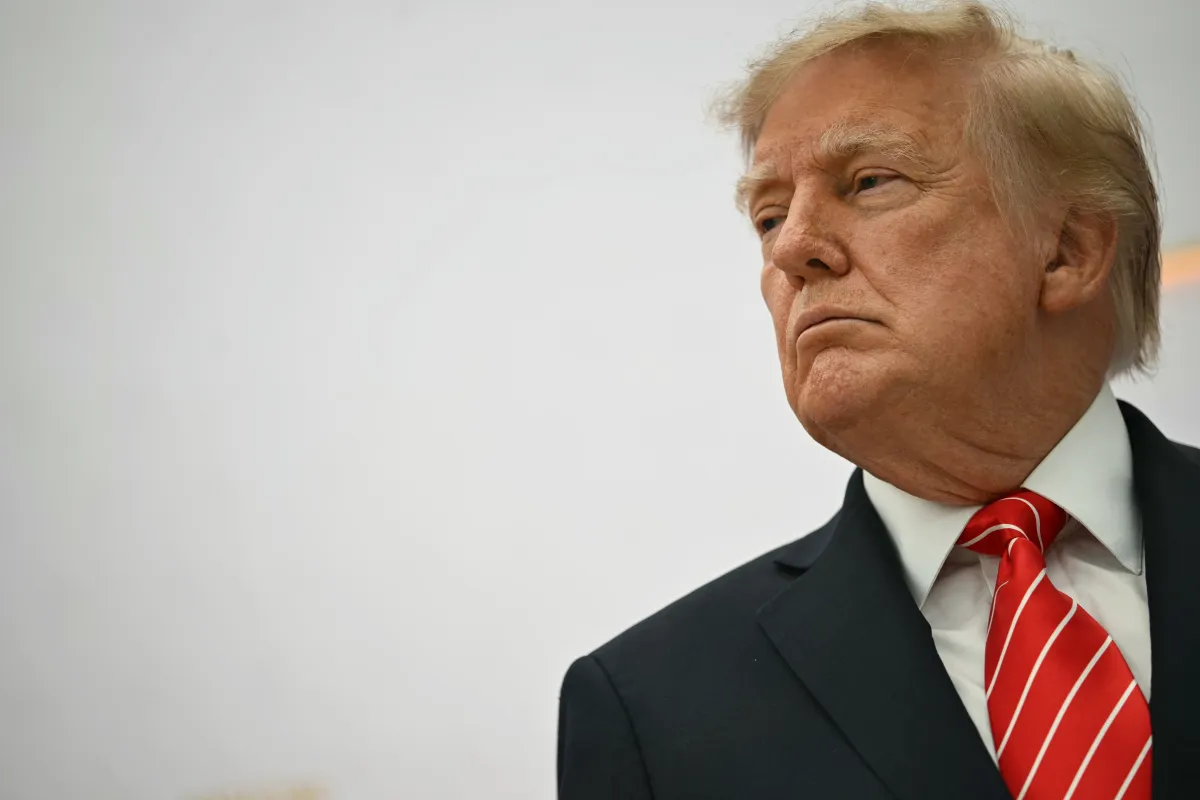
At a moment when the country is already bracing for a contentious midterm election, a new Pew Research Center survey has delivered a sobering snapshot of President Donald Trump’s standing. According to the poll, conducted from September 28 to October 4 among roughly 5,000 U.S. adults, including 3,917 registered voters, Trump’s approval rating has fallen to 30 percent, its lowest level of his second term. The number is all the more striking because it puts him eight percentage points behind where former President Joe Biden stood at a comparable point in the 2022 midterm cycle, when 38 percent of Americans approved of Biden’s performance and 59 percent disapproved. In other words, a president who has dominated American politics for the better part of a decade is entering the final stretch of the 2026 campaign in a weaker position than the man he defeated and has repeatedly attacked. For Democrats, the poll offers a glimmer of energy and hope; for Republicans, it raises uncomfortable questions about whether the party’s fortunes are too closely tied to a leader whose appeal may be shrinking. The survey also found that Democratic voters are reporting greater engagement and motivation than Republicans, a shift that could matter enormously in an election where control of Congress hangs in the balance. With 26 days remaining in the midterm campaign, these numbers are not just abstract statistics. They represent the mood of millions of Americans, some energized, some disillusioned, and many unsure what to expect. The human story beneath the data is one of restlessness: a public that remains deeply dissatisfied with the direction of the country, a president struggling to convert his base’s loyalty into broader approval, and a political environment in which every vote feels freighted with consequence. The Pew survey is only one measure, but it captures a moment of profound uncertainty, and both parties are now trying to read its meaning as they make their final appeals to voters.
Perhaps the most telling finding is that much of Trump’s decline has come from his own 2024 voters. At the start of his term, about 95 percent of those who supported him approved of the job he was doing. Now, about two-thirds still approve. That is still a majority of his base, but it represents a significant erosion, and the sharpest drops are among Hispanic voters and younger voters. These are groups that Trump and his allies spent considerable energy courting, and their movement away from him is not just a political problem; it is a personal and cultural one. For a president who prizes loyalty and often speaks in terms of betrayal, seeing once-supportive communities cool on his performance may be harder to dismiss than a generic partisan disapproval. The reasons behind the shift are likely as varied as the voters themselves. Some may be disappointed in economic conditions, frustrated by the pace of change, or weary of the constant turbulence that has come to define Trump’s public life. Others may have been drawn to his message in 2024 but now feel that the promises have not translated into their daily lives. The poll cannot tell us exactly why these voters have drifted, but the pattern is clear: the coalition that once seemed solid is now showing cracks. That is especially significant in a midterm election, where turnout and enthusiasm are everything. A voter who supported Trump in 2024 but now disapproves of his performance may not necessarily vote Democratic, but they may stay home, or split their ticket, or cast a protest vote. In close races, that kind of shift can be decisive. The survey’s finding that Democratic voters are more engaged than Republican voters reinforces the sense that the political energy has shifted. If that enthusiasm gap persists through Election Day, it could make the difference in districts and states where the margins are narrow. For Trump, the challenge is not just winning back the voters he has lost; it is reminding them why they believed in him in the first place.
Trump’s shadow also looms large over voters’ congressional choices. The Pew survey found that 63 percent of registered voters say Trump will be a factor in their vote for Congress, and more than twice as many say their vote is against him rather than in support of him. By comparison, in October 2022, 36 percent of voters said their congressional vote was in opposition to Biden, while 19 percent said it was in support of him. This is a remarkable reversal. It suggests that Trump is not just a background presence in the 2026 midterms; he is the central character, the figure around whom many voters are organizing their decisions. Grant Davis Reeher, a professor of political science at Syracuse University, told Newsweek that voting against the president in a midterm is not unusual. “You’d probably also find that a lot of Republicans are voting against Democrats, rather than for the president or for the Republican candidates,” he said. “And ‘versus’ seems to be more powerful than ‘for’ in recent years.” Reeher’s point is an important one. Midterm elections have long functioned as a referendum on the party in power, and the party that controls the White House often loses ground. But the intensity of the opposition to Trump in this poll is notable. It is not simply that voters prefer a different party; it is that many appear to be motivated by a desire to send a message, to push back, to make a statement. That kind of negative motivation can be a powerful force in an election. It drives people to the polls even when they are not excited about the candidates. It also makes the race more personal. For Republicans, the challenge is to channel support for Trump into votes for their candidates without allowing his unpopularity to drag them down. Trump himself has leaned into his role as the center of the campaign, appearing at rallies and urging voters to “pretend that I’m on the ballot.” At the Republican National Committee’s first-ever midterm convention in Dallas in September, he told the crowd, “Pretend that I’m on the ballot. I’m on. Just one more time.” It is a strategy that energizes his base, but it also reinforces the idea that the election is a verdict on him.
The survey also reveals a significant enthusiasm gap on the Democratic side. Seventy-eight percent of Democratic supporters said it matters which party wins control of Congress, compared with 69 percent of Republican supporters. That nine-point gap may not sound enormous, but in a midterm environment where turnout is the key variable, it can be the difference between victory and defeat. Democrats, it seems, are more convinced that the stakes are high and more determined to do something about it. The broader mood of the country is one of dissatisfaction. The Pew poll found that 77 percent of Americans are dissatisfied with the state of the nation, while only 22 percent are satisfied. These numbers are a stark reminder that political discontent is not confined to one party. Many Americans, regardless of affiliation, feel that things are moving in the wrong direction. That kind of widespread unhappiness can manifest in unpredictable ways. It can lead to anger at the incumbent party, but it can also lead to cynicism and apathy. If people are unhappy but do not believe their vote will change anything, they may simply stay home. The fact that Democratic voters are more engaged than Republican voters suggests that, for now, the unhappiness is being channeled into political action on one side more than the other. But the large number of unsettled voters, 42 percent, according to a Harvard CAPS/Harris poll conducted on September 26, adds another layer of uncertainty. In a typical midterm cycle, voters’ preferences are usually more firmly set by this point, especially when the election is widely seen as a referendum on the president. Reeher noted that this large number of voters still in play is striking. “I take the large number of votes still being in play as potential good news for the Republicans, especially in those close Senate races that Republicans have won more easily in the past,” he said. “Those folks might ‘come home’ in the final week of the election.” In other words, the apparent fluidity of the race could cut both ways. It might mean that voters are open to persuasion, or it might mean that they are simply not paying attention yet. The next few weeks, then, are not just about winning arguments; they are about getting people to care enough to show up.
Other recent national polls tell a similar story. An AP-NORC poll conducted September 24-28 found that 31 percent of Americans approved of Trump’s job performance, while 69 percent disapproved. A Quinnipiac University poll conducted September 24-27 found 34 percent approved and 61 percent disapproved. A CBS News/YouGov poll conducted September 30-October 2 found 39 percent approved and 61 percent disapproved. The numbers vary slightly, but the direction is consistent: Trump is underwater, and significantly so. For a president who has often seemed to thrive on defying expectations, the consistency of these findings is noteworthy. It is not just one poll or one methodology; it is a pattern across multiple surveys. Yet Trump has not accepted the verdict. On August 30, he wrote on Truth Social: “THE FAKE POLLS USED BY OUR CROOKED MEDIA ARE OUT OF CONTROL, AND SOMETHING MUST BE DONE ABOUT IT. FCC TO THE RESCUE!” The message reflects a familiar strategy: discredit the messenger rather than engage with the numbers. It is a tactic that has worked for Trump before, at least with his supporters, who may be inclined to distrust polls that show him struggling. But the persistence of the low ratings raises a question that no amount of rhetoric can fully answer: if the polls are all wrong, why do they consistently point in the same direction? The human reality behind these numbers is complex. There are voters who have supported Trump through every controversy and will continue to do so, seeing him as a fighter for their interests. There are voters who supported him once but now feel let down, uncertain, or exhausted. And there are voters who have never supported him and see the midterms as an opportunity to check his power. The polling cannot capture all of that nuance, but it can give us a sense of the balance of forces. And right now, the balance is not in Trump’s favor. That does not mean the Republicans cannot win in November; midterm elections are decided district by district, and national approval ratings are not destiny. But it does mean that the party is swimming against a strong current.
What does all of this mean for the final weeks of the 2026 midterm campaign? For Democrats, the Pew survey offers reason to hope that the energy that has been building since Trump returned to office will translate into votes. The higher levels of engagement among Democratic voters, combined with the large number of voters who say their congressional vote is a statement against Trump, suggest that the party may be able to turn dissatisfaction into turnout. But there are no guarantees. Midterm elections are notoriously difficult to predict, and the large number of undecided voters could swing the outcome in either direction. For Republicans, the challenge is more acute. Trump’s approval rating is a burden that many candidates will have to carry, and his insistence on making himself the centerpiece of the campaign could alienate the very voters the party needs to reach. Yet there is also an opportunity. If the undecided voters are, as Reeher suggests, potential Republicans who have not yet “come home,” then the party’s best hope may be to spend the final weeks reminding those voters of what they stood for in 2024. The fact that 42 percent of voters have not firmly settled on their choice is a sign of an electorate that is still listening, still weighing its options. That is rare in a polarized age, and it could make the difference in close races. In the end, the numbers are more than just data points. They are the accumulated hopes, fears, and frustrations of millions of people. A 30 percent approval rating means that seven in ten Americans are not satisfied with the president’s performance. That is a powerful statement, whatever the polls eventually show on Election Day. The country remains deeply divided, and the political landscape can shift quickly. But for now, the mood is one of restlessness and uncertainty, and both parties are fighting to define what that restlessness means. Trump’s response to the polling, dismissing it as fake and calling on the FCC to intervene, is a reminder that he is not willing to accept a narrative of decline. Whether that defiance will inspire his supporters or simply reinforce the concerns of everyone else is one of the great questions of the 2026 campaign. As the final days tick away, the only certainty is that the choice facing voters is not just about policies or parties. It is about whether they believe the country is on the right track, and whether they trust the people in charge to change it.