


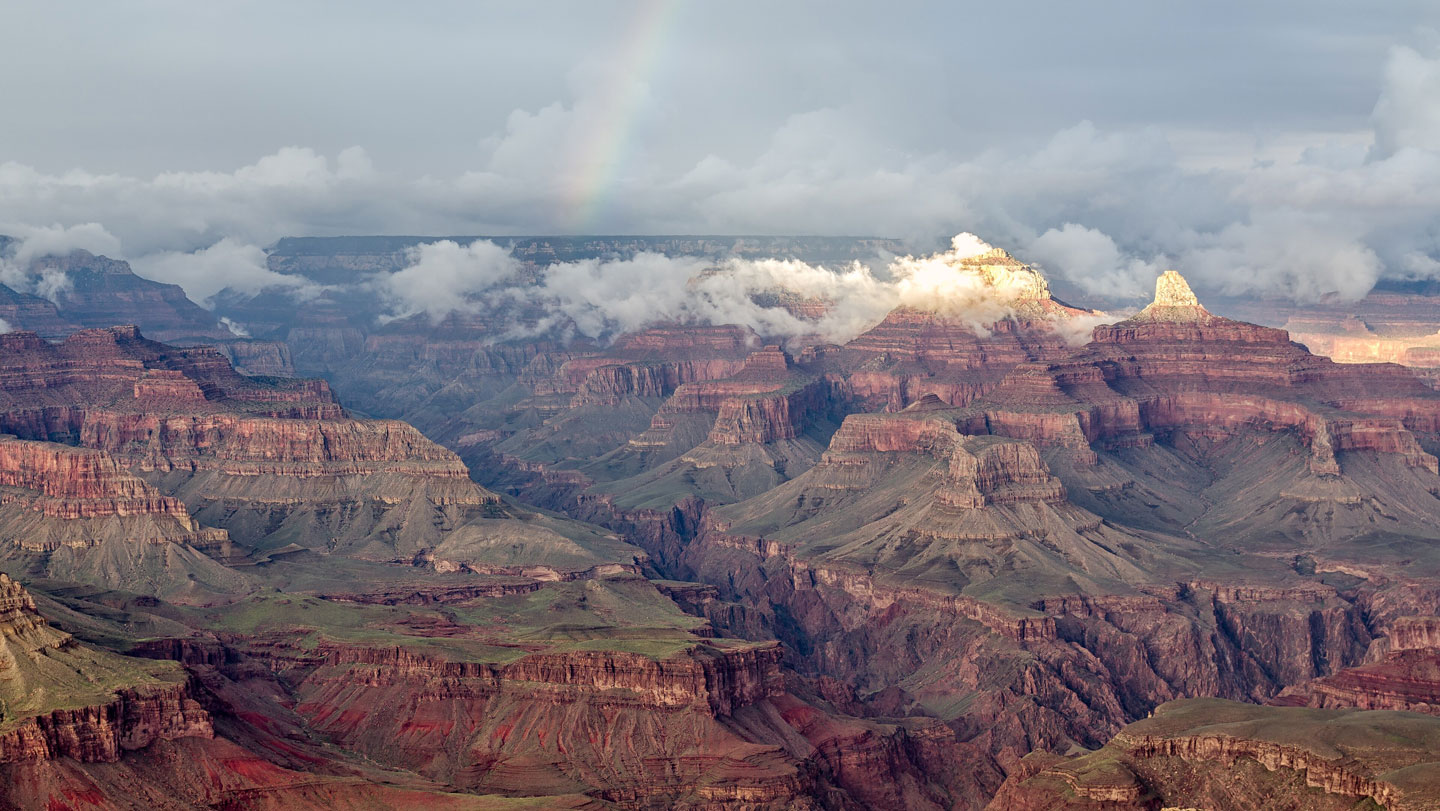
Standing on the rim of the Grand Canyon, it is easy to imagine that you are looking at the whole story of deep time in one breathtaking glance. The canyon’s towering walls expose layer after layer of sediment, a natural record that seems to run continuously back roughly two billion years. But geologists have long known that the story is far from complete. Between about 520 million and 1.8 billion years ago, the rocks simply disappear. It is as if someone broke into a museum, removed an entire wing of exhibits, and left nothing behind but an empty hall. That missing interval, more than a billion years of Earth’s history, is one of the great unsolved mysteries of the Grand Canyon. The rock layers that should sit between the older and younger units are absent, and there is no obvious sign of where they went. They were almost certainly deposited, then removed; the canyon’s walls are not a full library of time but a collection with a huge section ripped out. For decades, researchers have debated what kind of force could erase such a colossal span of the geological record. The answer, according to a new study, is not a single event but a spectacular landscape: an enormous cliff that once ran across much of North America, aided by one of the most extreme ice ages the planet has ever known. Understanding that missing time is not just about satisfying curiosity; it also reveals how the Earth’s surface is continually destroyed, reshaped, and rebuilt over millions of years. The Grand Canyon, with its dramatic absent chapter, offers a perfect window into that restless process.
The story begins about 800 million years ago, when an ancient supercontinent called Rodinia began to split apart. As that enormous landmass broke, the Earth’s crust shifted, stretched, and tore, creating steep new landscapes. Among them was a giant escarpment, a cliff so vast that it stretched from the region that would eventually become Alaska all the way down to what is now Arizona. It rose perhaps one to two kilometers into the sky, towering over the land that would one day hold the Grand Canyon. Scientists led by Thomas Gernon, an earth scientist at the University of Southampton in England, used computer models to simulate how this cliff would have evolved over hundreds of millions of years. The models showed that the escarpment formed at roughly the same time that the Grand Canyon’s rock record went silent. That was no coincidence. A cliff of that size would have been a perfect machine for erosion. Rain, wind, frost, and gravity would have attacked its exposed slopes constantly, gradually eating away at the land. Gernon’s team described the process as something like waves on a beach steadily erasing one layer of sand after another. Over time, the escarpment could have retreated inland, scraping away huge volumes of rock and opening a gap in the geological record. “No study has previously suggested the existence of a continental-scale escarpment in the Grand Canyon region,” Gernon said. “Our study shows it’s a plausible, straightforward explanation for the immense erosion that took place in the Grand Canyon.”
Yet a cliff, no matter how massive, would probably not have been enough on its own to delete more than a billion years of history. That is where the accomplice comes in: ice, and not just the ordinary ice of mountain glaciers, but the kind of ice that once covered nearly the whole Earth. Geologists call that extraordinary period Snowball Earth, a time when ice sheets may have crept from the poles all the way to tropical latitudes. Ice is one of nature’s most powerful eroding forces. It wedges into cracks, pries rocks apart, and grinds them down as it slides across the land. If Snowball Earth glaciers swept across Laurentia, the ancient core of North America, while the great escarpment was still standing, the two forces would have worked together perfectly. The cliff’s high, steep slopes would have been especially vulnerable to frost and glacial scouring. The ice, in turn, would have carried away the loosened rock, leaving behind a vast, smooth, scoured surface. There is even a more recent precedent for this process. In a separate study published in Science, Gernon and his team showed that an escarpment created by tectonic activity in Antarctica helped trigger the formation of the East Antarctic Ice Sheet about 34 million years ago. High rocky ridges and peaks served as gathering places for snow, which eventually compacted into massive glaciers. “The exposed rocky peaks of the escarpment would have acted as glacier factories,” Gernon said. The same may have been true hundreds of millions of years earlier: the Laurentian escarpment could have helped manufacture the very ice that then helped dismantle it.
Timing, however, remains one of the trickiest parts of this geological cold case. A billion years is a mind-bending length of time, and within such a stretch the escarpment and the ice sheets might not have appeared at exactly the same moment. Did the cliff form first, and only then get scoured by Snowball Earth glaciers? Did the glaciers soften and fracture the rock first, making it easier for the escarpment to retreat? Or did the erosion happen in multiple stages, separated by tens or even hundreds of millions of years? Gernon is careful not to overstate what the models can prove. “That’s the real hole that needs filling: pinning down the erosion history in space and time, continent by continent, precisely enough,” he said. The broad pattern is clear, but the specific sequence of events is still blurred. To sharpen the picture, geologists will need to look beyond the Grand Canyon itself. They will need to search for ancient sediments shed from Laurentia, for buried erosion surfaces, and for signs of glacial action on other continents. It is possible that the missing billion years in the Grand Canyon is only one small sample of a much larger pattern. If the escarpment truly stretched across the continent, then huge portions of North America may have been planed down at the same time, leaving similar gaps in the rock record from Alaska to Arizona. In that sense, the famous canyon is not just a unique spectacle; it is a place where scientists can read the signature of an event that shaped an entire ancient landmass.
Though the case is not officially closed, outside geologists are taking the new explanation seriously. Alan Collins, a geologist at Adelaide University in Australia who was not involved in the study, said that linking the disappearance of the rocks to major recognized events in Earth’s history, such as the breakup of Rodinia, makes the argument far more convincing. The escarpment is not a random invention; it fits naturally into the known tectonic history of the planet. Gernon’s team also pointed to modern-day places where similar erosion is still happening. In southern Africa, an escarpment has been slowly retreating inland for millions of years, carving away the landscape in much the same way the Laurentian cliff may have done. In Antarctica, another escarpment is helping to generate ice and scour rock even today. These living modern examples give the ancient scenario a sense of reality. It is not merely a theoretical model; similar processes are observable right now. Collins summed up the reaction of many geologists when he said, “Maybe not quite case closed yet, but I find this very convincing.” The study also highlights how much of Earth’s history is preserved not in the layers that remain but in the spaces between them. Missing time can be just as informative as present rock, if only scientists can figure out what caused it.
Ultimately, this is a story about deep time, impermanence, and the relentless motion of the Earth’s surface. The Grand Canyon is often described as a place where the planet’s history is written in stone, but its missing chapter is a reminder that the geological record is more like a partially erased chalkboard than a perfect textbook. Erosion is constantly rewriting the story, destroying old pages and creating new ones. The same forces that shaped the canyon are still at work today: wind and water, ice and gravity, the slow drift of continents and the sudden collapse of a cliff. Knowing that a billion years vanished may seem like an abstract fact, but it gives visitors to the canyon a deeper sense of movement. The landscape is not a static monument; it is a living, changing surface shaped by forces that continue to operate, usually too slowly for human eyes to notice. For scientists, the missing rock is not simply an absence to mourn. It is a clue, a lead, a pointer toward the vast chain of events that built the modern world. The escarpment and the Snowball Earth glaciers may have stolen a billion years from the geological record, but they also left behind a rich and ongoing mystery. That mystery inspires geologists to keep asking questions, to build better models, and to keep looking at the Grand Canyon not as a finished masterpiece but as an active crime scene—one that may never be completely solved, but whose secrets are slowly, patiently, being pieced together.