



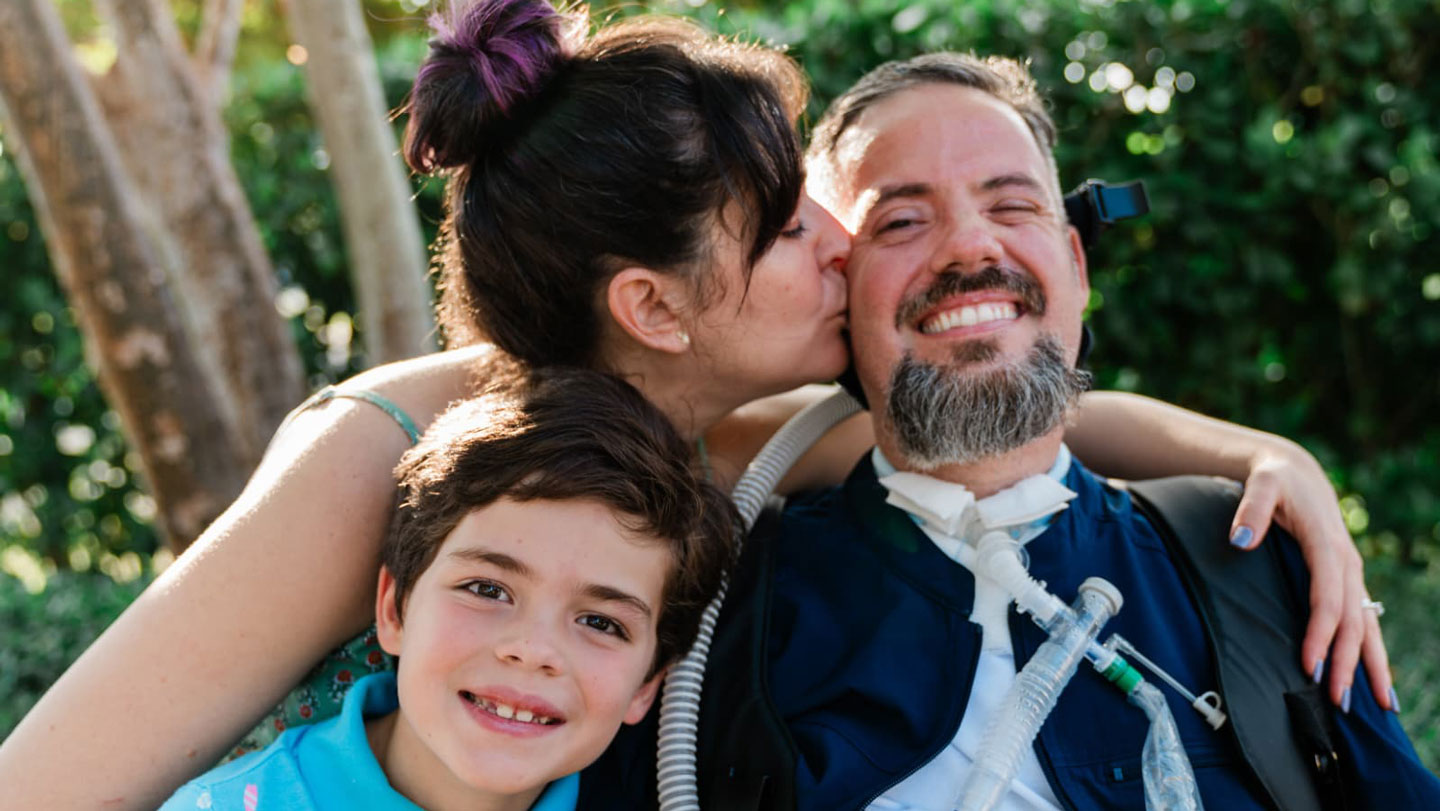
Jules Rodriguez has always had a lot to say. He is a dad, a husband, a former science teacher, a podcaster, and a stand-up comedian—someone who built his life around connection, conversation, and the sound of his own voice. He has spent years talking to kids in classrooms, sharing his life on a podcast he created with his wife, and even standing in front of crowds to make them laugh. But in 2020, Jules was diagnosed with ALS, a disease that slowly and relentlessly interrupted the signals between his brain and his muscles. Today, many of those muscles no longer respond, and Jules cannot move his body, breathe on his own, or speak a single word out loud. Instead, he communicates by typing with his eyes, using an assistive device that tracks his gaze across a screen, and then an AI-generated voice clone speaks his words aloud. It is a startling reminder that our voices are so much more than just the sounds we make. They carry our personality, our history, our humor, our warmth, and our very sense of self. And for those who love Jules, especially his wife Maria Aleandra Fernandez, whom everyone calls MA, that loss is profound. MA still remembers the night they met at her thirtieth birthday party, when Jules got up and sang Sir Mix-A-Lot’s “Baby Got Back” with three of his buddies. It was pure joy, the kind of moment that made her fall in love with him. She says she always loved hearing his voice, and that she isn’t just saying that. They sang at their wedding, took ballroom dancing classes, and danced at every wedding they ever attended. Now, the voice she fell in love with exists only in memories, in old recordings, and in a digital imitation that was built from his original voice before it disappeared.
The human brain, it turns out, is wired to search for voices in the world around us. Greg Bryant, a cognitive scientist at UCLA who studies vocal communication, explains that there is a voice-selective region in the brain that responds strongly to voices, and it activates early in life. Our brains are so attuned to voices that we sometimes hear them where none exist, like when we’re out camping and think we hear whispering in the wind. This isn’t a glitch. It’s a feature. Voices are packed with information, and they carry far more than words. A single voice can communicate emotion, history, condition, and identity all in one quick auditory signal. It is one of the most personal things we encounter in another person. This is why babies are drawn to voices before they are even born, recognizing their mother’s voice in the womb and picking up on the rhythm and language that surrounds them. A voice is both incredibly common and entirely unique, and losing it is a loss unlike almost any other. Kate Nilson, a speech-language pathologist who works with people facing the loss of their voice, says simply: “So much is in a voice.” She helps people with ALS plan for the future by banking their voices, recording messages that might be used later, and creating AI-powered voice clones that can speak typed words in the person’s own voice. But even she admits that nothing can fully prepare anyone for what it means to lose the voice that has always been you. For Jules, who had so much to say, the loss of his voice became a kind of vanishing. He would later describe it as feeling like he was fading away, like Marty McFly watching his family disappear from a photograph in Back to the Future.
The experience of losing a voice is not just about silence. It is about isolation, frustration, and fear. Patrick Darling, a thirty-three-year-old from Bristol, England, knows this deeply. Before his ALS diagnosis in 2022, Patrick had been a barista, a barber, a boatman, a gamer, a painter, a voice actor, a YouTube content creator, and a musician. He lost the ability to sing and play his instruments, and he lost his voice. He describes being unable to talk as extremely isolating, unbelievably frustrating, and often frightening. He says that people who don’t really know you often feel uncomfortable by your silence, and it is easy for people to forget that there is still a person stuck in there. That feeling of being overlooked and disconnected is one of the cruelest parts of ALS. The disease takes away movement in many ways, making it impossible to button a shirt, apply mascara, walk, or even swat a gnat away. During an interview with Jules and MA on a video call, a little fly began circling Jules, and MA pointed out how torturous it must be not to be able to swat it away. But without a way to communicate, Jules couldn’t even ask her to do it for him. He couldn’t say he was annoyed or thirsty or that something was beeping too loudly. He couldn’t ask for help. Speech-language pathologist Jessica Piotrowski, who works at the UC Davis Center for Voice and Swallowing, says that for many people losing their speech is far more devastating than losing their mobility. It is through communication that people can express pain, comfort, humor, and dignity. Going through every other loss without a voice makes those losses so much harder to bear. Being able to express yourself, she says, is how you hold onto the sense that this disease has not taken everything. That is still me. I still have my voice. I still have my humor. I still have my emotion.
One of the most striking parts of this story is how much we take the ability to speak for granted, and how easily we can understand its importance by trying to imagine life without it. Kate Nilson gives her students, all future speech-language pathologists, an assignment to go two hours without talking, communicating only through an app on their phones. The experience is eye-opening. Her students, young and healthy, suddenly find themselves stopping mid-thought because it’s too hard to type out everything they want to say. They feel lonely. They realize how much their voice is who they are. Many of them reflect that they did not know how deeply their identity was tied to the sound of their voice. Laura Sanders, the host of The Deep End, tried the assignment herself. She put it off for a long time, because there was always a good reason to talk: a meeting to lead, a soccer practice to coach. That procrastination itself was revealing. When she finally did it, she found the logistics difficult—ordering a smoothie, asking her children what they wanted for breakfast, trying to call the cats inside. But the harder part was the loss of connection. She could not say a casual hello to a friend at the gym without typing it into her phone and having a robotic voice say it for her. She smiled extra big instead and felt awkward. She found herself avoiding conversations altogether, self-censoring, stopping before she even tried. It felt too hard, too slow, too artificial. It did not feel worth it to ask other people to slow down and listen. Her brief experiment gave her only a tiny glimpse into what Jules and Patrick live with every day, and it was enough to make her understand how a silence can become a wall.
For MA, the possibility of losing Jules’ voice was something she dreaded long before it happened. As his physical abilities slipped away one by one, she thought each loss was heartbreaking, but she always told herself that when he lost his voice, she would shatter into a million pieces. That moment came gradually. In the summer of 2022, she heard the first little crack in his voice, a tiny sign that something was changing. It was devastating. Jules and MA had been podcasting together for years, and the recordings became an archive of his real voice as it slowly decayed, episode by episode, until they had to stop. Looking back, MA says it was like listening to him disappear little by little. It was disarming and painful. But eventually, she says, you begin to get used to it, and you find ways to work around it, and you learn to appreciate what is still there. Yet the loss remains. Jules himself put it even more simply: losing his voice felt like he was fading away. The voice that had told stories, made people laugh, and sung karaoke at her birthday party was gone. What took its place was a synthetic voice generated by artificial intelligence, a voice clone built from recordings of the voice he used to have. It can read the words he types with his eyes, but it cannot laugh, cannot sigh, cannot sing, cannot whisper. And yet, in a strange way, it gives him a presence again. It lets him say “I” and mean it, lets him tell a joke, lets him be heard. The technology is not perfect, and it is not the same as his real voice, but it is a connection to the world and to the people he loves.
What Jules’ story reveals, in the end, is how much of our identity is created by the way we sound. The voice is not just a tool for communication. It is an instrument of selfhood, a bridge between the inner world and everyone else. It carries emotion in every pitch and pause, history in every accent and habit, and intimacy in every familiar phrase. When that sound disappears, even with a digital replacement, there is a deep sense of something missing. Scientists and clinicians are exploring new technologies that can speak for people who cannot, and some are even working on pulling words directly from the brains of people who cannot speak at all. These advances are remarkable, and they offer hope to people like Jules and Patrick who have so much to say and so few ways to say it. But they also ask us to think carefully about what we mean by a voice. Is your voice only the sound you make? Or is it something larger, something that includes your thoughts, your feelings, your humor, your history, your presence? Jules may not sound the way he used to, but he is still trying to connect, still trying to make people laugh, still trying to say who he is. His story is a powerful reminder that our voices matter more than we often realize, that they are worthy of awe and attention. And it is a reminder to listen, truly listen, to the voices around us while we still have them, because every voice tells a story, and no story is ever quite like another.