Cosmic endings are rarely clean. A star that has burned for billions of years does not simply switch off; it expands, convulses, sheds its outer layers into space, and then collapses down to a dense, cooling ember. That may sound like the final word for anything around it, but the universe is a relentless recycler, and a new discovery is offering a stunning example of how death can become life. Astronomers have found tentative evidence of a planet born from the wreckage of a dead star—a so-called second-generation planet, a world that has risen from the ashes of a previous stellar system. The idea of such planets has existed in theory for more than fifteen years, but until now, no one had actually spotted one. If this object is confirmed, it would be the first known “phoenix” planet: a world whose very existence owes more to its star’s death than to its birth. The study, published October 5 in Nature Astronomy, centers on a white dwarf—the tiny, hyperdense core that remains after a low-mass star like our sun dies—designated HS 0209+0832. Led by Jamie Williams of the University of Warwick in Coventry, England, the research team argues that this white dwarf is surrounded by something unexpected: the signature of a planet formed from material cast off by the star as it was dying. We are used to thinking of planetary systems as built at the same time as their star, from a swirling disk of gas and dust. The star forms first, the planets follow, and together they age until the star dies and likely takes its worlds with it. But this discovery suggests another path. A dying star can leave behind more than a corpse; it can leave behind ingredients, and those ingredients can assemble into something entirely new. For Williams, the image is deeply poetic. “A phoenix is reborn from the ashes of its predecessor,” he says, “and this planet is formed from the ashes of the star.” More than a mythic metaphor, the phrase captures a process that could change our understanding of planetary survival. The universe, it seems, does not always wipe the slate clean when a star dies. Sometimes it scatters the ink into a new story.
To appreciate why this matters, it helps to know how strange white dwarfs are. Our sun and other low-mass stars end their lives in two dramatic stages. First, they swell into red giants, enormous and luminous, swallowing any planets that happen to orbit too close. Then, after shedding much of their mass into space, they leave behind their exposed cores: small objects about the size of Earth but with roughly the mass of a star. White dwarfs are so dense that ordinary physical intuition dissolves; a spoonful of their material would weigh several tons. Their gravity is so intense that heavier elements should sink quickly into their depths, leaving only a pure skin of hydrogen and helium. This makes them cosmic fingerprints—any unusual element in their atmospheres stands out as a violation of the expected order. That is why astronomers have been so fascinated by “polluted” white dwarfs. Between a quarter and half of these stellar corpses show traces of silicon, iron, and other rocky elements. These elements almost certainly came from planetary bodies that were destroyed, torn apart by tidal forces, and then ingested by the dead star. In that sense, a polluted white dwarf is both a grave and a geological record, storing the chemical signatures of worlds that no longer exist. Zifan Lin, a planetary scientist at Washington University in St. Louis who was not involved in the new work, put it simply: such elements can serve as “probes into the interiors of planets.” But HS 0209+0832 has never been ordinary. When the Hubble Space Telescope observed it in 1999, its spectrum contained a weird mixture of chemical lines that no one could identify. The data were filed away, a cosmic puzzle waiting for the right tools. Two decades later, with more sophisticated models of how atoms absorb light in a white dwarf’s atmosphere, Williams and his colleagues returned to those observations, determined to solve the mystery.
The reanalysis produced a chemical cocktail that initially made no sense. The white dwarf contained only traces of silicon and virtually no iron, which was already odd for a polluted white dwarf. But it also contained an enormous amount of niobium. On Earth, niobium is a hard, silvery metal used in jewelry, rocket systems, and superconductors. It is rare in our planet’s crust, and even rarer in the context of a stellar atmosphere. In fact, no one had ever before found niobium in a white dwarf. “We’ve never observed anything in the universe that’s this niobium-rich before,” Williams says. “We were quite confused at first.” Confusion gave way to understanding when the team looked at where niobium comes from. It is forged in the slow neutron-capture process, or s-process, a chain of nuclear reactions that happens inside certain red giant stars near the end of their lives. In those stars, iron nuclei absorb neutrons one by one, slowly turning into heavier elements like strontium, zirconium, and niobium. The process can take thousands of years, but it is relentless. Eventually, the red giant sheds its outer atmosphere, ejecting into space a stream of newly forged elements. That material can mix with other gas and dust, cool, and begin to clump together, potentially seeding an entire new generation of planets. Williams and his colleagues propose exactly this scenario: the dying star’s outflow produced a planet unusually rich in s-process elements, and the white dwarf left behind then began to draw gas from that planet, like a slow cosmic siphon, painting its atmosphere with a fresh layer of niobium and other heavy elements. It is a strange and elegant story—a star forges rare metals, gives them away in death, watches them form new worlds, and then consumes a small taste of those worlds’ atmospheres. The niobium, once a mystery, becomes evidence of a complete and previously unseen cycle.
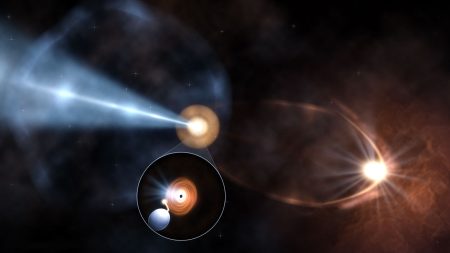
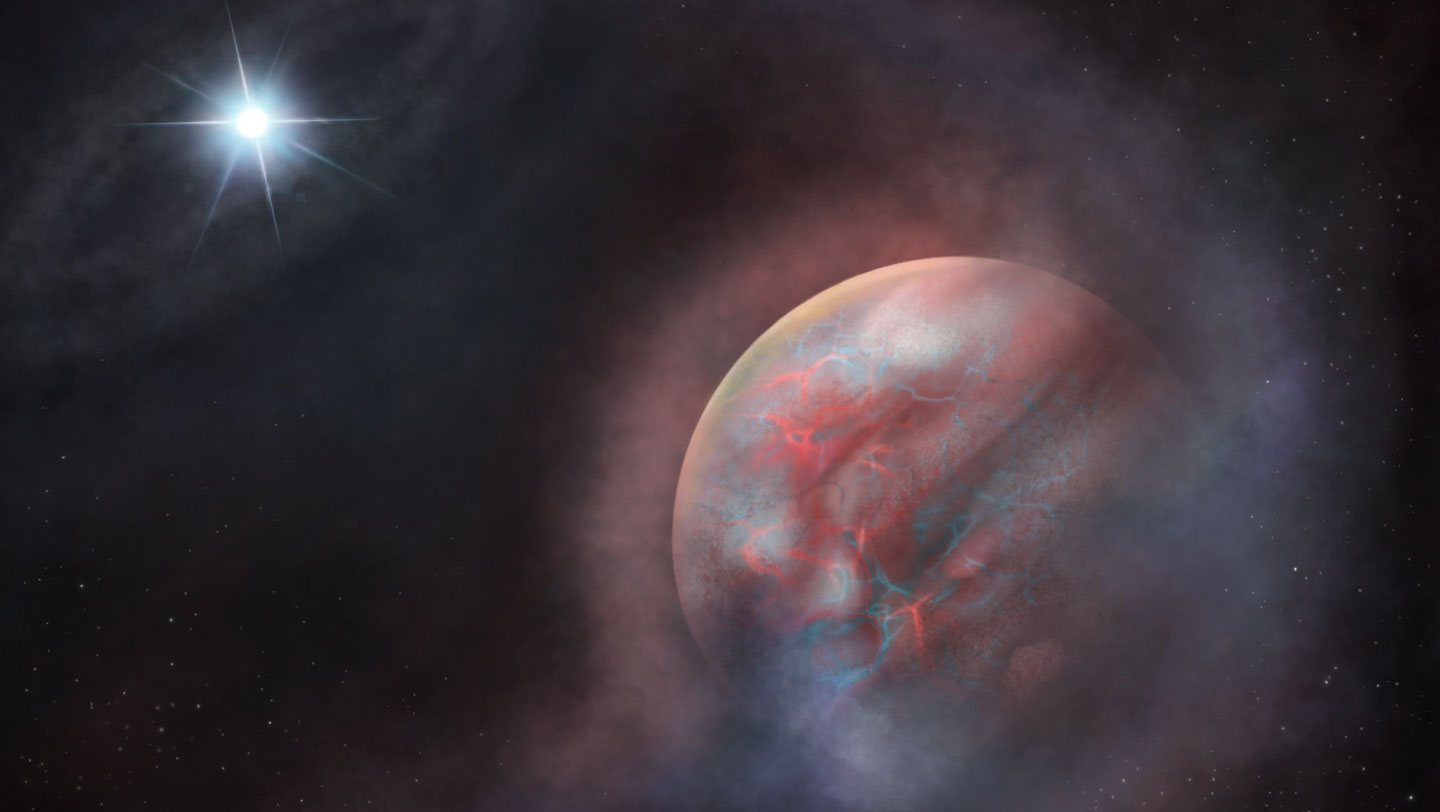
To support this scenario, the team turned to a very different kind of telescope. NASA’s TESS mission, the Transiting Exoplanet Survey Satellite, is designed to find planets around nearby stars by watching for regular dips and changes in starlight. It is an expert at detecting the subtle, rhythmic signatures of orbiting worlds. When Williams and colleagues examined TESS observations of HS 0209+0832, they found something striking: the white dwarf’s brightness changes with a period of about 4.4 days. This was immediately puzzling, because a white dwarf’s own rotation period should be much shorter—hours at most, not days. Something else had to be responsible. The simplest explanation, the team says, is a giant planet orbiting remarkably close to the white dwarf. Based on the signal, the planet would be roughly 6 million kilometers from the star, only about 4 percent of the Earth-sun distance. At that range, it would be bathed in the dim blue-white light of a stellar ember, completing an orbit every 4.4 days. Williams pictures it as a gas giant, a “silvery version of Jupiter,” perhaps even stranger to look at than anything in our own solar system. The exact way the planet causes the white dwarf to brighten and dim is still being worked out, but the two pieces of evidence—the niobium-rich atmosphere and the rhythmic brightness variation—fit together neatly. The dead star seems to have a companion, and that companion seems to be made, at least in part, from the star’s own chemical legacy. “We’re not really sure, if it’s not a planet, what it is,” Williams admits. “A planet is the most reasonable explanation.” That combination of confidence and humility is typical of frontier science. The team has a strong case, but they are not ready to overstate it. What matters is that the hypothesis can now be tested.
If confirmed, this discovery would mark a major shift in how we think about planetary systems. It has long been assumed that a star’s death signals the end of its planets, and often that is true. But here, the death of one star seems to have created the conditions for a new world. That means planetary systems can have a second life, and possibly even a third. It also suggests that white dwarfs, far from being tombstones, might be some of the most interesting places in the universe to look for the chemistry of life. Because their atmospheres are usually so clean, any detected heavy elements are highly visible, like ink drops on white paper. Astronomers can use those elements to reconstruct the types of planets that once orbited the star and better understand their interiors. “They can be probes into the interiors of planets,” Lin says. The new finding adds another layer: the elements in a white dwarf might not only tell us about worlds that died, but also about worlds that were born. Lin noted that, until now, the second-generation planet formation process has been “more like a hypothesis, more like speculation.” This, he said, is “the first time we’ve seen evidence for that process.” That alone is enough to make the discovery significant. It gives scientists a new target to study, a new kind of world to classify, and a new set of questions about how common this process might be. Are phoenix planets rare flukes, or are they a normal part of the universe’s long-term operation? Could a dying star routinely seed a new generation of worlds? Some astronomers have even suggested that white dwarfs might be prime hunting grounds for signs of extraterrestrial life, precisely because planets can survive a star’s death and because their atmospheres can reveal biosignatures. If planets can also be born around these remnants, the possibilities become even stranger and more exciting. The answers will require more observations of other white dwarfs, more detailed theoretical work, and perhaps missions designed specifically to search for planets around stellar remnants. But the door has been opened.
Finally, this discovery invites us to look toward our own future. The sun is not immortal. In about five billion years, it will run out of hydrogen fuel and begin its transformation into a red giant. Its outer layers will balloon out past the orbits of Mercury and Venus, and quite likely Earth. If our planet is not swallowed, it will be roasted to a cinder. Then the sun will eject its outer shroud into space, leaving behind a white dwarf, a faint and slowly cooling star about the size of Earth. It will be the last light of our solar system, a ghost glowing in the dark. The story might end there, but this new research suggests it might not have to. The material the sun sheds will drift outward, rich with elements forged over billions of years in its core. Some of that material could eventually coalesce into new worlds, born not from a young star’s disk but from an old star’s final exhale. Whether our solar system could actually form a second-generation planet is unknown. “We don’t know enough about second-generation planets yet to say,” Williams admits. “But I think it’s definitely possible.” That thought carries a strange comfort. The sun that gave life to Earth may one day give life to another world, in another epoch, using the same atoms that once made our oceans, our mountains, and perhaps even us. It will not be quick. It will not be recognizable to any human eyes. But the universe has a long memory and a powerful imagination. A dead star’s wreckage is not simply the end of a story; it is the raw material for the next one. The discovery of this phoenix planet, if it holds up, is a reminder that in the cosmos, nothing is ever truly lost.