



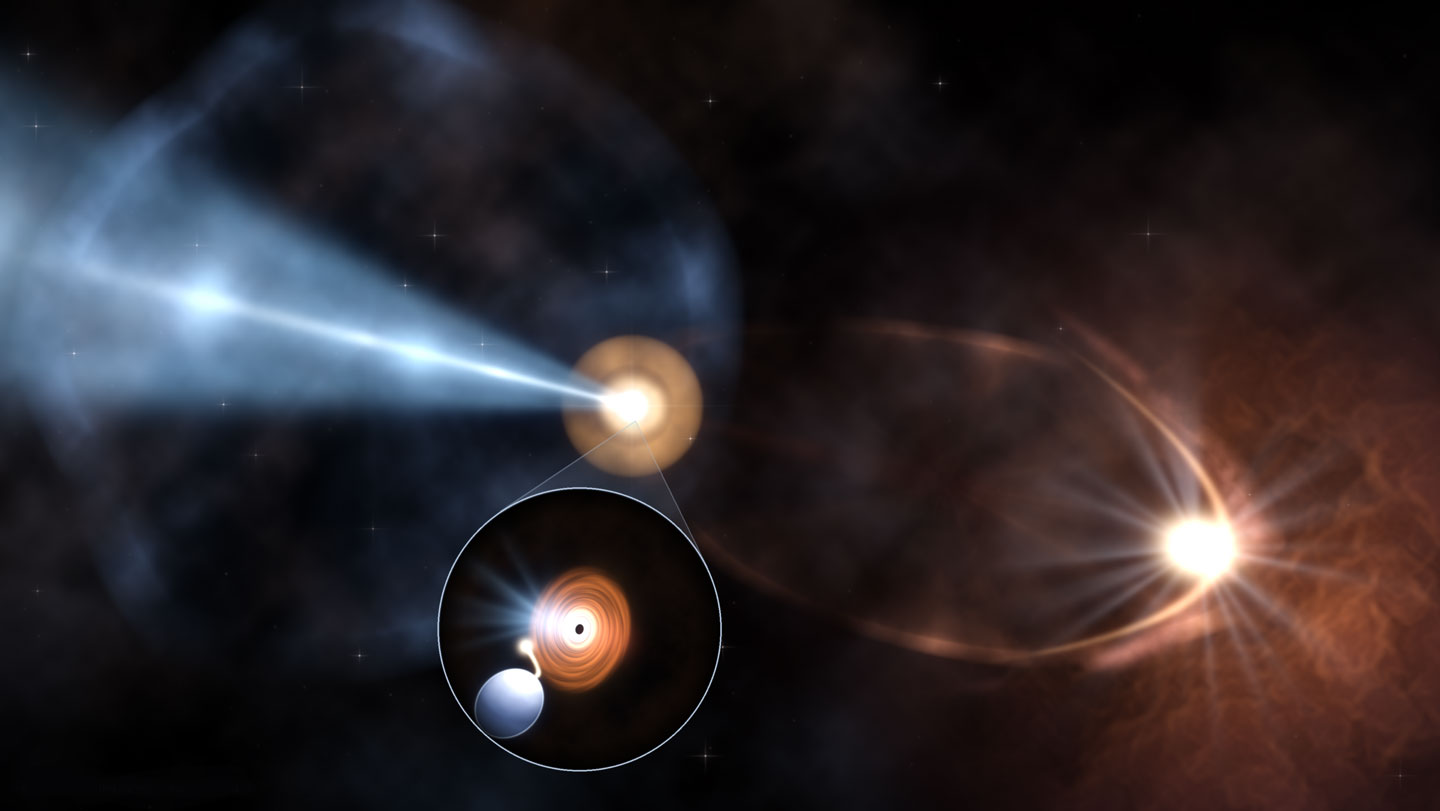
Sometimes the universe has a way of shrinking the colossal down to something almost manageable, and that seems to be exactly what astronomers have just discovered hiding in our own Milky Way galaxy. For decades, scientists have been captivated by blazars, some of the brightest and most extreme objects in the cosmos. These are gigantic black holes, often billions of times heavier than the Sun, that devour enormous amounts of matter and hurl powerful jets of superheated material into space. What makes them blazars is a trick of perspective: one of those jets happens to point almost directly at Earth, making them appear dazzlingly bright from our vantage point. Now, researchers believe they have found a miniature version of one of these cosmic beasts, a so-called microblazar, right here in our celestial backyard. The discovery is still tentative, but it has astronomers buzzing because it could explain one of the most stubborn mysteries in astrophysics: where the highest-energy particles in the universe come from. These particles, known as ultrahigh-energy cosmic rays, carry far more energy than any particle accelerator on Earth could ever produce, and their origin has been notoriously difficult to pin down. The finding, described in a forthcoming paper in Astronomy & Astrophysics, offers a compelling new suspect, and it wraps the whole story in a surprisingly human frame: a cosmic mystery that may finally be yielding its secret thanks to decades of patient searching and a little bit of luck.
To understand why this discovery matters, it helps to understand what blazars actually are. They belong to a family of objects called quasars, which are essentially supermassive black holes surrounded by swirling disks of gas and dust. As material spirals inward, it heats up violently and emits enormous amounts of radiation. But not all of that material falls into the black hole. Some of it is blasted back out along two opposing jets, racing through space at nearly the speed of light. When one of those jets happens to aim directly at Earth, the object is called a blazar. Because they are so far away, usually in distant galaxies, these huge cosmic engines appear only as brilliant points of light. But the universe also offers a smaller version: microquasars, which consist of a black hole only a few times the mass of the Sun paired with a large companion star. The black hole pulls gas from the star, forming a disk and launching jets just like its much larger cousins. A microblazar, then, is simply one of these small-scale systems whose jet happens to point toward us. That small size is a gift. In a supermassive blazar, changes that would take thousands of years unfold in a matter of days or weeks in a microblazar. As astrophysicist Pedro Luque-Escamilla of the University of Jaén in Spain put it, it’s like a perfect scale model where astronomers get to watch a cosmic movie in fast-forward. For scientists who study the most violent processes in the universe, that kind of compressed time is invaluable.
But finding such an object has been far from easy. For nearly 35 years, astronomers have hunted for miniature blazars hiding in the Milky Way, and for most of that time, the search ended in disappointment. Luque-Escamilla and his colleague Josep Martí, both based in Spain, spent more than two decades combing through archival telescope data, chasing candidate after candidate. Each time, their hopes were dashed when the object turned out to be something far away and far too large. “We found many candidates in the past,” Martí said. “They turned out to be extragalactic objects,” meaning full-sized blazars living in other galaxies, changing so slowly that they could never offer that fast-forward glimpse. It was the kind of slow, repetitive scientific grind that rarely makes headlines. But persistence eventually paid off. The turning point came when the pair began examining a catalog compiled in 1983 by a Dutch-American spacecraft called IRAS, short for Infrared Astronomical Satellite. That mission scanned the entire sky in infrared light, cataloging millions of cosmic sources. One entry, a cryptic designation known as IRAS 18293−0941, caught their attention. When they cross-referenced it with modern radio telescope observations, they found something small but surprisingly bright, with an unusual feature: light seemed to be coming from only one side of the object. For astronomers, that one-sided emission is a classic fingerprint of blazars. It suggests a jet pointed almost directly at us, with the other jet aimed away and invisible. It was a clue, but it was not yet proof.
The researchers were understandably cautious, especially after so many false starts. Their initial assumption, shaped by years of disappointment, was that IRAS 18293−0941 was simply another distant blazar lurking beyond the Milky Way. But something about it felt different, or at least intriguing enough to keep digging. They gathered observations from three different observatories, both on the ground and in space, using telescopes that see the universe in different wavelengths of light. This multi-wavelength approach is exactly what allowed them to measure the object’s distance and, ultimately, to pinpoint its location. The result was a surprise: the object was not far away at all. It was inside our galaxy, making it one of the first convincing microblazar candidates ever found. Alexandra Tetarenko, an astrophysicist at the University of Lethbridge in Canada who was not involved in the work, was impressed by the team’s thoroughness. “The authors took a truly multi-wavelength approach, making use of all different types of astrophysical data from many telescopes,” she said. “This is not only what distinguishes this work from past claims on other microblazar candidates but also makes it far more convincing.” In other words, this wasn’t just another hopeful guess. It was a carefully cross-checked detection, built on decades of archived data and modern technology working together. And as if by cosmic coincidence, the object turned out to be sitting very close to something else mysterious: a patch of sky emitting ultrahigh-energy particles, the fastest and most powerful particles known to science.
That connection may be the key to the entire discovery. The scientists noticed that IRAS 18293−0941 was located near a known “hotspot” of ultrahigh-energy cosmic rays, particles carrying energies roughly 100 times greater than anything the Large Hadron Collider can produce on Earth. For years, physicists have struggled to explain what could possibly accelerate particles to such extreme energies. The usual suspects, supernova explosions and active galactic nuclei, can only account for a fraction of the observed cosmic rays. But a microblazar offers a tantalizing solution. If one of its jets is pointing toward Earth, the other jet is pointing in the opposite direction, straight into a surrounding cloud of gas and dust. When that invisible jet slams into the dense material, it could act as a massive natural particle accelerator, boosting particles to incredible energies. The hotspot, in this interpretation, marks exactly where that collision is taking place. Martí and his colleagues argue that this is too perfect a coincidence to ignore. The jet, invisible to us because it points away, may be generating the very particles that have puzzled scientists for decades. It would be a poetic answer to a long-standing question: the same object that looks like a small, bright spark in our galaxy could be responsible for sending some of the fastest particles in the universe hurtling across space. It also reinforces just how much we have yet to learn about the wild variety of objects lurking in our cosmic neighborhood.
The discovery is far from the end of the story. The team is already working to gather additional observations of the hotspot and of the visible jet, hoping to understand exactly how this tiny cosmic engine operates. Luque-Escamilla says the observations should give scientists a much better understanding of the microblazar’s dramatic capacities, almost as if the universe had built a special particle accelerator just for human researchers to study. “It’s like comparing a high-tech human laboratory to a supreme cosmic engine,” he said. That sense of wonder is hard to resist. What began as a routine search through old data has transformed into a window on some of the most extreme physics imaginable, and it all started with a mysterious dot in the sky that astronomers had walked past for decades. There is something deeply human about the story: a patient hunt, a series of dead ends, a flicker of suspicion, and finally a breakthrough made possible by persistence and collaboration. The microblazar, if confirmed, offers more than just a solution to the puzzle of cosmic rays. It reminds us that the universe still holds surprises in our own galactic backyard, and that even the smallest objects can have outsized power. As telescopes grow sharper and data archives become richer, astronomers will likely find more of these hidden gems, each one adding a new chapter to our understanding of the cosmos. For now, the microblazar named IRAS 18293−0941 stands as a remarkable reminder of the joy of discovery, the value of looking again at data we thought we already knew, and the elegant, unexpected ways the universe chooses to reveal its secrets.