


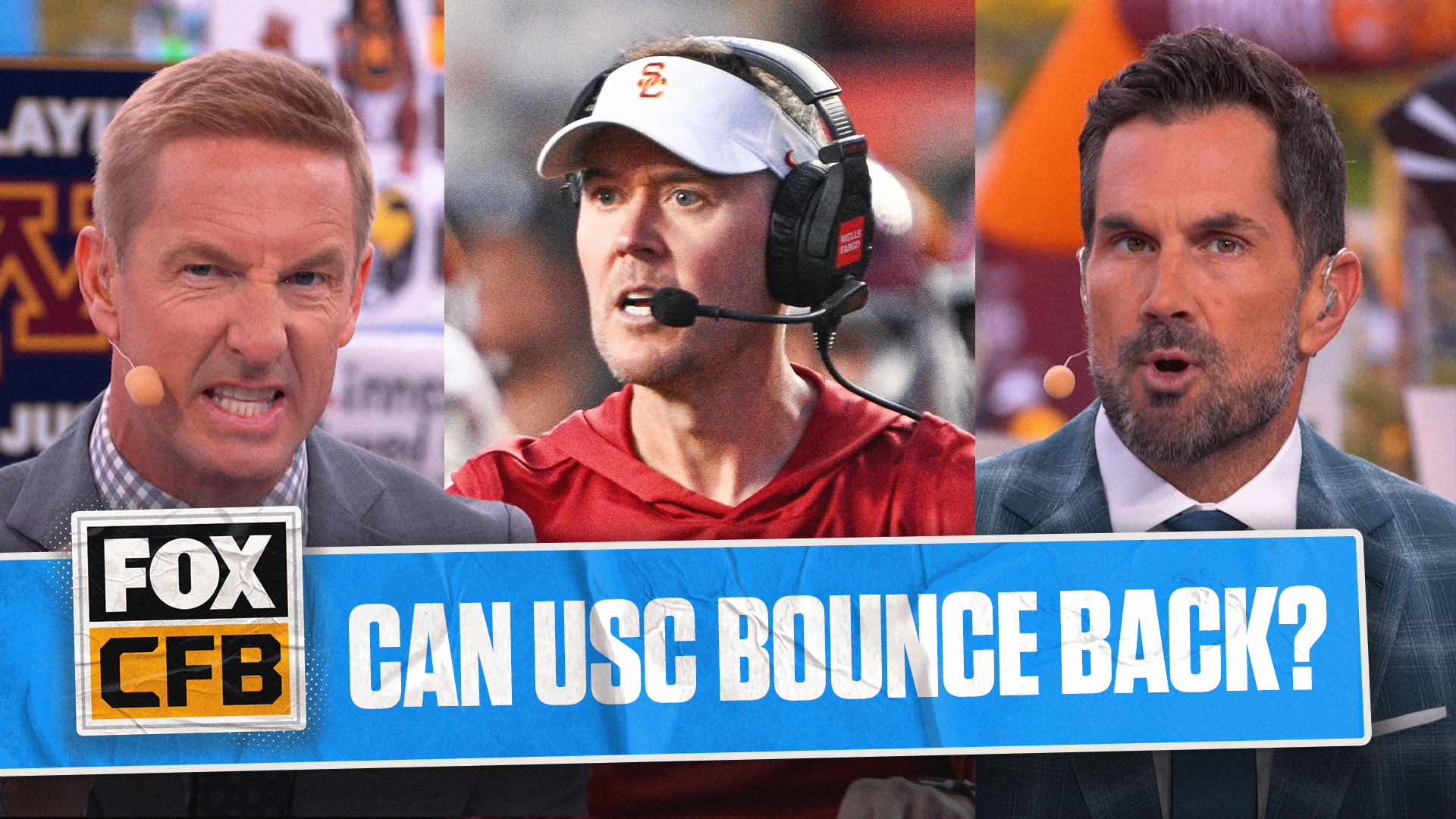
On a sunlit Saturday in Los Angeles, the USC Trojans were supposed to be taking a step toward redemption. Instead, they walked into a brick wall. Lincoln Riley’s team had a golden opportunity to make a statement against Oregon, a Big Ten heavyweight with its own national aspirations, and for a moment it felt like the kind of game that could define a season. But the moment came and went. Oregon rolled to a 41-27 victory, and all the old doubts about Riley’s tenure came rushing back with a vengeance. The Trojans looked disjointed on both sides of the ball. There were missed assignments, costly penalties, third-down conversions allowed, and a general sense that the team was being outcoached and outmuscled. By the time the final whistle blew, many fans were heading for the exits with more anger than sadness in their eyes. It wasn’t simply another loss; it was the kind of loss that forces everyone to ask hard questions about the direction of the program. On Fox’s Big Noon Kickoff, those questions were put directly to Matt Leinart, the former USC quarterback and Heisman Trophy winner. Leinart did not reach for pleasantries or spin. “They’re stuck in the mud with nowhere to go,” he said. The words hit hard because they came from someone who had actually lived the glory days, someone who had won national championships and knew exactly what the program was capable of being. His assessment was not about a bad afternoon or a tough opponent; it was about a team that seems to have lost its way, trapped between a talented roster and a vision that hasn’t fully materialized. The frustration is real, and it is growing louder with every missed opportunity.
But Leinart’s blunt assessment was only part of the conversation. Joel Klatt, the former college quarterback turned analyst, pushed the discussion even further by suggesting that the problem at USC is not simply a matter of wins and losses. “These fans are frustrated with the culture,” Klatt said. That’s a different kind of criticism. It’s not just about the scoreboard; it’s about the way the team carries itself, the standards it accepts, and the vibe that surrounds the program from the locker room to the sideline. Klatt pointed to a specific moment from the Oregon game that seemed to sum up everything wrong with the current state of things. USC safety Desman Stephens II delivered a hard hit on Oregon quarterback Dante Moore. The hit knocked Moore out of the game, but it was also flagged for targeting, and it happened in a way that made people uncomfortable. As Moore lay on the turf, attended by Oregon’s medical staff, Stephens was seen celebrating with teammates, high-fiving and smiling, seemingly oblivious to the gravity of the moment. There was no teammate walking over to him, no veteran pulling him aside, no coach on the sideline telling him, “Hey, we don’t do that here.” Klatt saw that as a telling sign. In a program with real discipline and a strong culture, someone would have stepped in. At USC, nobody did. For fans, that was the most discouraging part of the loss. They didn’t just watch their team get beaten; they watched a lack of awareness, a lack of accountability, and a lack of the kind of edge that used to define USC football. It made the defeat feel less like an isolated bad day and more like evidence of deeper problems. And when people start using words like “culture” in the same sentence as your team, it usually means the trust is broken.
There has been no shortage of fans and media personalities calling for USC to move on from Lincoln Riley. The social media mob is loud, and every loss makes it louder. But Klatt wants people to understand how expensive a decision like that would really be. He threw up a caution flag, as he put it, reminding everyone that firing Riley isn’t just about writing one big check and hitting the reset button. First, there is Riley’s massive buyout, which Klatt estimated at around $70 million. But that’s only the beginning. The school would also have to buy out the contracts of Riley’s assistant coaches, and then it would have to hire a new coach, which means paying another buyout to whatever school currently employs him. Once that new coach is in place, USC would have to spend even more money to build an elite roster, because the new guy would want his own players, his own staff, and his own system. Klatt put the total cost of making a change at somewhere between $100 million and $120 million. Let that sink in. For a university already spending millions on athletic facilities and recruiting, that kind of money is not a casual decision. It’s a bet-the-farm move. And there is no guarantee that the gamble would pay off. The people in charge at USC have to weigh all of that against the very real anger of a fan base that wants to see results right now. They also have to consider what another coach might do with the same roster and the same resources. Is it fair to judge Riley after a handful of close games? Is the problem the coaching staff, or is it something deeper? These are questions without easy answers, and they become even more complicated when you put a nine-figure price tag on the alternative.
Klatt further argued that coaching changes are not always the silver bullet they appear to be, and he used a cautionary tale from another program to illustrate the point. He pointed to Penn State, a team that had come tantalizingly close to the mountaintop. According to Klatt, Penn State had been a national finalist in the previous season and had lost a few games it felt it should have won. The frustration led to a change, and the program moved on from James Franklin. But the fairy tale ending did not follow. Instead, Klatt said, Penn State went out and “got their head kicked in” by Northwestern, losing 34-13 at Ryan Field. It was a humbling moment for a program that had hoped a fresh face would bring immediate results. The broader point Klatt was making is that grass-is-greener thinking can be dangerous. When a fan base is hurting, it’s natural to believe that a new coach will solve everything. But coaching changes bring their own chaos, their own growing pains, and their own risks. The new guy might not be better. He might not fit the school. He might not connect with the players. And if the culture is already shaky, a transition can make it worse before it gets better. That’s not to say programs should never fire a coach; sometimes it’s the only option. But Klatt’s point is that USC should be careful about dreaming of instant salvation, because the road after a change is rarely smooth. The Penn State example, at least as Klatt framed it, was a reminder that the pain of a bad season doesn’t automatically disappear just because you hire a new coach. Sometimes the mud gets deeper before it clears.
Perhaps the biggest reason for caution is what USC would risk losing on the recruiting trail. The Trojans entered the season with the nation’s No. 1-ranked freshman class, a group of highly-touted young players who chose USC because of Lincoln Riley’s reputation and the promise of a bright future. That class is not just a collection of talented bodies; it’s the foundation for whatever comes next. Klatt noted that the best coaches in college football are paying close attention to USC’s situation. In fact, they are praying for a coaching change. Why? Because if Riley leaves or is fired, those young players become available, and every elite program in the country would love to swoop in and steal them. Klatt specifically mentioned freshmen Luke Wafle, Kaden Dixon-Wyatt, Trent Mosley, and tight end Mark Bowman as players who would be prime targets for other schools. He described USC’s freshman class as one of the elite groups in all of college football, full of future stars who could form the core of a resurgence. But a coaching change would put that entire class at risk. New coaches often bring new systems, and not every player fits. Some kids would enter the transfer portal. Others would be recruited by competing programs with shiny presentations and promises of playing time. The recruiting GMs at places like Oregon, Ohio State, Georgia, and even USC’s own rivals would be parked in Los Angeles, trying to flip these young players before they even unpacked their bags. Klatt was painting a vivid picture of the domino effect that a change could trigger. It’s not just about the coach leaving; it’s about the players who might leave with him. And if USC loses that freshman class, the program could be set back not just one or two years, but an entire cycle. That’s a terrifying thought for a fan base already starving for a return to greatness.
So where does USC go from here? It’s a question that won’t be answered with a single game, a single quote, or even a single season. Klatt, for his part, made it clear that he doesn’t think making a change would actually make USC better going forward. That might sound like a tough pill to swallow for fans who want Riley out tomorrow, but it’s also a reminder that patience is sometimes the hardest part of rebuilding a program. The Trojans have talent. They have a great recruiting class, a passionate fan base, and a coach who has proven he can win at the highest level. What they don’t have yet is consistency, discipline, and trust. Those things can’t be bought in the transfer portal or hired on a coaching contract. They have to be built over time, through tough losses and tough conversations, through moments like the one where a player celebrates while an injured opponent lies on the field. The culture that fans are so frustrated with is not going to change overnight, and it might not change at all if the program keeps lurching from one panic to the next. Leinart’s “stuck in the mud” comment is grim, but it’s not final. Mud can be drained. Foundations can be rebuilt. But the first step is admitting the truth, and the truth is that USC has a long way to go. The season isn’t over, and the next few weeks will tell us a lot about whether Riley can still turn this ship around. The fans are desperate for hope, but they also need honesty. And if USC can find a way to steady itself, stop the noise, and focus on the fundamentals, there’s still a path forward. It just won’t be an easy one.