


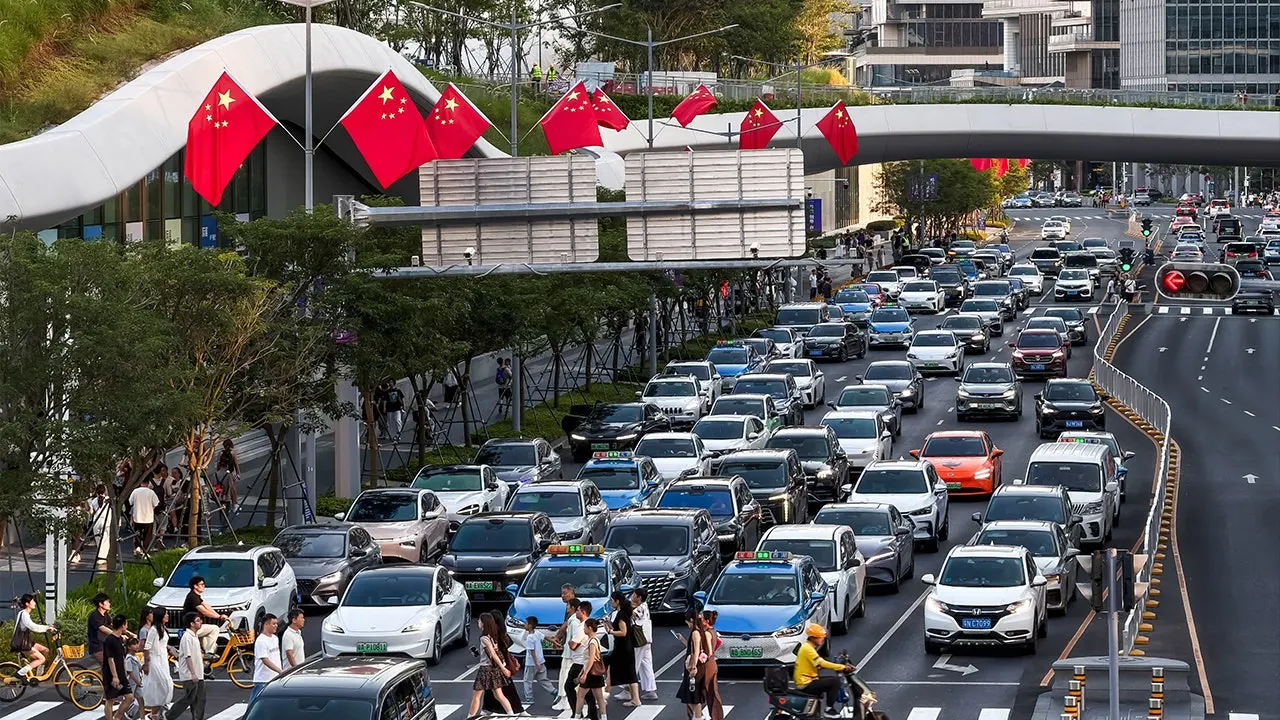
Picture this: you’re driving down a highway, and your car isn’t just navigating by GPS. It’s talking to cameras mounted on traffic lights, sensors embedded in the asphalt, and a massive government cloud platform that can see every vehicle on the road. It knows where you’re going, how fast you’re going, and whether you’re about to turn. It can warn you about a hazard, suggest a faster route, or, in the most advanced versions, take over the wheel entirely. In China, that’s not science fiction. It’s a rapidly expanding reality called “vehicle-road-cloud integration,” and it has U.S. officials worried. A new report from Strategy Risks, shared exclusively with Fox News Digital, reveals that researchers at the University of Wisconsin-Madison were involved in developing this technology alongside China’s Ministry of Public Security—the country’s powerful police ministry. The collaboration didn’t happen in a vacuum. It grew out of a formal academic partnership with Southeast University in Nanjing, and it put American researchers on technical papers with Chinese police-affiliated institutes. The technology itself sounds benign at first: connect cars to roadside infrastructure and cloud systems to improve traffic flow and safety. But at its most advanced level, it allows authorities to monitor vehicles in real time and even send commands to them. That’s a level of control that raises alarms in Washington, especially as Beijing begins deploying these systems in cities across China. The Commerce Department has already moved to restrict certain Chinese and Russian connected-vehicle technology in the U.S., warning that foreign adversaries could collect sensitive data about American drivers or remotely manipulate their cars. So how did an American university end up entangled in this? The answer involves academic ambition, international partnerships, and a technology that straddles the line between convenience and surveillance.
The story begins in 2016, when Jeffrey Russell, then vice provost at UW-Madison, traveled to Southeast University in China. The two schools signed agreements covering research, faculty exchanges, student training, and plans for a joint institute. The following year, Southeast University’s president visited Madison to formally establish the Joint Research Institute, or JRI. According to UW-Madison’s own College of Engineering, the institute “launched in late 2017.” Its focus: intelligent transportation, connected and autonomous vehicles, and vehicle-road-cloud technology. That might sound like a standard academic exchange, but the paper trail gets more complicated. Later, according to the Strategy Risks report, UW researchers appeared on technical work that also involved an institute of China’s Ministry of Public Security. A Chinese industry report on vehicle-road cooperative automated driving listed 46 contributors, including five UW-Madison researchers. The UW-SEU joint institute was listed first among the report’s drafting units, while the Traffic Management Research Institute of China’s Ministry of Public Security was listed seventh. That’s a direct overlap between an American public university and China’s police research apparatus. But how deep was UW-Madison’s involvement? The answer is disputed. A lawyer for a UW professor told Strategy Risks that the contemplated arrangement was never implemented and that the institute was never operational, funded, or staffed by UW. Strategy Risks acknowledges it hasn’t independently resolved that dispute, pointing to public records from both universities describing the institute as established. UW-Madison didn’t respond to Fox News Digital’s request for comment. The dispute matters because it gets to the heart of a bigger question: when universities collaborate internationally, do they know where their research ends up? In this case, the research didn’t stay in academic journals. It became part of China’s national connected-vehicle push.
To understand why this matters, you need to understand what vehicle-road-cloud integration actually does. Imagine a city where every intersection has a smart camera, every lane has sensors, and every car broadcasts its location, speed, and destination. All that data flows into a centralized cloud platform, which can process it in real time. The system can then send information back to vehicles—warning of a pedestrian, suggesting a faster route, or even taking control of braking and steering. In China, this isn’t just a pilot project. In 2023, three major Chinese transportation and communications standards bodies published a national framework for vehicle-road-cloud integration. Southeast University was among the drafters, alongside the Road Traffic Safety Research Center of China’s Ministry of Public Security. The following year, the Ministry of Public Security joined four other Chinese ministries in launching a vehicle-road-cloud pilot program across 20 cities and regional groupings. Under that plan, participating cities are required to install connected roadside equipment and sensing systems, and to build city-level cloud platforms capable of communicating with vehicles. The platforms can provide information to vehicles and assist with decision-making, planning, and control. Safety-monitoring systems track participating vehicles in real time. Chinese authorities describe all this as an effort to improve traffic safety, advance autonomous driving, and accelerate the country’s connected-vehicle industry. And maybe that’s part of the story. But the same capabilities that make traffic flow smoother also make surveillance easier. A system that can track every car in real time is a system that can track every driver. A system that can send commands to vehicles is a system that can override a driver’s choices. That’s why U.S. officials are paying attention. It’s also why the involvement of the Ministry of Public Security is so significant. This isn’t just a transportation department building smart highways; it’s the country’s internal security apparatus helping to build a networked system that touches every vehicle and, by extension, every driver.
The U.S. government has already started to push back. The Commerce Department moved last year to restrict certain Chinese and Russian connected-vehicle technology in the United States. The official warning: foreign adversaries could potentially collect sensitive information about American drivers or remotely manipulate their cars. That’s not a hypothetical concern. Connected vehicles are essentially computers on wheels, and they collect a staggering amount of data—where you go, how fast you drive, when you brake, who’s in the car, maybe even what you say to your voice assistant. In the wrong hands, that data could be used for surveillance, blackmail, or worse. And remote manipulation isn’t just about taking over a car for fun; it could be used to cause accidents, create chaos, or hold a city hostage. The UW-Madison case is part of a larger pattern that has U.S. officials scrutinizing university research ties to China. The Pentagon recently hit 30 universities, including Harvard and NYU, with deadlines to audit foreign ties. Ohio State paid a $2.1 million settlement after admitting a researcher had “inappropriate foreign affiliations” to China. The message is clear: academic collaboration with foreign entities, especially those linked to military or police agencies, is no longer seen as innocent. Universities are being asked to account for who they work with, what they share, and where the research ends up. But the UW-Madison case is particularly uncomfortable because it involves a police ministry, not just a university or a tech company. China’s Ministry of Public Security is not a neutral research partner. It’s the agency responsible for domestic surveillance, censorship, and enforcement. Having its research institute listed on a technical report alongside American researchers raises questions that go beyond academic freedom. It raises questions about whether American taxpayer-funded research is inadvertently helping to build the infrastructure of a police state.
Strategy Risks, the group that compiled the report, is careful not to accuse UW-Madison of intentional wrongdoing. The report states: “Strategy Risks does not allege that UW-Madison, either on its own or through the JRI, deliberately channeled U.S. technology into Chinese surveillance or military systems.” That’s an important distinction. The researchers may have believed they were working on civilian traffic technology, not surveillance tools. But the report argues that the research nevertheless contributed to technology that later took on broader applications in China. It calls vehicle-road-cloud integration a “civilian-framed dual-use technology”—meaning it was presented as a civilian project but has significant military, surveillance, and human rights dimensions. The report says: “The available evidence indicates that research conducted by scholars affiliated with the JRI contributed to the development of a civilian-framed dual-use technology in technical areas that also received U.S. institutional and federal research support. When Beijing incorporated this technology into national standards, the state absorbed a system that has significant surveillance, military, and human rights dimensions.” In other words, even if the American researchers didn’t intend to help China’s police state, their work helped build a foundation that Beijing could build upon. This is the uncomfortable reality of dual-use technology. A traffic management system can become a surveillance system. A vehicle communication standard can become a control mechanism. The same algorithms that predict traffic jams can predict protest movements. The same sensors that monitor road conditions can monitor people. It’s not that the technology is inherently evil; it’s that it can be used for good or ill, depending on who controls it. And in China, the controlling hand is the Ministry of Public Security. That’s a sobering thought for any researcher who believes their work is politically neutral. It’s also a reminder that the line between civilian and military technology is often blurrier than it appears.
So what should we take away from this? First, the UW-Madison case is a reminder that academic research doesn’t happen in a bubble. When universities sign agreements with foreign institutions, they are making choices about who benefits from their expertise. Sometimes those choices are straightforward and beneficial. But sometimes they create entanglements that are hard to unwind. The researchers at UW-Madison may have been pursuing legitimate scientific questions about connected vehicles. They may have believed that international collaboration would make roads safer and transportation more efficient. But the technology they helped develop is now being deployed by a government that uses surveillance to control its population. That doesn’t mean all international research should stop. Science has always been a global endeavor, and many of the world’s greatest advances have come from cross-border collaboration. But it does mean universities need to be more careful about who they work with, especially when the partner is linked to a police or military agency. It also means governments need to provide clearer guidance on what kinds of research are off-limits. The U.S. has already started down this path with restrictions on connected-vehicle technology and audits of foreign ties at universities. But the UW-Madison case shows that the rules may have come too late. The research was already done. The papers were already published. The technology was already absorbed into China’s national standards. The question now is what happens next. Will other universities learn from this example? Will researchers think twice before collaborating with foreign agencies that have track records of human rights abuses? Will the U.S. government do more to protect American innovation from being repurposed by adversaries? The answers aren’t clear. But one thing is certain: the car you drive is no longer just a machine. It’s a data-collecting, network-connected device that can be watched, tracked, and even controlled from afar. And the decisions about who gets to do that watching and controlling are being made right now, in boardrooms, in government offices, and in university labs. The story of UW-Madison and China’s police ministry is a warning about what happens when those decisions are made without enough foresight. It’s a story about good intentions, unintended consequences, and the thin line between innovation and surveillance. And it’s a story that’s still being written.