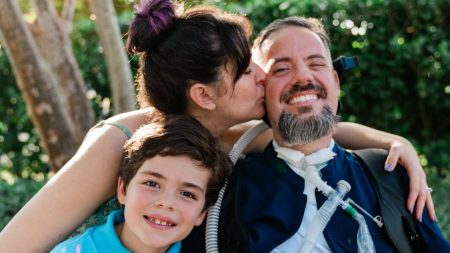



When Naomi Eisenberger’s father developed dementia, she heard the same warning that countless family caregivers hear: taking care of a sick loved one will break you. It will corrode your health, shorten your life, and leave you depleted. But Eisenberger, a social and affective neuroscientist at UCLA who studies how people connect and care for one another, was skeptical. She watched her father decline over time, and the experience was certainly painful. There were days of frustration, grief, and worry, and she does not romanticize the difficulty of navigating a loved one’s lost memory and independence. Yet she also refuses to reduce caregiving to a health hazard. Her father died in January, and looking back on the years she spent helping him, she remembers something more complicated and more hopeful. “It gave me a lot of joy to bring him some happiness,” she says. That simple statement carries a powerful challenge to a scientific and cultural story that has been told for decades—the story that caregiving kills. She does not deny the stress. But she wonders whether our narrow obsession with that stress has blinded us to a deeper truth: caring for another person, even at great cost, can also feed something essential in us, and that nourishment may be its own kind of protection.
The idea that caregiving is deadly first appeared in scientific literature nearly thirty years ago. In 1999, psychiatrists Richard Schulz and Scott Beach published a now-famous study in the Journal of the American Medical Association. They followed more than eight hundred older adults and found that caregivers who said they were experiencing serious emotional strain were 63 percent more likely to die within four years than people who were not caregivers. It was a stunning, alarming finding, and it became a cornerstone of how doctors, journalists, and families understood the role of family caregivers. The study has been cited almost 5,300 times, including nearly 300 times in the last two years alone. It gave scientific authority to something many people already feared: that sacrificing yourself for a sick relative could literally kill you. But the finding has not aged well. Researchers have largely failed to replicate it, and a growing body of work suggests the opposite may be true. In a paper published in September in Biopsychosocial Science and Medicine, Eisenberger and her colleagues reviewed the evidence and concluded that caregiving is actually linked with living longer, not dying sooner. They suspect that the stress of caregiving may be softened by a fundamental human trait—our hardwired inclination to help others in need. This is not to say that caregiving is easy. The statistics are sobering. In 2025, according to a report by AARP and the National Alliance for Caregiving, nearly one-quarter of all adults in the United States—about 63 million people—provided care to an adult or child with a medical condition or disability. Almost 65 percent of those caregivers reported moderate or high emotional stress, and nearly half reported financial hardship. Yet financial and emotional support for caregivers remains limited. So why is anyone talking about the positives? Because understanding the full picture matters, especially for caregivers who are struggling and deserve help without being told that their love and labor is destroying them.
There is a very real tension here, and researchers are aware of it. Rebecca Utz, a sociologist and gerontologist at the University of Utah, worries about celebrating caregiving too much when so many caregivers are overwhelmed. “I don’t like to take our foot off the pedal and say that caregiving is so positive because it’s hard, and people need support,” she says. That fear is understandable. If we tell people that caregiving is good for them, will policymakers decide that caregivers don’t need help? Will family members feel even more pressure to step in and sacrifice themselves? But Eisenberger and her colleagues argue that painting caregiving as wholly negative, rather than nuanced, does its own kind of damage. It erases insight into how caregiving might protect health. Most stressors—like work-related burnout or chronic financial insecurity—are linked to inflammation, which is a marker of physical wear and tear. Caregiving, remarkably, is less likely to show that link. Understanding that paradox could reveal how the human body can withstand stress, Eisenberger says. It could also change how we support caregivers. The problem is that we have been telling only one side of the story. We tell caregivers they are at risk of dying, but we rarely tell them that caring for a loved one might also give them a profound sense of purpose. Even the original 1999 study had a critical flaw. Schulz and Beach compared caregivers of disabled spouses with people whose spouses were healthy. But those two groups lived in entirely different realities. Having a sick or disabled spouse is a massive stressor in itself, regardless of whether you serve as a caregiver. When Eisenberger and her colleagues re-examined the data, they found something that had been buried in the original report: people who had disabled spouses but did not provide care died at the same rate as caregivers who reported distress. In other words, it may have been the illness of the spouse that increased mortality risk, not the act of caregiving itself. The comparison between people with sick spouses and people with healthy spouses was not really a comparison of caregiving at all.
Eisenberger and her colleagues are not the first to question the caregiving-kills narrative. That list includes Schulz himself, who coauthored a 2009 study in Psychological Science with the title “Caregiving behavior is associated with decreased mortality risk.” Another author on that paper, evolutionary and social psychologist Stephanie Brown of Stony Brook University, later wrote a review about the health benefits of helping others. But that 2009 study has been cited far less than the original 1999 study—fewer than 400 times, with only a couple dozen citations in recent years. Brown says the old story has been hard to dislodge. “Slam pieces on caregiving” still show up in doctors’ offices and medical settings, she says, shaping how caregivers see themselves and how physicians see their patients. Part of the problem may be that the science is genuinely surprising. Stress is supposed to trigger inflammation, which compromises the immune system over time. In theory, stressed caregivers should be walking around with high levels of inflammation. But they are not, according to a 2020 study in the Proceedings of the National Academy of Sciences. Researchers analyzed data from more than 30,000 American adults, including about 250 people who became regular caregivers during the study period. They examined six inflammation-related biomarkers in their blood. When people transitioned into caregiving, those biomarkers did not go up on average, and they did not go up compared to matched non-caregivers. Even caregivers under the most extreme stress, including spouses taking care of a partner with dementia, did not show the expected inflammatory signatures. “We don’t really know” why that is, says William Haley, a gerontologist and clinical psychologist at the University of South Florida. “There’s a lot of mysteries here.”
Eisenberger and her colleagues have a hypothesis. They think the answer may lie in a biological system that evolved among mammals to protect offspring that are helpless long after birth. This “mammalian caregiving system” seems to encourage nurturing and, at the same time, tamp down the normal stress response that tells animals to flee from danger—at least when they are caring for an infant. Studies in rodents offer clues about how this system works, and emerging research in humans suggests it activates even in non-parenting contexts. When people hold a partner in pain, when they give money to family, when they feel compassion for someone in need, the caregiving system may switch on, calming the body’s alarm bells and replacing fear with something closer to tenderness. In preliminary work, Brown and her colleagues have even seen signs of this activation among strangers who bond during a shared activity. For caregivers, this may help explain the contradiction at the heart of their experience. They are tired, frightened, financially strained, and sometimes resentful. But they are also connected. They are needed. They are doing something that matters. In survey after survey, caregivers report that caring for a loved one gives them a sense of purpose, even when it exhausts them. More than half of the caregivers surveyed by AARP said exactly that. Eisenberger argues that minimizing these positive feelings, in an effort to protect caregivers from being taken advantage of, may actually backfire. If we talk only about how awful the next few years of a person’s life will be, we may scare away people who would otherwise step up with love and find meaning in the process. Then those people may carry regret later, wondering if they should have been there when they were needed.
So what are the questions we should be asking? Eisenberger and her colleagues argue that the all-negative framing has kept scientists from exploring some of the most interesting terrain. Does feeling compassion for a sick relative activate the mammalian caregiving system, or do you actually have to provide hands-on care? What happens when a caregiver has a complicated or painful relationship with the person they are caring for—does the protective biological system still kick in, or does it fail? And ultimately, when does the stress of opting out of caregiving outweigh the stress of opting in? These are not abstract intellectual puzzles. They are questions that real families face every day, often without any guidance. A fuller, more honest picture of caregiving could help people make better decisions about whether to take on care, how to sustain themselves while doing it, and what kind of support they need. Eisenberger is not suggesting that everyone should become an informal caregiver, and she is certainly not denying that caregiving can be brutal. She watched her own father disappear into dementia, and she knows that the role can be lonely and overwhelming. But she believes that caregivers deserve more than fear. They deserve a story that includes their strength, their love, and the strange, quiet joy that can accompany even the hardest acts of care. “What if we tell people that helping others can be really fulfilling even if it can be stressful, too?” Eisenberger asks. That question is not just a scientific hypothesis. It is an invitation to see caregiving clearly—not as a death sentence, but as a deeply human experience, full of hardship and meaning, strain and connection, and a resilience we are only beginning to understand.