


There are nights in playoff basketball when the scoreboard tells only a fraction of the story, and Friday night at Barclays Center was exactly that kind of night. The Atlanta Dream outlasted the New York Liberty in an 85–83 slugfest, a game so intense, so physical, and so emotionally charged that the final buzzer felt less like an ending and more like a sudden release of breath. From the opening tip to the last second, the two teams played as if their entire seasons were compressed into forty minutes, and in many ways they were. The Liberty were fighting to keep their title hopes alive in front of a home crowd that knew what was at stake. The Dream, meanwhile, were playing with the kind of desperate edge that defines teams on a mission. Every rebound, every loose ball, every screen became a battleground. Bodies collided, voices rose, and the referees were forced into the unenviable role of trying to keep order in a game that seemed determined to push past the edge of control. When it was over, the Dream had punched their ticket to the WNBA Finals, and the Liberty were left to process a loss that would linger long after the lights went down. But the game itself, with all its friction and fire, was never just about the final score. It was a living, breathing reminder of how much these athletes invest in every moment, and how quickly the line between competitive ferocity and outright confrontation can blur under the weight of playoff pressure.
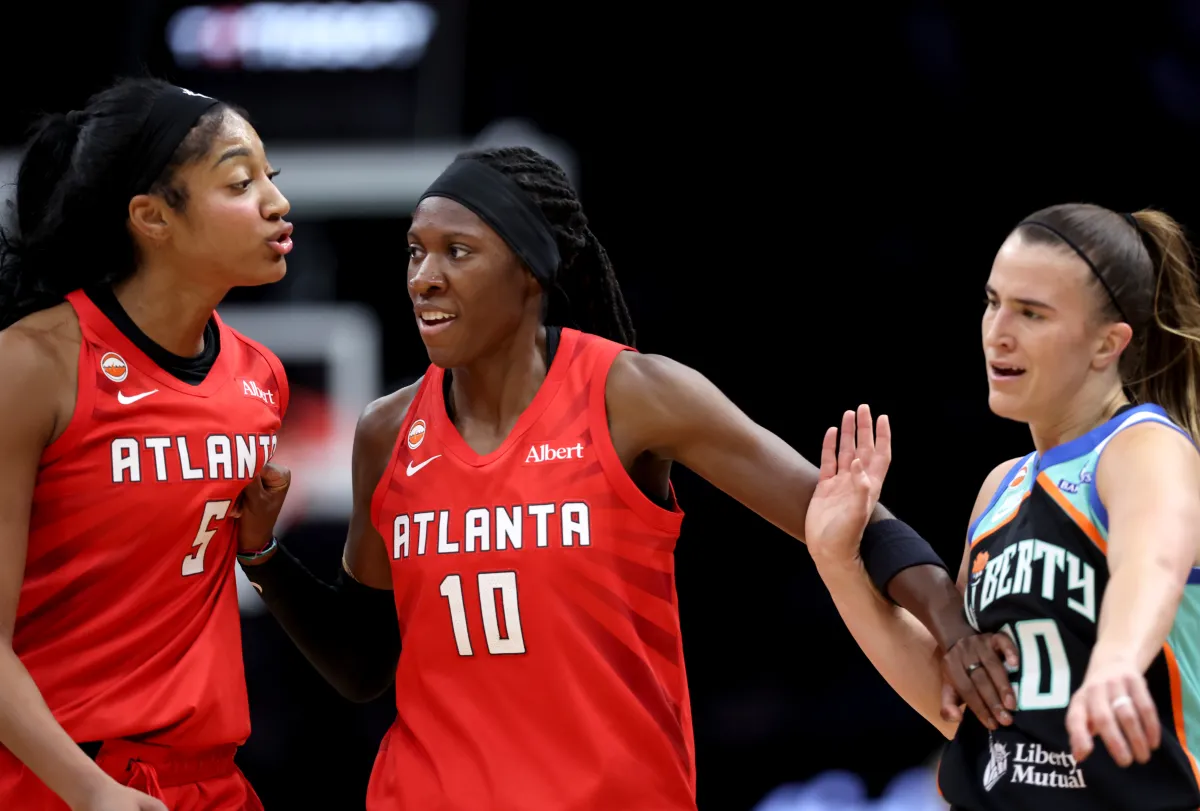
That line was tested early and often, but it came into sharpest focus in the first half when the Dream’s Angel Reese and the Liberty’s Jonquel Jones got into it. The play happened quickly, as these things often do, but the fallout was immediate. Both players were assessed technical fouls, and both sides looked at the officials with a mix of disbelief and frustration. For Atlanta fans, however, there was an even deeper worry. Reese, known for her relentless energy and unapologetic aggression, was now carrying a technical foul, and in a game this volatile, the possibility of a second one was never far from anyone’s mind. Every subsequent hard screen, every contentious rebound, every moment where Reese and her opponents came chest to chest felt like a potential turning point. It was the kind of tension that makes watching sports equal parts exhilarating and agonizing, because on one hand you want to see players compete with everything they have, and on the other hand you dread the moment when emotion boils over and the game gets taken out of the players’ hands. The incident between Reese and Jones was not malicious in a vacuum, but in the heat of a semifinal battle, it felt like a spark in a room full of gasoline. The crowd felt it. The players felt it. And most of all, the officials felt it, because from that moment forward, every whistle, every non-call, and every stare between opponents would be magnified. Reese, to her credit, did not shrink from the moment. She kept playing, kept battling, kept imposing her will on the game, but the shadow of that first technical hung over her like a storm cloud, and it seemed entirely plausible that the most memorable moment of the night still had yet to happen.
It almost did on a play that had nothing to do with Jones and everything to do with the unrelenting chaos of the game. With the Liberty in possession and Sabrina Ionescu setting a hard screen on a Dream player, the referees called a foul on Ionescu. But the play did not end with the whistle. Reese, clearly still agitated and looking for any advantage she could find, followed Ionescu up the court, jawing at her the entire way. It was not a scream, not a confrontation that required separation, but it was persistent, unbroken chatter, the kind of calculated edge that players use to live in an opponent’s head. ESPN commentator Rebecca Lobo saw it clearly and called it out over the replay, saying, “The whole time, walking down the floor. That should be a T. That should be a T.” The words hung in the air, and for Atlanta fans, they were a stomach-dropping reminder of how close Reese had come to putting her team in a terrible spot. For New York fans, they were fuel for the belief that the officiating was uneven at best. And for neutral observers, they were a perfect example of how much of this game is psychological warfare. Reese was not trying to start a fight. She was trying to plant a seed of doubt, to remind Ionescu and the Liberty that the Dream would not be pushed around. But the margin between gamesmanship and a technical foul is razor thin, and with Reese already having been whistled once, the risk was enormous. The fact that she escaped without another technical was seen by some as good fortune and by others as another glaring inconsistency from a referee crew that seemed to be making up the rules as they went.
The fans made their feelings known almost immediately, and the comment sections of social media posts turned into a firestorm of frustration. One commenter on an Underdog WNBA video wrote, “These refs legit are the worst in sports and it’s not close.” Another, trying to find some middle ground, said, “Angel just getting carried away here. Say your peace and leave it at that.” Some blamed the officials for creating an environment where players felt the need to police the game themselves. “WNBA refs blunders lead to games become unnecessarily chippy,” one person suggested. Others made pointed comparisons, with one fan writing, “Caitlin would have got ejected for this! LOL. Angels all big and bad against Sab but wouldn’t step to jj! LOL.” The comment was messy, ungrammatical, and yet it captured the deep well of emotion that fans bring to these moments, where stars are judged not just by their stats but by their conduct, their demeanor, and how they handle the pressure of the brightest stage. Other comments were more blunt: “Worst refs in sports history” and “The W refs are consistent. Consistently awful.” It was a chorus of discontent that has become all too familiar over the past season, a season in which WNBA officials have been under constant fire from players, coaches, and fans alike. They are asked to call a fast, physical, increasingly athletic game while players are crashing into each other at full speed, and the margin for error is minuscule. But the complaint is not simply that mistakes are made. It is that the mistakes often seem to change the momentum of games, to heighten tensions rather than calm them, and to create a sense that no one, not even the referees, has full control of what is happening on the floor.
That larger officiating controversy did not start in this game, and it will not end with it. Just days earlier, in Game 2 of this same semifinal series, the Liberty had been involved in a late-game situation in which Breanna Stewart and the team believed they had called a reset timeout when, in the eyes of the officials, they had not. The play drew immediate scrutiny and added another layer of distrust between the league and its fans. It also made the stakes of every subsequent whistle feel heavier, because people were no longer observing isolated calls in a vacuum. They were seeing a pattern, or at least the perception of a pattern, in which the most important moments of the most important games were being decided by officials who seemed to be figuring things out in real time. This game against the Dream was no exception. By the time the final minutes arrived, both teams were playing with extra caution, not just about turnovers or shot selection, but about how much they could do without drawing whistles. It is a strange reality for any sport when players have to factor officiating into their decision-making, but it has become a nagging truth in the WNBA. The league has grown tremendously in recent years, with more talent, more visibility, and more passionate audiences. But with that growth has come intense pressure on the officials to be perfect, and when they are not, the fallout is immediate and unforgiving. The calls and missed calls from this semifinal will likely be debated for weeks, and they will almost certainly cast a shadow over the Finals as well, especially if the league does not find a way to regain the confidence of its players and fans.
Amid all the chaos, the game itself featured performances that deserved to be remembered beyond the officiating drama. Angel Reese finished with 22 points, nine rebounds, three assists, two blocks, and a steal, a stat line that reflected her ability to impact every part of the game even when emotions threatened to get the best of her. She was everywhere, crashing the boards, running the floor, and refusing to back down from any challenge. Her presence was a statement, not just to the Liberty, but to the entire league, that the Dream had arrived. She was not the only star for Atlanta, though. Jordin Canada delivered a sensational performance with 19 points and 11 assists, orchestrating the offense with a calm that belied the eruption of tension around her. While Reese provided the fire, Canada provided the grace, weaving through defenses, finding open teammates, and making crucial plays down the stretch when the game hung in the balance. Together, they embodied the two sides of playoff basketball: the passion that fuels the fight and the composure that wins the close games. The Dream needed both of those qualities to survive this battle, and they got exactly that from their two leaders. In the end, the 85–83 score line was almost too close to breathe in, but it was enough. Atlanta earned its place in the WNBA Finals, and now they wait to see whether they will face the Golden State Valkyries or the Las Vegas Aces in the next round. Either way, the Dream have already proven something to themselves and to the world. They are not just happy to be here. They are here to win, and they are willing to go through everything, including the chaos, the technicals, the questionable calls, and the relentless physicality, to do it. For the Liberty, the loss is bitter, but for the Dream, it is a step toward history, and no amount of controversy can take that away.