


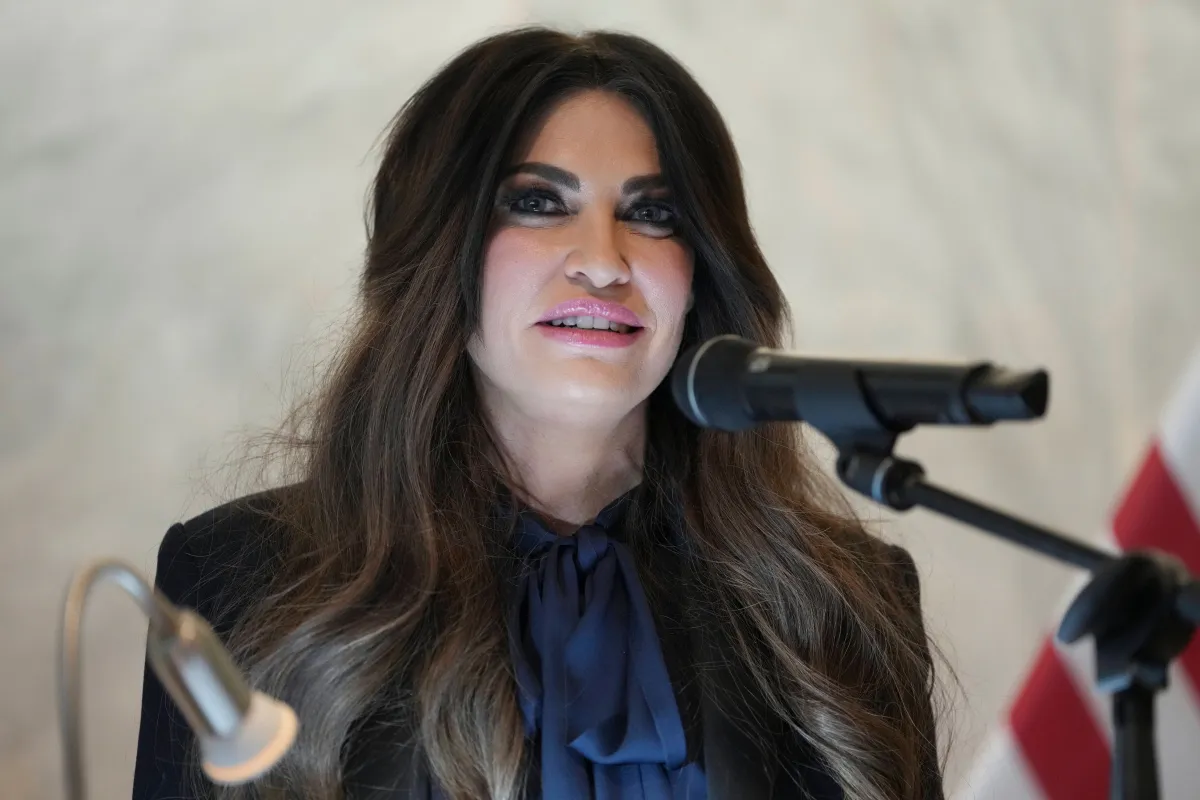
Few things blur the line between personal need and political power quite like a request for money made in the shadow of a confirmation hearing. That is the strange and uncomfortable place Kimberly Guilfoyle now finds herself. As the U.S. ambassador to Greece and the former fiancée of Donald Trump Jr., she has spent years moving through the highest circles of American political life. But in July 2025, just days before she was scheduled to appear before the Senate for her confirmation hearing, she allegedly reached out to a longtime Trump donor named Eric Deters and asked him to pay off a $100,000 American Express bill. The request, made through Signal messages first reported by The Wall Street Journal, was not described by Guilfoyle as a loan or a gift. Instead, she reportedly framed it as a favor that came with an implicit promise: access to senior members of the Trump administration. In one message, she reportedly wrote, “It won’t show up anywhere if you wire money to American Express.” In another, she pressed him with a phrase that has since become the centerpiece of the controversy: “I have been officially announced honey please I need you to get this done for me today.” The tone was curious—at once intimate, urgent, and transactional. Deters, a former Republican congressional candidate and conservative media personality, understood it as an explicit exchange: money for access. “I have no doubt it was pay to play,” he told CBS. “It was a quid pro quo.”
The details that followed did little to simplify the picture. Deters said he had previously paid Guilfoyle for speaking engagements and had discussed compensation for other work. He said she had been helping him with tax and legal matters, including efforts to draw federal attention to a dispute involving an Ohio surgeon who fled to Pakistan. He denied owing her any balance, and he did not make the $100,000 payment, telling her at the time that his wife would not approve—a reason he later admitted was merely an “excuse.” Guilfoyle’s attorney, Jesse Binnall, disputed the authenticity of the messages and said his client was owed money for travel and speaking engagements that predated her nomination. The U.S. Embassy in Greece issued a statement describing Guilfoyle’s career as guided by “deep and abiding values,” while Vice President JD Vance said he did not like “anybody selling access to another government official” and Secretary of State Marco Rubio cautioned that published reports should not automatically be accepted as fact. There was no smoking gun, no indictment, no admission. But there was something else: a familiar pattern, one that has emerged repeatedly around figures in Trump’s political orbit. It is the pattern of proximity being used as currency, of relationships being transformed into transactions, and of the slow, corrosive confusion between loyalty and influence. The Guilfoyle story, on its own, might be dismissed as an awkward personal request between people who knew each other. But placed against a broader history of Trump allies accused of selling access, it takes on a different weight.
That history includes people who were not just accused, but convicted. Stephen Calk, the former chief executive of The Federal Savings Bank, was found guilty in 2021 of financial-institution bribery and conspiracy after arranging about $16 million in loans to Paul Manafort, Trump’s former campaign chairman, in exchange for Manafort’s help securing a senior position in the incoming administration. Calk reportedly supplied a ranked list of jobs he wanted, including Treasury secretary, deputy Treasury secretary, and secretary of the Army. He used the bank’s power not as a normal business tool, but as a lever to buy his way into the corridors of power. He was sentenced to one year and one day in prison. Then there was Elliott Broidy, a major Republican fundraiser and vice chairman of Trump’s inaugural committee, who pleaded guilty in 2020 to conspiring to violate the Foreign Agents Registration Act. Prosecutors said Broidy agreed to lobby Trump, the attorney general, and other senior officials to drop civil forfeiture proceedings connected to the Malaysian state investment fund 1MDB, and that he was paid at least $9 million by Malaysian businessman Jho Low for his efforts. Broidy also agreed to lobby the administration on behalf of Chinese interests concerning a dissident living in the United States. He received a full presidential pardon from Trump on January 19, 2021, before he was ever sentenced—a reminder that even when the law catches up, political grace can sweep the consequences away. George Nader, an adviser to senior United Arab Emirates officials, helped funnel millions of dollars in foreign money into U.S. political committees during the 2016 election, including at least $3.5 million in unlawful contributions, and later received additional prison time for his role in the scheme. Imaad Zuberi, a venture capitalist and political fundraiser who donated to candidates from both parties, was sentenced to twelve years in federal prison after pleading guilty to undisclosed foreign-agent activity, tax evasion, illegal campaign contributions, and obstruction of justice. The Department of Justice described his work as turning unregistered foreign lobbying into a business enterprise.
Not every case ended in conviction, and the line between political access and criminal corruption has often been harder to draw than the headlines suggest. Michael Cohen, Trump’s former personal attorney, was accused of soliciting at least $1 million from Qatar’s government in late 2016 in exchange for access to and advice about the incoming administration. The alleged request was made during the transition period, and Qatar declined it; Cohen was never convicted of anything related to the solicitation itself, although he later pleaded guilty to campaign-finance violations, tax evasion, and making false statements to a financial institution. In Trump’s second term, the pattern has continued in different forms. Tom Homan, Trump’s border czar and a former acting director of Immigration and Customs Enforcement, became the subject of a controversy in 2025 after Reuters reported that he accepted $50,000 in cash from an undercover FBI agent during an investigation into alleged promises to help secure future immigration-related government contracts after he returned to the administration. The investigation was later closed, with FBI Director Kash Patel and Deputy Attorney General Todd Blanche saying there was “no credible evidence of any criminal wrongdoing” and describing the probe as politically motivated. Homan was not charged. Then there was the strange and opulent story of Donald Trump Jr.’s wedding celebration in the Bahamas, reportedly financed in substantial part by Russian oligarch Umar Kremlev, a close associate of Vladimir Putin. ProPublica found that Kremlev paid hundreds of thousands of dollars in expenses for the three-day celebration, including the rental of a private island and a fireworks display. Trump Jr. and his wife, Bettina, confirmed that Kremlev had hosted the post-wedding celebrations as a gift, and Bettina described him as a “dear friend.” Kremlev told the Associated Press that Trump Jr. had reimbursed him, and President Trump defended the arrangement as generosity between friends. Democrats were highly critical, with Senate Democratic Leader Chuck Schumer suggesting the gift was a “bribe.” But the reported expenses, by themselves, did not establish that Kremlev purchased political access or that Trump Jr. promised government favors. The question of whether a wedding gift from a foreign oligarch is a crime or a personal gesture remains, at least legally, unresolved.
What makes these stories so unsettling is not that they all involve the same moral offense, but that they occupy a strange gray zone where human motivations are tangled and difficult to separate. In some cases, the greed is obvious: a man lending millions to a campaign chairman and then asking for a cabinet position; a fundraiser being paid millions by foreign interests to lobby senior officials; a venture capitalist using foreign money to buy influence in Washington. In other cases, the situation is more ambiguous, like a former presidential attorney offering access to a foreign government for a fee, or a border czar accepting cash from someone he may have believed was a potential business partner, or an oligarch paying for fireworks and a private island at the wedding of a president’s son. The people involved are not abstract villains. They are human beings with families, ambitions, rationalizations, and fears. Calk likely believed he was playing the game as it had always been played, that wealth and connections were simply how the world worked. Broidy may have convinced himself that his lobbying was legitimate, that representing foreign clients was no different from any other consulting arrangement. Guilfoyle likely saw her request to Deters as a favor between friends, a desperate attempt to get her finances in order before one of the most important moments of her life. Deters, for his part, may have genuinely believed he was being asked to pay for access, or he may have been an embittered former ally seeing betrayal in a request he found insulting. The truth is probably messier than any one interpretation. But that is the point. The system does not need every player to consciously think, “I am committing corruption.” It only needs enough ambiguity for people to tell themselves that they are not. The question of what constitutes a bribe, a gift, a business arrangement, or a personal favor is not merely legal; it is cultural. In a political world built on relationships, where a conversation with a cabinet secretary can be worth millions, the boundary between generosity and bribery is constantly being redrawn, often by the very people who benefit from its blurriness.
That is why the Guilfoyle story matters, not because it is shocking but because it is familiar. It is a reminder that access in Washington has always been a commodity, bought and sold in ways that range from legal campaign contributions to outright bribery, with a vast and murky middle ground in between. The ethics of that trade are rarely a matter of simple right and wrong. A lobbyist who takes wealthy clients to dinner with a senator is not committing a crime; he is practicing his trade. A donor who gives generously to a presidential campaign and then asks for a meeting with the secretary of state is not necessarily engaging in pay-to-play; he is exercising a privilege that has existed for as long as politics has existed. But when personal debts are paid by political supporters, when foreign oligarchs fund family celebrations, when businessmen seek government appointments and ambassadors ask for money through encrypted messaging apps, the line becomes harder to defend. The allegations against Guilfoyle are serious not because they prove she did anything illegal, but because they reveal an assumption that access can be exchanged for financial relief, that political relationships are assets to be monetized, and that the people who surround the powerful have a right to leverage their proximity for personal gain. That assumption is not new, and it is not unique to one political party or one president. It is a recurring feature of democratic life, a temptation that grows stronger as power grows more concentrated. And it is why independent journalism, public scrutiny, and accountability still matter. In an age where reputations can be destroyed by unverified messages and congressional hearings can be shaped by carefully staged performances, the public needs more than accusations; it needs information, context, and a willingness to see the people involved as complicated figures rather than simple caricatures. Kimberly Guilfoyle is not just a politician accused of a shady financial request; she is a woman who built a career in media and public relations, who faced a confirmation hearing at a pivotal moment, and who may have made a terrible decision under pressure. The donors around her are not just cynical operators; they are participants in a system that rewards access and punishes those who do not play along. And the public, caught between outrage and cynicism, must decide whether these stories represent corruption that must be addressed or just politics as usual. Perhaps the truth is that they represent both. The challenge is to act on that truth without losing sight of the human beings at the center of it—or the responsibility of a democracy to demand better than the trade of influence, no matter how normal it has become.