


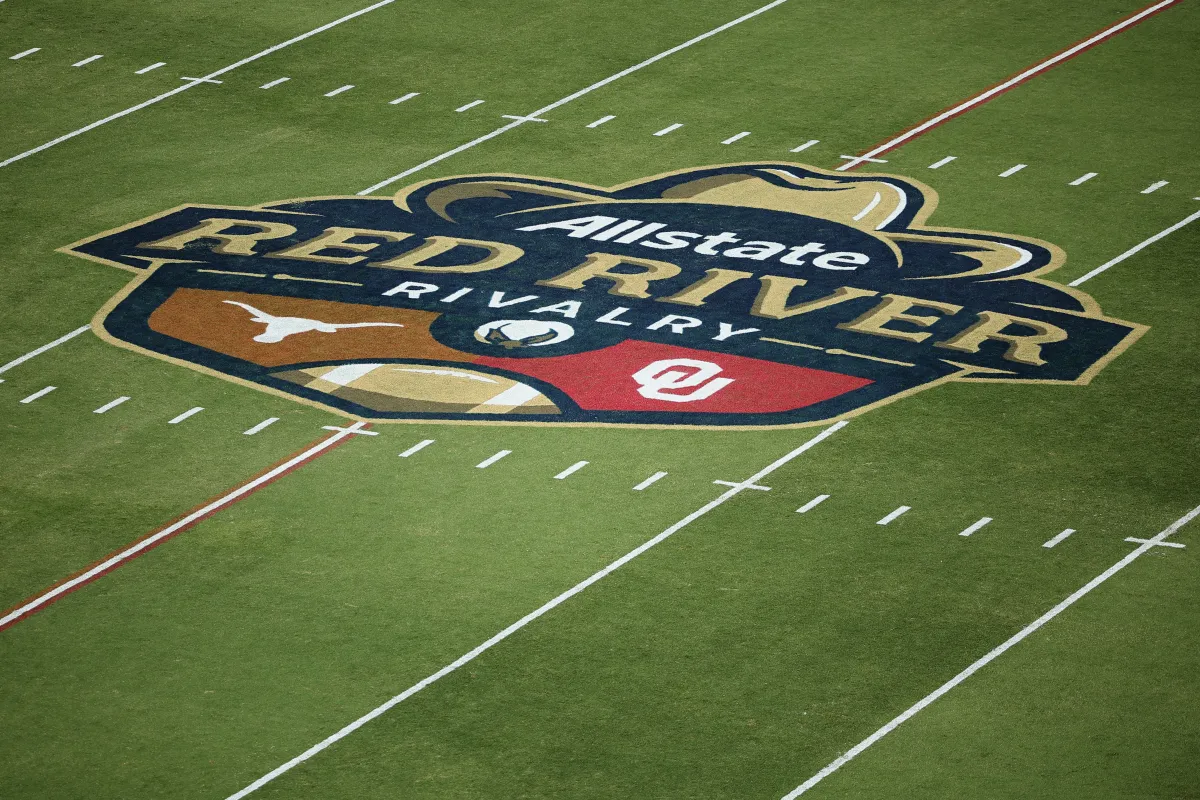
The air in the Cotton Bowl was thick with more than just the scent of fried food and autumn Texas heat—it was charged with the raw electricity of one of college football’s most storied rivalries. When Oklahoma’s 47-yard field goal sailed through the uprights as time expired, sealing a 27-24 victory over the top-ranked Texas Longhorns, the game itself became a footnote to the chaos that followed. For a rivalry defined by crimson and burnt orange, by decades of bitterness and bragging rights, the ending didn’t just sting—it ignited a powder keg of emotion that spilled off the field and into the tunnel. Players from both sides, still sweaty and adrenaline-fueled, had to be physically separated after the final whistle, with Texas players, their championship dreams shredded in a single, agonizing kick, turning their frustration outward. The taunts came sharp and primal: “Y’all still suck,” a chant hurled at the Sooners as if to reclaim some shred of superiority in a moment where the scoreboard had just robbed them of it. It was the kind of raw, unfiltered outburst that only a rivalry like this can produce—where losing to anyone else might be bearable, but losing to them feels like a wound that won’t heal.
The drama didn’t start with the field goal, of course. The game had been a brutal, back-and-forth war from the opening snap, a grudge match played with the kind of intensity that makes grown men forget that football is supposed to be fun. Oklahoma, the underdog in this Cotton Bowl showdown despite the rivalry’s history, had clawed and scraped to stay within striking distance of the Longhorns, who entered as the undefeated, undisputed No. 1 team in the nation. Arch Manning, the heir to football’s most famous surname, had been the engine of Texas’s offense, throwing for three touchdowns and flashing the arm strength and poise that had made him the most hyped quarterback in college football. But in the fourth quarter, with the game hanging in the balance, the young signal-caller made a mistake that would define the afternoon. His interception—a pass that sailed just a beat too late, a decision that would haunt every film session for weeks—gave Oklahoma the ball in prime position. And with the clock winding down, the Sooners methodically drove down the field, setting up the kick that ripped the Longhorns’ undefeated season to shreds. It was a cruel twist for Manning, who had shown flashes of brilliance but also the raw inexperience that comes with playing against a defense that refused to let him settle into a rhythm. The game was a testament to the fine margins between glory and heartbreak, and in that moment, Manning learned the lesson that every great quarterback eventually faces: sometimes, one bad throw can erase all the good ones.
But the real story wasn’t just the interception or the field goal—it was what happened next, when the emotions of a 60-minute war boiled over into a confrontation that felt less like a post-game handshake and more like a schoolyard brawl. As the final seconds ticked away and the Sooners celebrated on the field, a group of Texas players, red-faced and seething, made their way toward their opponents. The chants started as a defiant cry, a way to vent the crushing disappointment of a loss that felt like a betrayal of the season’s promise. “Y’all still suck,” they yelled, the words dripping with venom, as if the scoreboard didn’t exist, as if they could rewrite reality through sheer volume. Oklahoma players, already high on the euphoria of an upset, didn’t back down, and the confrontation escalated until Texas head coach Steve Sarkisian—a man who knows something about pressure and scrutiny—had to physically step in, wrapping his arms around his players and guiding them off the field like a parent breaking up a playground fight. The image of Sarkisian, his face a mixture of disappointment and exhaustion, trying to restore order while his team’s season spiraled in front of him, was a powerful reminder that behind the helmets and the pads, these are still young men learning to cope with loss in a world that treats every game as a matter of life and death.
The internet, as always, had its say within minutes. The viral video of the post-game scuffle became a canvas for every shade of fandom, from gleeful schadenfreude to pointed criticism. “Alright, we’ll see if Texas misses out on the playoffs again,” one fan wrote, the words dripping with the kind of petty satisfaction that only comes from watching a rival’s dreams crumble. “Yessssss, bitter tears!” another exclaimed, taking pleasure in the Longhorns’ visible misery. But not all reactions were so one-sided. A more analytical fan pointed out the irony: “Texas yelling ‘y’all still suck’ like they weren’t trying to settle who sucks worse,” a comment that encapsulated the absurdity of the moment—two teams, both with their own flaws, engaged in a war of words that only highlighted their shared vulnerability. Others called for accountability, with one observer noting, “Character check time,” suggesting that the confrontation revealed more about the Longhorns’ composure than their skills. The social media chaos mirrored the chaos on the field, a digital echo of a rivalry that refuses to be contained by the rules of the game. It was a reminder that in the age of instant reaction, every emotional outburst becomes a public spectacle, analyzed, memed, and dissected before the players even get to the locker room.
In the aftermath, the focus shifted to Manning and the very human dilemma of a young quarterback facing the weight of a famous name. Criticism came from all corners, but perhaps none stung more than the words of Robert Griffin III, a former Baylor quarterback and Heisman Trophy winner who knows a thing or two about the pressures of college football stardom. “And that’s why Arch Manning needs to come back for another year of college football,” Griffin posted on X, his message blunt and direct. “Just needs more experience.” The comment cut to the heart of the debate that had been simmering all season: Was Manning ready for the NFL, or was he still a work in progress, a gifted but raw talent whose growth would be better served by another year in the college game? Griffin’s statement was not a condemnation but a pragmatic observation, a reminder that even the most celebrated prospects sometimes need time to develop. For Manning, who had thrown for three touchdowns but also two interceptions—one of which directly led to the game-winning field goal—the loss was a bitter pill, but also a lesson. He had shown flashes of brilliance, but he had also shown that the moment can get too big, that the pressure of a rivalry game against a fierce opponent can cause even the most composed minds to waver. Whether he heeds Griffin’s advice or chooses to chase the NFL dream, the experience will stay with him—a defining chapter in a story that is still being written.
As the dust settles on the Cotton Bowl, the rivalry between Oklahoma and Texas once again proves why it is one of the most compelling spectacles in sports. It is not just a game; it is a collision of cultures, a clash of egos, a stage where heroes are made and hearts are broken. For Texas, the loss is a gut punch to a season that had promised so much. The undefeated run is over, the No. 1 ranking is gone, and the playoff hopes now hang by the thinnest of threads. For Oklahoma, the victory is a statement—a reminder that despite their struggles, they can still rise to the occasion when it matters most. But beyond the standings and the statistics, the post-game confrontation revealed something deeper about the human side of sports. These are not just athletes executing plays; they are young men who invest their entire identities in the outcome, who taste failure as a physical ache, who react to loss with the same raw emotion as anyone else. The chanting, the shoving, the tears of frustration—they are all part of the messy, beautiful, and often ugly reality of competition. And while the adults in the room, like Sarkisian, try to restore order, the truth is that the lines between rivalry and resentment will always blur in moments like this. The game will be replayed, the analysis will continue, and the debate about Manning’s future will rage on. But what will linger in the memory of everyone who watched is not just the score, but the sight of two proud programs, locked in an embrace of animosity, refusing to let go even after the clock has run out. That is the enduring, human heart of college football—and the reason we can’t look away.