


The air hangs thick and heavy across the American heartland, charged with an uneasy electricity that has nothing to do with the political tensions of the season. Just hours before the nation’s polling places are set to open, a powerful and sprawling storm system is flexing its muscles, promising a volatile mix of severe thunderstorms, torrential rain, and the ever-present threat of flash flooding. This is not just a weather forecast; it is a test of logistical resilience and civic determination, set against the backdrop of a critical midterm election that will decide the balance of power in Congress. From the sweeping plains of the Midwest to the flood-weary coasts of Florida, the elements are conspiring to place an extra obstacle in the path of millions of Americans who are preparing to exercise their most fundamental democratic right. The timing is particularly acute, as the storm’s peak intensity is predicted to coincide with the morning and afternoon hours when many voters across the central United States will be making their way to the ballot box.
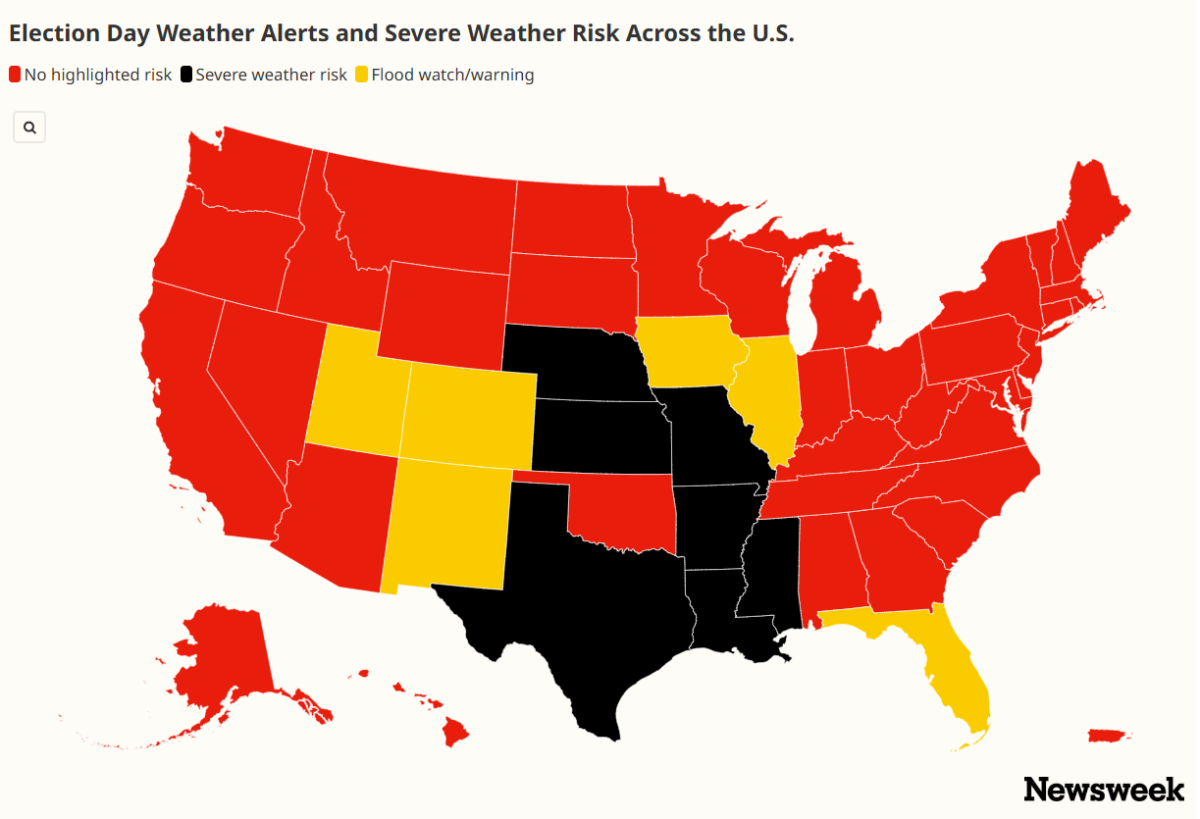
The immediate fury of the storm is concentrated, with the National Weather Service issuing a flurry of alerts on the eve of Election Day. In Texas and Oklahoma, the sky cracks with severe thunderstorm warnings, while more ominous tornado watches stretch across entire counties in Kansas and Oklahoma, urging residents to stay vigilant and weather-aware. Down in the Southeast, the situation is equally dire, though for a different reason. Florida’s east-central coast is reeling from a relentless assault of rain, with 6 to 12 inches already saturating the ground in Indian River, Martin, and St. Lucie counties. Here, the threat is not from the wind, but from the rising water, with flood warnings in effect as officials in New Mexico grapple with their own flooding crisis in Rio Arriba County, where roads around the town of Chama have been closed due to the deluge. It is a fragmented tableau of chaos, a reminder that this system is not a single, monolithic event but a collection of dangerous phenomena, each capable of disrupting the daily lives of the people in its path. For those in the affected zones, the simple act of leaving home to cast a vote becomes a calculated risk, dependent on the shifting fortunes of the sky above them.
As the sun rises on Election Day, the danger does not dissipate; it merely shifts its focus. The Storm Prediction Center’s forecast paints a grim picture for the lower and middle Mississippi Valley, where voters in states like Arkansas, Tennessee, and Missouri will face the brunt of the system’s next act. The atmosphere is primed for explosive thunderstorm development, with the potential for damaging straight-line winds that can snap trees and power lines, and even isolated tornadoes capable of leveling structures in their path. But the greatest threat, once again, is the sheer volume of water. Forecasters are warning of a “training” effect, where thunderstorms repeatedly move over the same geographic areas, wringing out relentless rainfall that can overwhelm drainage systems and turn streets into rivers in a matter of minutes. This is a phenomenon that transforms a steady rain into a life-threatening flash flood, and for voters in these regions, it represents a significant and unpredictable hazard. The stark contrast is palpable when one looks to the Northeast and mid-Atlantic, where high pressure is expected to hold the storm at bay, offering a mostly dry and mild day characterized by the quiet calm of a late-autumn morning, a world away from the turbulence unfolding in the nation’s interior.
The intersection of this meteorological turmoil with the democratic process is the central drama of the day. For the residents of states squaring off with the storm, the election is no longer just a civic duty; it is a logistical puzzle fraught with anxiety. Their polling places, often housed in schools, community centers, and firehouses, may become inaccessible islands in a sea of mud and rising water. Downed trees could block the only roads leading to the local precinct, while power outages in these communities threaten to plunge voting machines and poll workers into darkness. In the rural expanses of the Plains, a drive to the polling station might be a journey of twenty or thirty miles, a trek that becomes perilous when confronted with blinding rain and the roar of a tornado warning siren. This is the human face of the storm, the father shepherding his young family to a church basement to vote before the worst hours arrive, the elderly woman in a flood-prone county wondering if she can safely navigate the slick pavement to her local library. The right to vote, so often discussed in abstract legal terms, is here ground into the very dirt and rain of the physical world, a reminder that the machinery of democracy is ultimately powered by the will of individuals who must show up, come what may.
This connection between the weather and voter behavior is not merely anecdotal; it is a subject of serious academic study. Researchers have long sought to quantify the impact of inclement weather on civic participation, and their findings, while often modest in scale, point to a consistent reality: bad weather does depress turnout. A comprehensive 2023 review of 34 separate studies on rainfall and voting, conducted by researchers Søren Damsbo-Svendsen and Kasper M. Hansen, concluded that local rainfall demonstrably reduces the probability of an individual casting a ballot. Their analysis suggests that for every additional inch of rain, turnout takes a hit of approximately 1 to 2 percentage points, a figure that can be significant in a tightly contested race. This builds on earlier research from political scientists Brad Gomez, Thomas Hansford, and George Krause, who studied US presidential elections from 1948 to 2000 and found a similar, though slightly smaller, negative relationship, with an inch of rain correlating with a turnout drop of just under one percentage point, and an inch of snow cutting it by about half a point. These numbers translate into real people—the young first-time voter who decides the soaked walk to the bus stop isn’t worth it, the working parent for whom an extra hour of commute in the stormy traffic is a dealbreaker.
These studies, however, provide a historical context that may not perfectly apply to the current electoral landscape. The way Americans vote has undergone a profound transformation, with early voting and mail-in ballots becoming increasingly prominent in election infrastructure. This means many voters have already cast their ballots, insulated from the Election Day weather. For those voting in person, the storm’s impact may be less about a general malaise and more about the specific, tangible barriers it throws up: a closed road, a flooded underpass, a failed power grid. The research serves as a sobering reminder that even in the 21st century, the physical environment can still exert a powerful influence on who shows up to be counted. The storm becomes a silent variable in the election’s complex equation, a force of nature that could suppress votes in certain counties and shift the outcome of a state or local ballot measure, not through the persuasiveness of an argument, but through the sheer indiscriminate violence of the weather. It is a poignant, humbling thought: that the fate of a democracy can hinge on the temperament of the skies, and that the determination of millions of voters is being tested by something as capricious as a patch of low pressure rolling across the continent.