

Paragraph 1: The Desperate Hour and the Bold Switch
There is a certain kind of tension that grips a stadium when a team is teetering on the brink of collapse—not just losing, but losing with a dull, uninspired rhythm that feels like watching sand drain through an hourglass. That was the scene in Arizona on Sunday, as the Cardinals found themselves staring up at a fourteen-point deficit against the Dallas Cowboys, with the third quarter bleeding into the fourth and the offense sputtering under the guidance of Jacoby Brissett. Brissett, a steady but unspectacular journeyman, had been tasked with keeping the ship afloat, yet his afternoon had been a study in frustration. He had managed to move the ball in fits and starts, but the defining moment of his day was a soul-crushing interception, a misread that seemed to encapsulate the offensive malaise. With zero touchdowns and that single, costly turnover, the game felt less like a contest and more like a slow, agonizing surrender. In that moment, sitting on the sideline with his helmet visor reflecting the desert sun, was Gardner Minshew II, the flamboyant, mustachioed backup who had yet to take a snap all season. Head coach Mike LaFleur, facing the possibility of a demoralizing home loss, made the kind of gut-level decision that defines a coaching career: he yanked Brissett out of the game, not as a punishment, but as a desperate act of revitalization. It was a gamble born of necessity, a recognition that sometimes a team doesn’t need a surgeon’s precision but a wrecking ball’s chaos to break a deadlock. The crowd, which had been murmuring with discontent, rose to a fever pitch as Minshew trotted onto the field. You could almost feel the shift in the air, a collective inhale of possibility. This wasn’t just a quarterback change; it was a philosophical about-face, a declaration that the coaching staff would rather lose spectacularly with a spark than fade quietly into defeat with a safety net. The stage was set for an improbable, gloriously chaotic comeback.
Paragraph 2: The Chaos Agent and the Resurrection
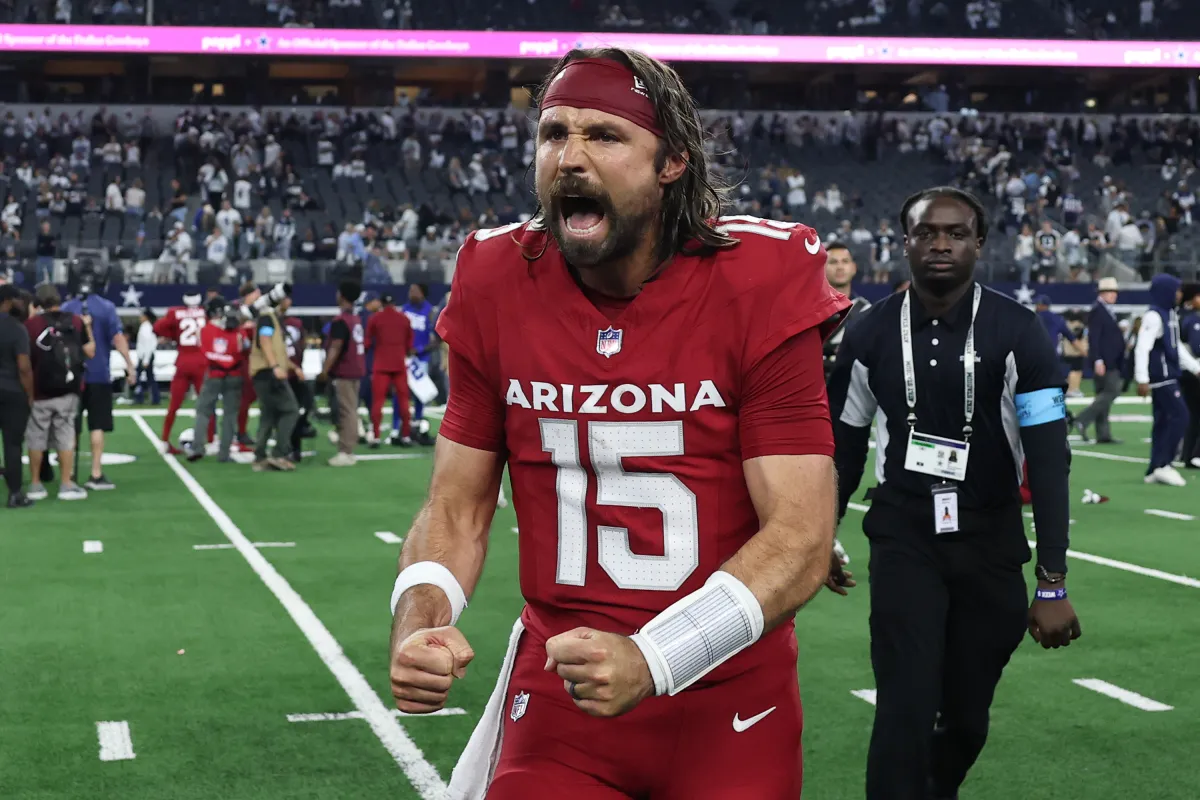
What followed was nothing short of a masterclass in infectious adrenaline, a performance that turned a lifeless offense into a relentless scoring machine. Gardner Minshew, making his Cardinals debut under the most pressurized circumstances imaginable, did not just play well; he played with a swagger that seemed to electrify every single player on the field. It was as if his entrance had flipped a switch, replacing the cautious, methodical approach with a gunslinging, improvisational rhythm that the Dallas defense simply could not handle. On four consecutive drives, Minshew marched the Cardinals down the field, dissecting the Cowboys’ secondary with a mix of precise short throws and aggressive deep strikes that flashed off his receivers’ fingertips. He threw three touchdown passes, each one delivered with that trademark, unshakable confidence, and the offense suddenly looked like a team possessed, moving the ball at will. The scoreboard, which had been a monument to frustration, ticked upward rapidly—chasing the 30-point plateau with a frenetic urgency that left the Cowboys scrambling to adjust. When the final seconds of regulation ticked away, the score was knotted at 30-30, a miracle of resilience that seemed utterly impossible just a quarter earlier. The overtime period was a mere formality of momentum, as the Cardinals’ defense, buoyed by the offensive surge, held firm, allowing the kicking unit to slot home the game-winning field goal that sent the home crowd into a frenzy. Looking at the box score, Minshew’s line was efficient—17 completions on 23 attempts for 188 yards and three touchdowns—but the statistics barely capture the earthquake he caused. It was a performance that transcended numbers, a visceral display of leadership and intestinal fortitude. In a single afternoon, he had single-handedly redefined the trajectory of the Cardinals’ season, turning a potential disaster into a signature victory and making it painfully, obviously clear that the quarterback hierarchy in Arizona had just been violently upended in the most compelling way possible.
Paragraph 3: The Declaration and the New Era
In the cold, fluorescent-lit reality of the Monday morning press conference, the emotional high of Sunday’s miracle gave way to a strategic reckoning. Coach Mike LaFleur, his face carrying the tired but satisfied look of a man who had just made a franchise-altering decision, addressed the media with an air of definitive finality that left no room for speculation. He announced, with the confidence of a coach who has seen the future and likes what he sees, that Gardner Minshew would be the starting quarterback moving forward. There was no hedging, no “we’ll see,” no talk of competition. LaFleur had witnessed the transformation live, watching his offense morph from a timid, predictable unit into a dynamic, fear-conquering force the moment Minshew took the helm. The decision was logical—almost obvious—but it carried immense weight, officially ending the Jacoby Brissett experiment and handing the keys of the franchise to the charismatic signal-caller who had only just arrived. For Minshew, this represents the apex of a long, winding journey through the NFL, a testament to his perseverance and his refusal to let the label of “backup” define his ceiling. He has always been a player who projects an unshakable belief in his own abilities, a man who wears his eccentricity as a badge of honor and his reckless courage as a virtue. Now, he gets to prove it all on a full-time basis, starting with the daunting task of facing the Seattle Seahawks on their home turf next Sunday. The announcement wasn’t just about the next game, though; it was a philosophical commitment to a style of play that prioritizes risk-taking and explosive potential over game managers and safe hands. LaFleur is betting his job, his reputation, and the team’s season on the idea that Minshew’s infectious energy can sustain itself week after week, that the magic we saw on Sunday isn’t a one-time Cinderella story but a sustainable reality. It signals a new dawn in the desert, one built on excitement, swagger, and the audacious belief that no deficit is too large to overcome.
Paragraph 4: The Fall, The Rise, and The Unspoken Politics of the Depth Chart
The ripple effects of this quarterback upheaval have created a fascinating, uncomfortable reshaping of the team’s hierarchy, one that highlights the brutal, unromantic nature of professional football. Jacoby Brissett, who just days ago was leading the offense, has been unceremoniously demoted not to second string, but all the way down to the third-string emergency quarterback position—a relegation that carries a stinging finality. It is a humbling fall from grace, a stark reminder that in the NFL, your job security lasts only as long as your last successful drive. The more intriguing, complex twist, however, is the promotion of rookie Carson Beck to the backup role. Beck, a highly touted prospect out of college, has yet to take a single regular-season NFL snap, and he has been battling back spasms throughout this season, a nagging injury that has kept him in a state of limbo. Yet, despite his lack of experience and his questionable health, LaFleur has chosen to elevate him above the veteran Brissett. When pressed on this curious decision, LaFleur offered a glimpse into his developmental philosophy, explaining that the move was about “continuing his development” and getting him more reps with the scout team in practice. He noted that Beck is “feeling really good right now,” suggesting that the injury is behind him. This is a calculated gamble on the future, a decision to mold a raw but talented rookie rather than rely on the known, but limited, commodity of Brissett. It sends a powerful message to the locker room: past pedigree and veteran status mean nothing if you don’t produce in the moment. It also places an enormous responsibility on Beck’s shoulders, forcing him to prepare each week as if he might be one play away from the spotlight, while navigating the physical toll of his back condition. It is a delicate balance of managing a young player’s health and confidence, all while demoting a respectable veteran to the cold, detached role of emergency insurance—a human story of aspiration, disappointment, and the relentless churn of professional opportunity.
Paragraph 5: The Business of Football and the Uncertain Horizon for Brissett
With Brissett now languishing as the third-string quarterback, the narrative shifts from the field to the front office, where the cold calculus of the trade market begins to take hold. The NFL trade deadline, looming just ahead on November 10th, suddenly presents a golden opportunity for the Cardinals to salvage value from a player who has become expendable almost overnight. Brissett’s situation is a classic case of football economics: he is a proven, albeit unspectacular, game manager who has led teams to wins before, and now, in a league desperate for competent signal-callers, he becomes a very attractive asset. The injury bug has ravaged starting quarterbacks across the league in recent weeks, leaving teams like the Philadelphia Eagles and the Baltimore Ravens scrambling for viable solutions under center. For those franchises, the idea of acquiring a steady, experienced hand like Brissett—a player who can step in, command a huddle, and execute a game plan without making catastrophic mistakes—is immensely appealing. It’s a human drama playing out behind closed doors, as Brissett waits by his phone, knowing that his career is suddenly hanging in the balance of a general manager’s decision. He is a consummate professional, a well-respected locker room presence, and yet, the team has effectively erased his role. Watching a veteran who has given everything to the sport prepare for a game he will likely never play in, all while hearing his name floated in trade rumors, is a stark reminder of the merciless nature of the business. The Cardinals, meanwhile, are playing a shrewd game of leverage, openly signaling that Brissett is available, hoping to spark a bidding war or at least secure a draft pick to bolster their rebuild. For Brissett, the next few days represent a whirlwind of uncertainty—a chance to resurrect his starting career with a new team, or the sobering reality of standing on the sideline in street clothes for the remainder of the season. It is an intensely personal, often lonely moment in a league that moves faster than the human heart can process change.
Paragraph 6: The Culture Shift and the Long Road Ahead
Ultimately, this entire saga—the benching, the comeback, the promotion, and the trade speculation—transcends the tactical details of football and speaks to the fundamental human desire for redemption, identity, and a second chance. The Arizona Cardinals have, in the span of 48 hours, fundamentally altered their cultural DNA, trading a conservative, risk-averse approach for the swashbuckling, unpredictable aura of Gardner Minshew. His presence is a rallying point, a refreshing antidote to the monotonous corporatism of modern quarterback play. He represents the idea that charisma and unvarnished grit can still move the needle in a sport dominated by analytics and robotic execution. The upcoming matchup against the Seattle Seahawks will be a litmus test, a chance for Minshew to prove that his debut wasn’t a fleeting mirage but the dawn of a legitimate starting career. For the rookies like Beck, it’s a lesson in patience, a reminder that opportunity often arrives disguised as an injury or a teammate’s misfortune. For Brissett, it’s a test of character, an opportunity to show the league how a professional handles adversity with grace. And for the fans, it is the intoxicating promise of hope—the belief that even when you’re down by fourteen with a quarter left to play, or when your season seems lost, a single spark of relentless enthusiasm can change everything. The Cardinals are no longer a team just trying to survive; they are a team reborn in the chaotic image of their new leader, ready to embrace the wild, unpredictable ride that lies ahead. As they take the field in Seattle, they carry with them not just the momentum of a stunning victory, but the profound understanding that in this game, and in life, the moment you think you know the script is the exact moment the adventure truly begins.