


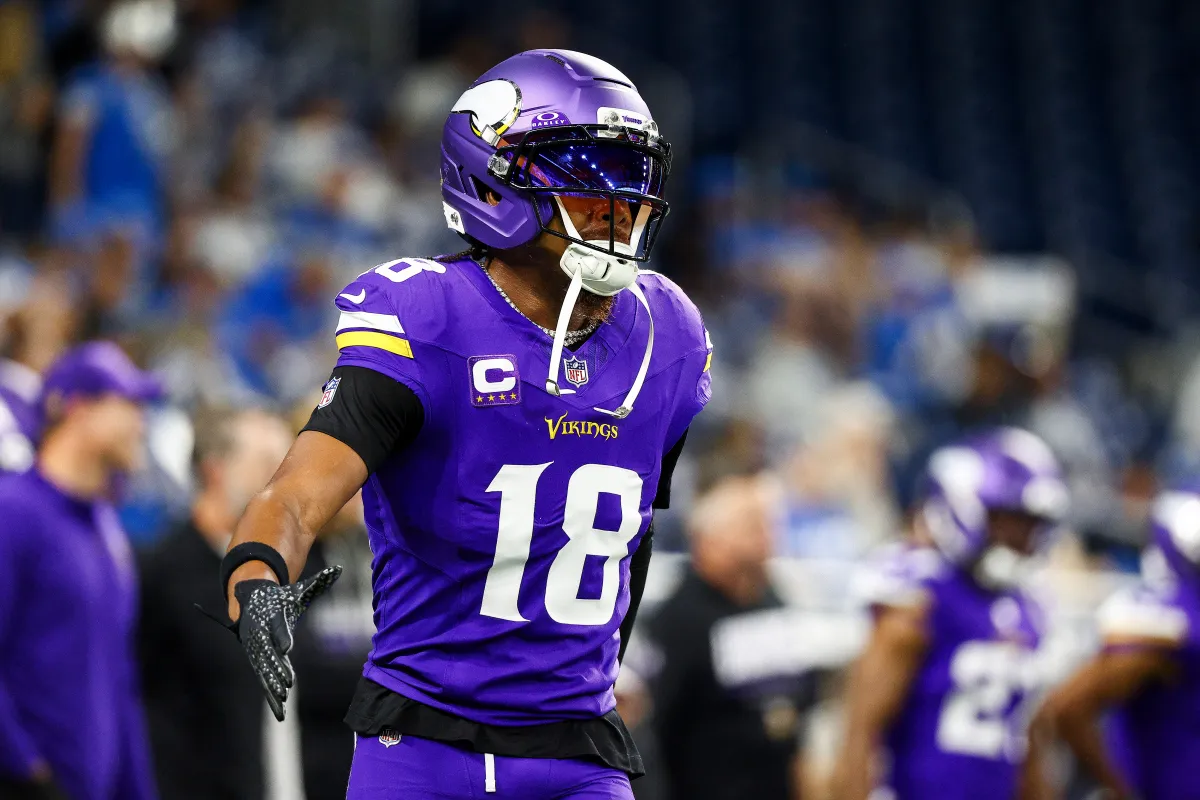
It wasn’t just another loss to Justin Jefferson. The final whistle had barely stopped ringing through Ford Field when the Minnesota Vikings’ superstar became the picture of everything that felt wrong about a 19-15 defeat to the Detroit Lions. Jefferson had found the end zone earlier in the day, but that brief moment of celebration didn’t last. When the game ended, he was left with five catches, 33 yards, and one touchdown on nine targets. For most receivers, that would be a decent afternoon. For Jefferson, a four-time All-Pro who makes the impossible seem ordinary, it felt like failure. The cameras found him on the sideline with his helmet off and his eyes fixed on the field, his face tight with frustration. He wasn’t trying to make a statement or create drama. He was feeling the weight of a close division game slipping away, and he couldn’t hide it. Jefferson entered this season with enormous expectations, and he had begun it with a performance against the Green Bay Packers that reminded everyone why he’s considered one of the most dangerous offensive weapons in football. But on Sunday, the game didn’t bend to him. The Lions made sure he never got loose, and Jefferson was left to watch the outcome from the sideline, carrying a loss that felt personal, heavy, and entirely unsatisfying.
What makes the numbers even more telling is what they mean in context. Before Sunday, Jefferson had already collected 23 receptions, 302 yards, and three touchdowns on the season. After the game, those numbers had grown to 28 catches, 335 yards, and four scores, but that doesn’t capture how far he was from the version of himself that often seems unstoppable. His best moment of the year came in the season opener, when the Vikings cruised past the Green Bay Packers 39-22, and Jefferson posted eight catches for 92 yards and two touchdowns. That day he looked like a player who could beat any defense by himself. Since then, however, he hasn’t posted a single 100-yard game. That would be abnormal for any top-tier receiver, but for Jefferson, it feels almost impossible. He isn’t losing his talent. He isn’t running worse routes. The problem is that defenses are building their entire weekly game plan around erasing him from the action. They’re playing with deep safeties, rolling coverage in his direction, bumping him at the line, and forcing the Vikings to beat them another way. On Sunday, the Vikings couldn’t do it consistently. Jefferson was targeted nine times and came away with only five catches, and most of those were short gains that required him to work for every inch. In a game that was decided by four points, the lack of big plays from their best player was impossible to ignore. He wasn’t asking to be force-fed the football on every down. He was asking for a real chance to be the difference between winning and losing, and that chance never really came.
The frustration that boiled over on the sideline didn’t disappear after the final whistle. In fact, it followed Jefferson into the locker room, where he made a choice that speaks volumes about how much he cared. He declined to speak to reporters. That might not seem like a big deal to casual fans, but in the NFL, it is. Under the league’s collective bargaining agreement, every healthy player must be available to the media after games unless they are in the concussion protocol. Players who skip that obligation can be fined, and the fine can be substantial. Jefferson knew the rule. He also knew that walking to the microphone while his heart was still racing, while his emotions were still raw, could lead to words he would regret. He could have said something about the game plan, the quarterback, the offensive line, or the way the receivers were being used. He could have let the frustration pour out in a way that would make headlines and damage chemistry. Instead, he chose silence. It was a human decision, not a diva decision. There are moments in every competitor’s life when the pain of losing is so sharp that it’s impossible to talk about it without breaking something. Jefferson protected himself and protected his team by staying quiet. He accepted the possibility of a fine because he valued the locker room and his own peace more than the obligation to produce polished clichés. It’s the kind of response that doesn’t fit neatly into a story about spoiled athletes. It’s the response of someone who takes winning so seriously that losing makes him feel hollow.
Kevin O’Connell, the Vikings’ head coach, understood that completely. In his postgame press conference, O’Connell didn’t scold Jefferson or call for more maturity. Instead, he shouldered part of the burden and made it clear that Jefferson’s fire is something to be embraced. “We had some opportunities for him, and there were some chances there,” O’Connell said, via ESPN. “But we’ve got to find a way to get him the ball, especially on potential chances for him on some of those sequences where we’re looking to kick off some momentum. He’s a great guy to do it behind, and we’ll continue to find ways to get him the football.” Then he added a line that should define how everyone sees this moment: “It was a division game. These guys want to win. I don’t fault the frustration or the competitiveness in any way, shape or form.” That is a coach protecting his star, but it’s also a coach being honest with himself. O’Connell knows that Jefferson isn’t the kind of player who can be reduced to a decoy. He is the engine of the offense, the player who changes the geometry of the entire field. Defenses may try to erase him, but the offense must keep searching for ways to put him in positions where he can win. The frustration isn’t a sign that Jefferson is difficult to manage. It’s a sign that he holds himself, his coaches, and his teammates to a championship standard. O’Connell seems to understand that a player who feels no disappointment after a close loss isn’t a player you want in the locker room.
The rest of the offense did show signs of life, but not enough to change the result. Jordan Addison led the Vikings in receiving with 66 yards on just three catches and eight targets, proving that there is another playmaker in the group. The quarterback, meanwhile, finished 17 of 29 for 210 yards, with two touchdowns and one interception. Those numbers reflect a passing game that was inconsistent, sometimes sharp, sometimes disjointed. In a game this close, every missed opportunity becomes enormous. One dropped pass, one poorly timed throw, one drive that stalled in the red zone, all of it contributed to a four-point loss. The Lions are a legitimate contender, and they know exactly how to punish a team when it is not at its best. They played physical, disciplined football, and they forced the Vikings to look somewhere other than Jefferson. For a defense, that’s a victory. But for an offense, it can’t be an endpoint. The Vikings need to take the next step by using Jefferson’s gravity against defenses. That means moving him around the formation, putting him in the slot, sending him on crossing routes, using quick screens, and taking deep risks even when coverage looks tight. They can’t let a defense feel comfortable because it has one player bracketed. They need to scheme ways to get Jefferson the ball in space and trust him to make defenders miss. He has done it before. He will do it again. The challenge is making sure those chances become more than just hopeful throws in coverage.
In the end, this story isn’t about a receiver complaining about his role. It’s about the real, human side of greatness. Jefferson is a player who refuses to accept losing, and that refusal sometimes looks messy. He didn’t speak to the media because he was still carrying the sting of the loss, and he knew that any words he said would not be able to capture exactly how much he cared. The potential fine from the NFL might have been worth the price of keeping his feelings honest and private. The Vikings will move forward. They have a coach who understands what makes Jefferson special, a supporting cast that can make plays when called upon, and a superstar who will not stop fighting until he and his team are back in the winner’s column. The 100-yard games will return. The highlight-reel catches will find their way back to Sunday afternoons. But the image of Jefferson on the sideline, face tight, eyes full of fire, refusing to fade into the background of a loss, is the moment that defines him best. It’s not weakness. It’s the competitive heart of a player who expects more from himself than anyone else can possibly demand. The Lions won the battle, but Justin Jefferson isn’t going to let that define him. He’s already thinking about the next chance, the next route, the next chance to prove exactly why he is one of the most feared players in football.