



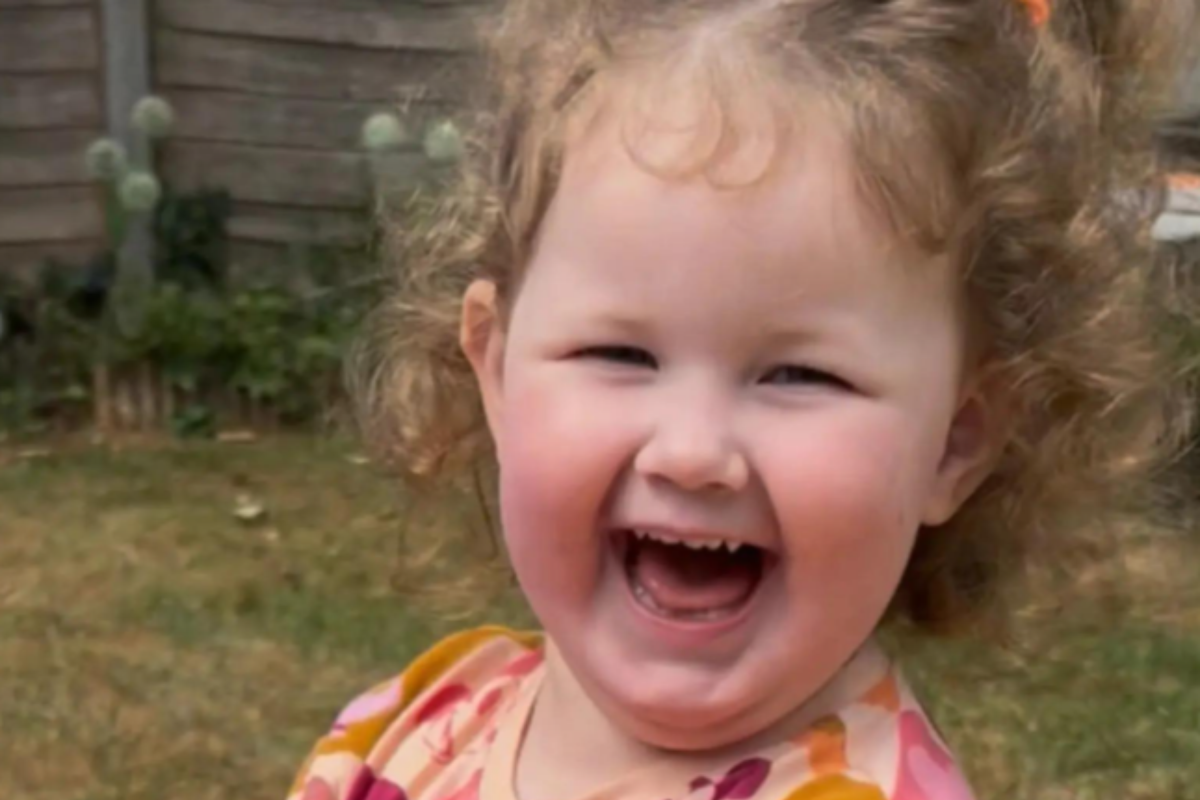
For months, everyone around Courtney Sherwood and Thomas Dunn tried to reassure them that their three-year-old daughter, Penelope, was simply battling one of those lingering childhood illnesses that seem to travel through nurseries and family gatherings every winter. But deep in her mother’s heart, something already felt wrong. Penny—as everyone called her—had always been bright, bubbly, and endlessly energetic, a little girl who filled a room with laughter and seemed to carry her own sunshine wherever she went. Around Christmas 2025, she came down with what looked like an ordinary cold, the kind that most children shake off in a week or two. But this one never really left. The coughing began to take over their nights. It was not just a small tickle or a brief cough before sleep; it was deep, relentless, and violent enough that Penny would end up vomiting. For a couple of months, she kept a sick bowl beside her bed, and Courtney and Thomas would listen helplessly through the walls as their little girl struggled through the dark hours, her small body exhausted by a cough that would not relent. They tried to comfort her, to rub her back, to whisper that everything would be okay, but the cough always won. The family’s life became a blur of sleepless nights, soiled sheets, and the quiet dread that something more than a cold was lurking beneath the symptoms. Penny, once so full of laughter, started fading in ways that were hard for even her parents to understand at first. But they knew their daughter, and they knew that this was not just a winter bug. It was a shadow that had moved into their home and was slowly growing longer.
As winter turned to spring and spring moved toward summer, Penny’s condition only became worse. Courtney took her to the doctor twice during May and June, once the vomiting had become more frequent and had begun to take a serious toll on her appetite. In just one month, the little girl lost three kilograms—a shocking amount for a child her age, a number that made Courtney’s stomach drop every time she thought about it. Still, the doctors initially believed Penny was suffering from a common childhood illness. When she developed a temperature, she was prescribed antibiotics, and when the cough stubbornly continued, she was given inhalers. The adults around her tried to fit her symptoms into familiar boxes: asthma, lingering infections, a weak chest. The doctors did checks, listened to her lungs, and said they could not hear anything wrong. Because the cough had gone on so long, they reasoned it was probably asthma, a manageable condition that would improve with the right medication. But Courtney knew her daughter. She knew that Penny was not just a little girl with a cough. She was a little girl who had stopped wanting to play, who would not eat even her favorite foods because she was scared of being sick afterward. That was the moment Courtney realized this was far more serious than any childhood illness. No happy, healthy three-year-old gives up the things she loves because she is terrified of what her own body will do to her. No cheerful child suddenly goes quiet and still without a reason. Courtney kept insisting that something was deeply wrong, but the answers did not come soon enough.
Just weeks later, Penny’s condition deteriorated dramatically, and the family’s worst fears came crashing down around them. On June 29, Penny went to nursery to take part in what would be her first sports day—a day that should have been filled with laughter, juice boxes, colorful medals, and proud parents snapping photos. She did manage to take part, but after completing just a single lap of the playground, she became breathless. Her little chest heaved, her face paled, and she could not catch her breath in a way that seemed normal after a simple run. Hours later, at home, Penny suffered two episodes that appeared seizure-like. Her parents rushed her to the hospital in absolute terror, their hearts pounding as they prayed that the doctors could help her. That same night, their little girl was placed on life support. Doctors delivered the kind of news no parent should ever have to hear: Penny had dilated cardiomyopathy, a disease that affects the heart muscle and makes it too weak to pump blood effectively. She was also diagnosed with monomorphic ventricular tachycardia, a potentially life-threatening abnormal heart rhythm that can cause the heart to beat out of control. A machine took over the work of her heart and lungs, oxygenating her blood and pushing it through her tiny body, because her own heart was no longer strong enough to do the job. Medical teams fought desperately to save her, working around the clock in a battle that felt like a terrible nightmare. But despite everything they tried, Penny’s body began shutting down. Only eight days after she was placed on life support, the family was told that she had suffered catastrophic brain damage, caused by a lack of oxygen. There was no coming back from that. Penny passed away in Courtney’s arms, surrounded by the love of the people who would never stop missing her.
In the weeks and months that followed, Courtney and Thomas were left with unimaginable grief and a heart-wrenching question: why? Why did their beautiful, vibrant little girl have a heart that was so sick? Why did she have to suffer through months of coughing and vomiting and fear, only to die in a hospital room with machines beeping around her? Courtney has been searching for answers, but the medical tests are so extensive and so complex that no clear explanation has emerged. The doctors told her that it was likely Penny had a spelling mistake in her DNA—a genetic error that meant her heart was always going to fail, no matter what anyone did. There was nothing they could have done differently, no preventative measure, no earlier diagnosis that would have changed the outcome. That knowledge is both a burden and a strange kind of mercy. Penny’s parents have tried to hold onto the one small comfort available to them: they are grateful that they did not wake up one morning to find Penny had passed away in her sleep from a cardiac arrest, unaware that anything was wrong. Instead, they were with her. They held her. They told her they loved her. They were there when she left, even though their hearts were breaking into a million pieces. Still, Courtney continues to seek answers, hoping that perhaps something can be learned from Penny’s story that might help another family, another child, another parent who feels in their gut that something is wrong and cannot get anyone to listen.
But amid the grief and the unanswered questions, Courtney wants people to remember Penny not for her illness or the way she died, but for the way she lived. Penny was what her mother calls “the life of the party.” She had a gift for making everyone around her smile, whether it was through something kind she did, something cheeky she said, or simply by being exactly who she was. She did not need toys or special occasions to bring joy; she could light up a room just by walking into it. Penny had recently become a big sister to baby Bobby, a role she loved with all her heart. She was endlessly curious about the world, always asking questions, always exploring, always wanting to know how things worked. She loved dinosaurs with a passion that made her parents smile. She could count to thirty, recite the days of the week, and name all the months of the year—little achievements that felt enormous to the people who loved her. She was not just a patient or a tragic story; she was a real little girl with a bright personality, a stubborn streak, and a contagious giggle that her family will carry with them forever.
Now Courtney finds herself missing the smallest, most ordinary things about her daughter. She misses Penny’s cheesy feet being pushed into her face—that silly, playful gesture that always made her laugh. She misses hearing Penny’s voice calling out “Mommy,” a word that now echoes in an empty house. She even misses the toddler tantrums, those loud, chaotic moments that once felt exhausting but now seem precious because they were so full of life. “She was my best friend, truly,” Courtney says, her words heavy with love and loss. “I miss her so, so deeply. I miss her putting her cheesy feet in my face, I miss her voice saying ‘mommy,’ I even miss the toddler tantrums. I just miss her so much.” There is no way to make sense of such a loss, no explanation that can fill the space left by a three-year-old who should have had a lifetime of birthdays, first days of school, and adventures still waiting for her. But in the midst of the sorrow, Penny’s family is determined to carry her memory forward. They want people to know her name, to see her face, to understand that behind the medical terminology and the heartbreaking headlines was a little girl who loved dinosaurs and counted to thirty and made everyone she met feel a little brighter. Penny’s life was short, but it was filled with love, laughter, and the kind of joy that does not disappear just because someone is gone. She will always be their best friend, their daughter, their Penny—and she will never be forgotten.