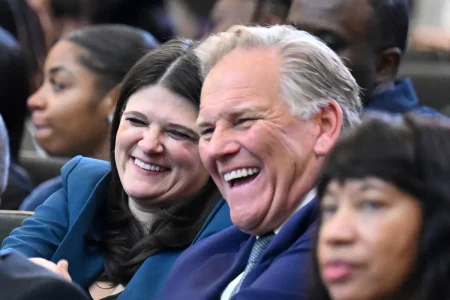



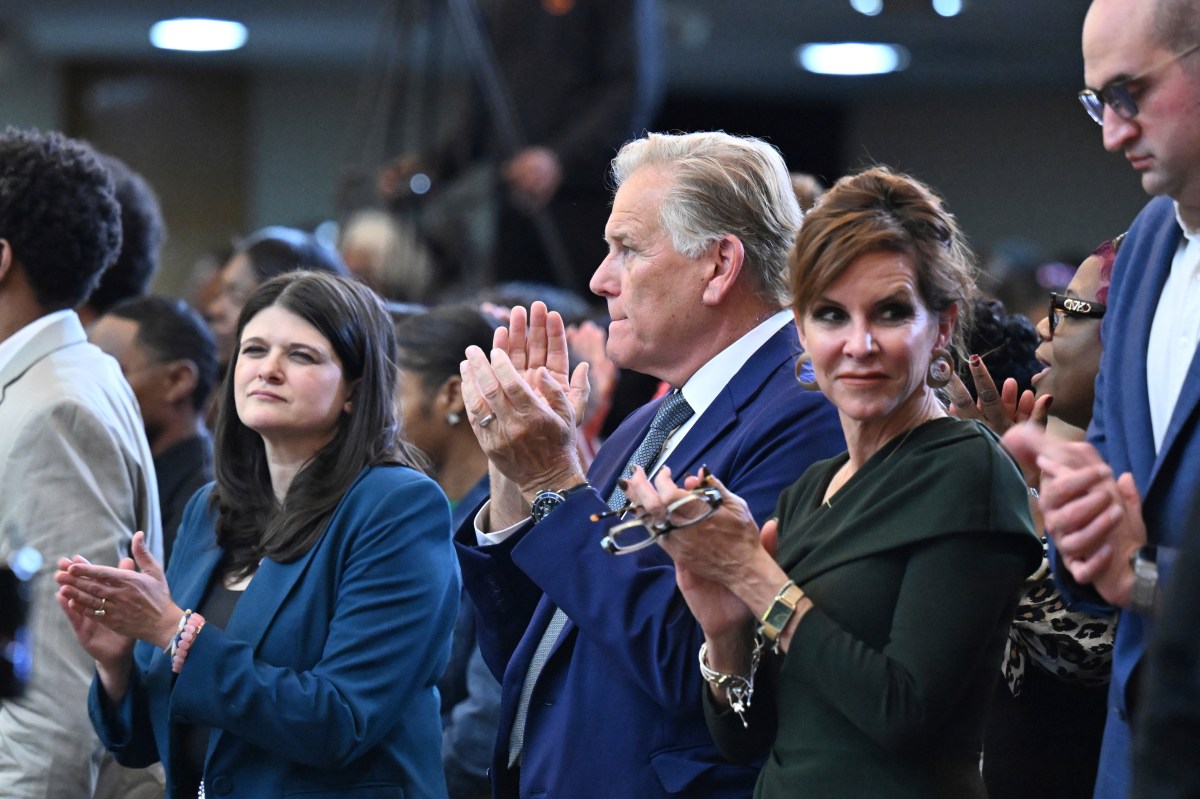
In the final stretch of one of Michigan’s most closely watched Senate races, something extraordinary happened: Representative Haley Stevens, a Democrat who had just lost her party’s primary, stood next to Republican Mike Rogers and endorsed him. The announcement came just two days before voters went to the polls, and it sent a shockwave through Michigan politics. Stevens had spent months campaigning for Abdul El-Sayed, the Democratic nominee, pledging to help him defeat Rogers after their bitter primary contest. She appeared at a unity breakfast with El-Sayed shortly after losing, promised to be a team player, and assured colleagues she would not switch sides. Yet on a Sunday morning in Detroit, at the Perfecting Church, she stood alongside the Republican, praised his leadership, and declared that her decision was personal and private. Within hours, Democrats across the country were using words like “betrayal,” “despicable,” and “horrific.” Friends and former aides were not just surprised—they were worried, and many pointed to one person they believed had played a central role in her dramatic reversal: her fiancé, Jason Turkish, a prominent disability rights lawyer with strong opinions about El-Sayed and a history of giving to both parties.
Jason Turkish is not a typical political spouse. At 39, he is the president and managing partner of Nyman Turkish, a litigation and disability rights law firm with about 150 employees and offices in California, Florida, and Michigan. Legally blind since birth, he graduated from the University of Michigan and earned a law degree from Northwestern University. He is best known for a landmark case that forced the Law School Admission Council to drop the LSAT’s logic games section, which had made the test nearly impossible for blind test-takers. He has served on Michigan’s Attorney Discipline Board, chaired the state’s Barrier Free Design Board, and co-founded a disability benefits advocacy group. He is Jewish, the son of a father born in Haifa, and the grandson of Holocaust refugees—a background that shapes his fierce views on Israel and antisemitism. He has donated generously to both Democrats and Republicans, including Senator Susan Collins of Maine, and more than $300,000 to Democratic causes. Stevens and Turkish met after the 2022 election through a mutual friend, David Kramer, who later became her Senate campaign chair. Their friendship turned romantic earlier in 2026, during the campaign. They announced their engagement in August, about three weeks after Stevens lost the primary, and planned to marry in May. Stevens, who divorced her husband Rob Gulley in 2022, told The New York Times she was considering converting to Judaism ahead of the wedding.
The relationship quickly became intertwined with the politics of a deeply divided Democratic primary. Stevens is a strong supporter of Israel; El-Sayed has described Israel’s military actions in Gaza as genocide and called for an end to U.S. aid. Millions of dollars in outside money poured into the race, including from groups tied to AIPAC that supported Stevens. Turkish made no secret of his feelings. Last week, he told The Detroit News he planned to vote for Rogers, despite being engaged to the Democratic congresswoman. He said El-Sayed’s rhetoric put Jewish people at risk, and told The New York Times he would feel “less safe on this planet” if El-Sayed won. Stevens initially pushed back, appearing on CNN to reaffirm her support for El-Sayed and urging his campaign to “shut out the hate and call it out.” But the tensions escalated quickly. On Friday, Stevens demanded that El-Sayed condemn an advertisement from an outside group, Rebellion PAC, which linked U.S. support for Israel to high grocery prices. El-Sayed’s campaign had already disavowed the ad, which the Anti-Defamation League called a case study in antisemitism. El-Sayed said he disagreed with its contents and accused Stevens of reopening a primary that had ended months earlier. By then, people close to Stevens were beginning to notice something troubling. Former Michigan Governor Jim Blanchard, a Democrat and friend of Stevens, said that during a dinner Friday night, Turkish criticized Stevens for endorsing El-Sayed, arguing that her supporters felt let down. “He was working her over,” Blanchard said. Blanchard later told her that Turkish was “not a good influence.” She replied that she was fine. But Blanchard could not shake the feeling that something had snapped.
On Sunday morning, any remaining doubts about Stevens’s loyalty vanished. She appeared with Rogers at Perfecting Church, and in a video announced that he was the right choice for Michigan. Her explanation was pointed: “Our Democratic nominee for Senate said I was no longer welcome in his campaign and that I should stay away. And he’s right.” El-Sayed had not said that publicly, but he had grown frustrated with her repeated criticisms and had said he wished she had stayed away from the events if she could not be a constructive supporter. Stevens insisted the endorsement was entirely her own. She told Politico that her conversation with Rogers had been brief and he made her no promises. On CNN, she told Anderson Cooper that she had “woken up clear-eyed, fresh and focused on what was in her heart,” and that she had spent the night alone with her thoughts. She said she was “rock solid” and an “independent woman.” But her friends were not convinced that the decision was made freely. Blanchard told Gongwer News Service that Stevens had discussed issuing a statement reaffirming support for El-Sayed at the Friday dinner and texted him later to confirm she would attend a unity service on Sunday. Maryland Congressman Jamie Raskin said he spoke with Stevens Saturday night for 25 minutes and that she assured him she would celebrate with Democrats on election night. “I’m dumbfounded by this turn of events,” Raskin said. “Something doesn’t compute about this whole sequence of events.” A friend told The Washington Post that Turkish had been “really working her over” to endorse Rogers. Jordan Acker, a University of Michigan regent who respects Turkish as a lawyer, wrote on X that he had become “deeply troubled” by Turkish’s behavior, citing “serious concerns about his treatment of Haley’s staff, friends, and allies.” Acker also claimed Turkish had taken Stevens’s phone away. Turkish denied it, saying she turned it off because of the volume of incoming calls. Politico reported that Stevens used Turkish’s phone to call them because hers had died. A former Stevens campaign aide accused Turkish of being “verbally abusive to staff” during the primary, without providing details.
The Democratic reaction was swift and brutal. Senate Majority Leader Chuck Schumer, who had supported Stevens in the primary, called her decision “a despicable betrayal.” Former House Speaker Nancy Pelosi called it “horrific.” Democratic National Committee Chairman Ken Martin said it betrayed the party’s values. The Michigan Democratic Party swept into action: Chairman Curtis Hertel declared Stevens “not a current member” of the party and had her photograph removed from its website. Her chief of staff of eight years, Justin German, said he and many other staff members had resigned and were “shocked and heartbroken.” CNN reported that half of her staff had left. Michigan Senator Gary Peters expressed extreme disappointment, and Senator Elissa Slotkin, who had received a donation from Turkish in 2024, said anyone making the election about themselves should ask whether they were serving the greater good. Former Pennsylvania Congresswoman Susan Wild said Stevens would become a pariah among her colleagues and that if she had abandoned her allies because of a new relationship, she was “no friend at all.” Michigan state Senator Mallory McMorrow, who also ran in the primary, suggested Turkish may have influenced the endorsement. Eight House Democrats privately told Politico they wanted Stevens removed from the caucus or punished. House rules bar members from campaigning for a non-Democratic candidate in a partisan federal election, though expulsion would require a two-thirds vote. A senior House Democrat told Axios the discussion should wait until after the election. Not everyone turned on her. Rabbi Aaron Starr of Congregation Shaarey Zedek expressed respect for her position. Pennsylvania Senator John Fetterman defended her in remarks to Jewish Insider. President Donald Trump invited her to join the Republican Party. Rogers called her a courageous leader. But the overwhelming sentiment among her former allies was anger and disbelief.
The political stakes were enormous. Most public polling showed El-Sayed ahead. The final New York Times/Siena College poll, conducted from October 23 to November 1, gave El-Sayed a 53 to 42 percent lead over Rogers. A CNN/SSRS poll showed him ahead 49 to 42 percent, and a WDIV/Detroit News poll had him leading 51.4 to 45.1 percent. The RealClearPolling average put El-Sayed ahead by 5.3 points. Prediction markets gave him a 78 percent chance of winning, and his campaign reported raising $2.4 million on the day Stevens announced her endorsement—its best fundraising day of the race. With more than 1.8 million Michigan voters already casting ballots before Election Day, the race could still be decided regardless of Stevens’s endorsement. But her switch threatened to redefine the closing days of the campaign and to deepen the divisions among Michigan Democrats that the primary had exposed. It also raised complicated questions about personal relationships, coercion, mental health, and political loyalty. Stevens has said she remains a Democrat, and she did not respond to Newsweek’s request for comment. She leaves Congress in January, having served as chief of staff to President Obama’s auto task force before winning a Republican-held House seat in 2018. In the wake of her endorsement, she has not said what she plans to do next. Her friends say they still hope she will find her way back, or at least explain what truly happened in those final twenty-four hours. For now, the image that lingers is of a once-promising Democrat standing with a Republican, while the people who believed in her wonder aloud how a close friend and fiancé could have changed everything—and whether the woman making that announcement was the same person they once knew.