



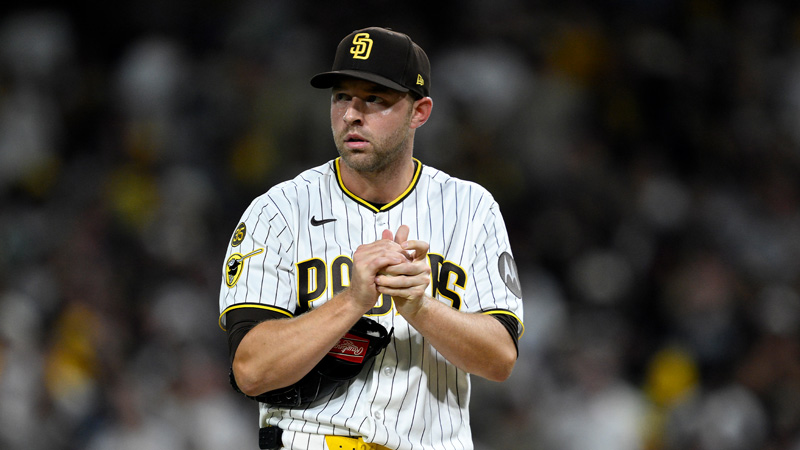
Michael King isn’t a name that’s been on everyone’s lips for the last few offseasons the way some superstar aces have been, but maybe he should be. In a baseball world where the best pitchers command nine-figure deals and teams are terrified of committing a third of a billion dollars to one arm, King represents something increasingly rare: a legitimate, top-of-the-rotation starter who might actually be worth every penny without breaking the bank. The San Diego Padres right-hander just made himself available by opting out of the final two years of his deal, and suddenly the free-agent market has a 31-year-old ace who has been quietly dominant since getting a real chance to start. He’s not Tarik Skubal, the kind of generational talent who might command $300 or $400 million, but he might be the smarter play for a team that needs an ace and doesn’t have unlimited resources. King has the stuff, the track record, and the postseason poise to change a franchise’s trajectory, and he does it without the overwhelming pressure that comes with being the highest-paid pitcher in baseball. For teams that are close, teams that are desperate, and teams that are looking for a veteran anchor, King is the kind of signing that can shift the balance of an entire division. He doesn’t need to be the most famous arm in the sport; he just needs to take the ball every fifth day and give his club a chance to win, and that’s exactly what he’s done since becoming a full-time starter with the Padres in 2024.
The Athletics are the first team that comes to mind, and honestly, it’s hard to blame anyone for looking at them and thinking they need King more than almost anyone. Their starting rotation has been a disaster for years, and last season was one of the worst in recent memory. They finished with a 5.61 ERA from their starters, 29th in baseball, and they were dead last in innings pitched from the rotation, which meant the bullpen was constantly taxed and the team was always chasing games from the very first inning. They gave up the most home runs in the league, 150, and they walked more batters than all but three other teams. If there was a silver lining, it was J.T. Ginn, who quietly posted a 3.71 ERA and 3.4 wins above replacement, but one promising arm doesn’t fix a rotation that needs an entire overhaul. The A’s have built something interesting on the position-player side, with Tyler Soderstrom, Nick Kurtz, Shea Langeliers, and Jacob Wilson forming a young core that can hit. They were fifth in hits, seventh in home runs, and eighth in OPS in 2025, and while their bats took a step back last season, the talent is clearly there. The problem is that the pitching has been so bad that it doesn’t matter how many runs the lineup scores. Signing King would change that overnight. He’s a guy who pitches deep into games, avoids the big inning, and gives his team a chance every single time out. In 2026, he posted a 3.21 ERA with a 127 ERA+ and 4.3 wins above replacement over 185 innings, and he did it while striking out hitters at an elite rate. The A’s don’t need five King clones; they just need someone to lead the way, and he would instantly become the most important pitcher in the organization. The AL West is not a juggernaut, and the Astros won the division at just 81-81 last season. With even league-average starting pitching, the A’s could make a run at the division, and King would be a massive step in that direction. The only reason they aren’t the No. 1 fit is that there are teams closer to actually winning a championship, but if the A’s are serious about competing, this is the move.
The Houston Astros are another fascinating fit, and maybe the most intriguing one because of what King would bring to a club that’s been running on fumes for years. Houston has been baseball’s most consistent contender for a decade, but the mystique is fading, and their rotation is no longer the terrifying force it once was. Last season, their starters walked more batters than any team in the sport, 378, and they finished 27th in ERA and 28th in WHIP. Hunter Brown looked like an All-Star again, and Peter Lambert was respectable, but the rest of the rotation was a mess. Tatsuya Imai struggled in his first taste of American baseball, Mike Burrows couldn’t find consistency, Cristian Javier keeps dealing with elbow and shoulder problems, and Hayden Wesneski can’t seem to stay healthy either. The offense, meanwhile, was explosive, leading all of baseball with 226 home runs, but great lineups don’t mean anything in October if the starting pitching can’t keep games close. King would give the Astros exactly what they need: a proven, durable, high-strikeout starter who has already shown he can pitch in the most intense moments. In the 2026 playoffs, he was spectacular for the Padres, allowing just one run over 14 innings, including a memorable relief appearance in a do-or-die game against the Brewers where he got the final six outs and kept San Diego alive. Over his postseason career, he has a 1.86 ERA and a 0.76 WHIP in 29 innings, which is the kind of sample size that makes executives comfortable giving a pitcher a big contract. The Astros have been known for finding magic in unexpected places, but they’re at a point where they need a real, reliable ace to lead a rotation that has more questions than answers. The AL is wide open, with only the Rays and Yankees winning 90-plus games last season, so adding King could be the difference between another early exit and a deep October run. Houston is close enough that King would fit perfectly, but they’re not the team that needs him most, because there’s a club in Chicago that is arguably one starting pitcher away from becoming the class of its division.
That team is the Chicago White Sox, and they might be the best fit of all for King, both in terms of need and opportunity. The White Sox are clearly on the rise. They have a young, powerful offense that was fifth in runs scored and fifth in home runs last season, with Miguel Vargas, Muntaka Murakami, and Chase Meidroth forming a dynamic core. They have two young starters in Sean Burke and Davis Martin who look like long-term building blocks, with Burke posting a 3.34 ERA and 4.2 wins above replacement in 2026 and Martin showing real promise with a 3.95 ERA in 28 starts. But beyond those two, the rotation is thin, and the lack of starting depth nearly cost them in the playoffs. Their starters ranked 26th in ERA and 24th in WHIP, and they were last in the majors in innings pitched from the rotation, which meant manager Will Venable had to rely on openers and bullpen games far too often. In the postseason, the White Sox starters and openers combined to throw just 17 ⅔ innings across seven games, which is almost impossibly low and a huge reason why they couldn’t finish off the Guardians in the AL Division Series. Chicago jumped out to a 2-0 lead in Cleveland, only to lose three straight games, with Cleveland scoring nine runs in both Game 3 and Game 4. It’s impossible to know if King would have changed the outcome, but it’s fair to say that a proven ace who can go six or seven innings would have given the White Sox a much better chance. King would step into Chicago’s rotation as the undisputed ace, the veteran leader that a young, hungry team desperately needs. He’s not just a guy who throws hard; he’s a smart pitcher who mixes a sinker, changeup, four-seamer, and sweeper, and he knows how to navigate a lineup three times through the order. That kind of presence can’t be measured in traditional stats alone. It’s the calm he brings to a clubhouse, the confidence he gives a defense, and the innings he saves for a bullpen that was overworked last season. The AL Central is there for the taking, and with King in the fold, the White Sox would arguably become the best team in the division.
What makes King such an ideal fit for the White Sox, and why they edge out the Astros and Athletics, is the combination of his age, his style, and the stage of their rebuild. The A’s are still a year or two away from being true contenders, and while they have a nice young core, they need more than just one pitcher to fix a rotation that was historically bad. The Astros are closer to contention, but they’re also a team with a lot of established veterans and a culture that has already been through the wars; King would help them, but he wouldn’t transform them in the same way. The White Sox, though, are a team on the cusp, with a lineup that can score runs, a couple of promising young starters, and a bitter playoff loss still fresh in their minds. They don’t need a total overhaul; they need a few proven pieces to push them over the top, and starting pitching is the most glaring weakness. Adding King would send a message to the rest of the league that Chicago is serious about winning now, not just in two or three years. It would give the fan base a reason to believe, and it would give the young players in that clubhouse a veteran who has been through the grind of a long season and knows what it takes to win in October. There’s also something poetic about King landing with the White Sox, a franchise that has been searching for an ace since the days of Mark Buehrle, and a team that just watched its postseason dreams die because it didn’t have enough pitching depth. King isn’t just a rental or a stopgap; he’s a guy in his prime who can anchor a rotation for the next several years. He’s not going to cost $400 million like Skubal might, but he’s going to be paid like a top-tier starter, and he’s earned that. For a team like Chicago, which has the financial flexibility and the competitive window opening, spending that kind of money on King is exactly the kind of bold move that can change a franchise’s trajectory.
In the end, Michael King’s free agency is a story about timing, opportunity, and the quiet value of a pitcher who doesn’t need to be the loudest name in the room to be the most important one. He came to San Diego as a piece of a bigger trade, proved he could handle the workload of a full-time starter, and then showed the baseball world that he can be just as dominant in October as he is in June. Now he gets to choose where he wants to write the next chapter of his career, and the teams lining up for his services all have their own reasons for wanting him. The Athletics need him to save a rotation that’s been a laughingstock. The Astros need him to reignite a dynasty that’s flickering. But the White Sox need him the most, because they have the pieces, the hunger, and the window to do something special, and he could be the missing piece that turns a promising young team into a true contender. Baseball has a way of rewarding players who bet on themselves, and King did exactly that by opting out and betting that his performance would speak louder than his reputation. It did. He’s not the biggest star on the market, and he won’t get the biggest contract, but for the right team, he might be the best signing of the winter. It’s the kind of move that doesn’t always make the biggest headlines, but it’s the kind of move that wins championships. Michael King is an ace, and sooner rather than later, he’s going to prove it in a new uniform, and the team that gets him will be very glad they didn’t spend an extra hundred million dollars just to say they signed a bigger name. Sometimes the best answer isn’t the most obvious one, and for a team looking for an ace without blowing up the payroll, King is exactly that answer.