

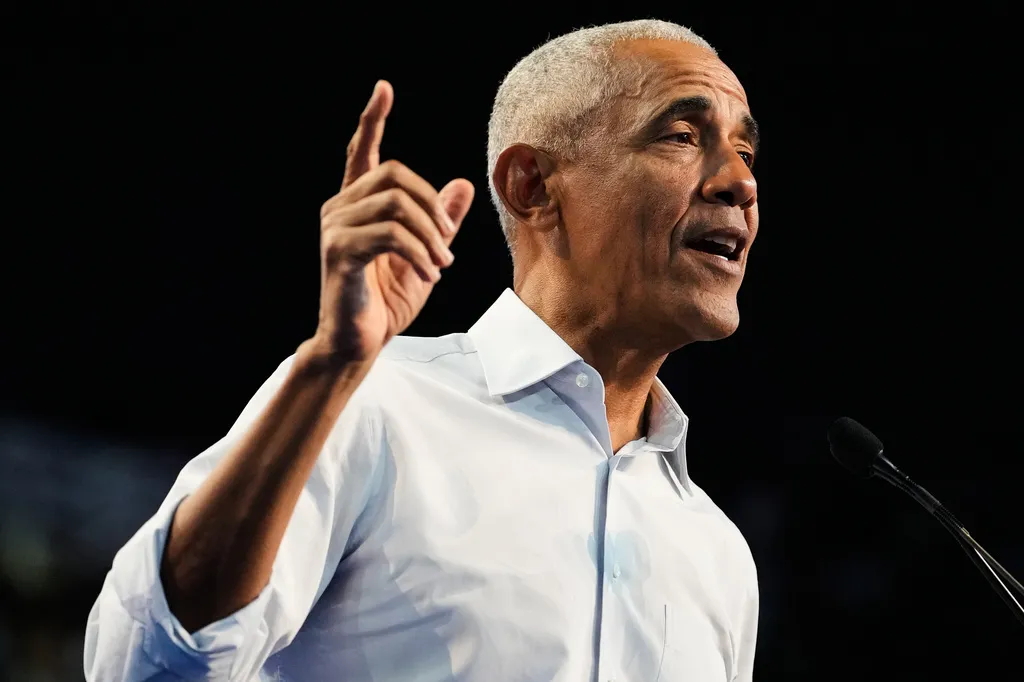
Imagine the leader of the free world sitting in the Oval Office, tube of superglue in hand, carefully pressing gold medallions onto the mantelpiece. That was the absurd image Barack Obama conjured on Wednesday as he campaigned in Morrow, Georgia, in the final frantic days before the midterm elections. Speaking at a rally for Democrat Jon Ossoff, who is fighting to keep his U.S. Senate seat, and gubernatorial candidate Keisha Lance Bottoms, Obama turned his attention to Donald Trump and his administration’s priorities. With war raging and prices climbing at the grocery store and the pump, Obama argued, the man occupying the Oval Office was busy decorating. “I’m not making this up, the president of the United States is spending time supergluing gold medallions to the mantel in the Oval Office,” Obama told the crowd, his voice carrying that familiar mix of disbelief and dry amusement. “He’s literally doing arts and crafts while we are fighting a war and trying to deal with out-of-control prices.” It was a classic Obama moment: mocking, but also deadly serious underneath the humor. He didn’t just want to make people laugh. He wanted them to feel the absurd mismatch between what a president should be doing and what Trump is actually doing. “The administration’s own actions are directly responsible for rising costs,” Obama said. “The current president chose to make a series of bad decisions, the most important of which was to start an unnecessary war that nobody asked for and nobody voted for.” For the crowd in Georgia, it was a reminder that the race wasn’t just about local politics—it was about the direction of the entire country.
Obama didn’t stop at the arts-and-crafts jab. He returned, with obvious relish, to a feud that had already consumed days of news coverage: the Cheesecake Factory. The whole thing started over the weekend when Obama, speaking at a rally in Ohio, said Trump had made the White House look “like Saddam Hussein opened a Cheesecake Factory.” It was a one-liner meant to poke fun at the gaudy renovations and gold-heavy décor Trump has installed in the people’s house. But instead of laughing it off, Trump and his team exploded. The president defended his renovations angrily, and Treasury Secretary Scott Bessent actually went to a Cheesecake Factory in Washington, D.C., to try to turn the joke back on Obama. To Obama, that reaction was not just silly—it was symptomatic of everything wrong with the administration. He stepped back onstage in Georgia and addressed the controversy directly, with the tone of someone setting the record straight rather than picking a fight. “Let me get this on the record. I am the father of two daughters,” he said. “Do you think I could have survived their childhood without going to the Cheesecake Factory? That was my jam.” The audience laughed, but Obama’s next point cut deeper. The administration, he noted, had not really disputed his criticism about prices or his accusations of corruption. They had instead latched onto his restaurant remark as a distraction. “The president wasn’t even mad about the Saddam Hussein comparison. That part didn’t bother him,” Obama said. “But he was very upset about the Cheesecake Factory comments. He took great umbrage.” Then came the punchline that summed up his whole argument: “They mobilized a whole-of-government response to that joke. Not to inflation, but to that joke.” In Obama’s telling, the Cheesecake Factory incident was not a funny footnote. It was proof that the people running the country had their priorities dangerously twisted.
What made Obama’s speech so effective was his ability to use humor as a scalpel. He wasn’t just making fun of Trump; he was making a broader point about seriousness and competence. Take the Bessent incident. Obama singled out the Treasury secretary for making a public appearance outside the restaurant, apparently to mock Obama in response to the joke. But the Treasury Department is supposed to be worried about the economy, inflation, and the financial stability of the nation. Instead, its leader was out posing for cameras in front of a chain restaurant. Obama contrasted that with his own experience handling the financial crisis when he took office in 2009. He described the kind of urgent, serious work that went into preventing an economic collapse. And then he made up a ridiculous imaginary scene: “I inherited this major financial crisis. I never called my Treasury secretary and said, ‘You’ve got to go to Arby’s. Order roast beef. No cheese though, that may look elitist.’” The joke landed perfectly, but the meaning behind it was clear. There is a difference between governing and performing, between solving problems and generating content for the news cycle. “This is what I mean when I say these are not serious people,” Obama said. “They don’t have solutions to actual problems, so they’d rather have the media and you talking about the Cheesecake Factory.” For Obama, this is the core of the critique: when you don’t have real answers, you create noise. When you can’t defend your policies, you change the subject. And when the country faces real crises—war, inflation, threats to democracy—you distract with shiny objects. He wanted the voters in Georgia to see through that distraction, to look past the headlines and the controversies and recognize what was missing: serious leadership.
From there, Obama moved from domestic absurdity to the high-stakes world of foreign policy, where his criticism became even sharper. He argued that the Trump administration had abandoned diplomacy and recklessly stumbled into a war with Iran that Americans did not ask for and did not choose. Obama reminded the crowd of his own approach to Iran’s nuclear program when he was president, a period that now feels like a distant, more orderly era. “We had curbed their nuclear program,” he said. “I had put in place a deal. I didn’t have to fire any missiles. I engaged in diplomacy.” He wasn’t just defending his legacy; he was drawing a stark contrast between a president who used every tool short of war to keep the country safe and one who seemed eager to escalate conflicts. Then Obama turned his attention to Russia and Ukraine, accusing the White House of betraying democratic allies on the world stage. “The White House is bending the knee to Vladimir Putin of Russia,” Obama said, “and selling out Ukrainians who are fighting for their freedom and democracy.” It was a bracing charge, made even more powerful by Obama’s understated delivery. He wasn’t shouting. He was making an argument. And he insisted that the economic pain Americans are feeling is not inevitable—it is the direct result of the administration’s choices. He cast himself as a “fact guy” and invited the audience to “play back the tape” of Trump’s promises before he returned to the White House. Trump had promised to get costs under control, to fix tariffs, to avoid foreign wars, to deliver better healthcare. But look at the results. “If you thought everything cost too much before, guess what? Everything is more expensive now.” It was a simple, devastating summary: the promises were broken, the prices went up, and ordinary people are paying the price for decisions made by people who seem to live in a different reality.
Underlying all of this was the immediate political stakes. Georgia has become the center of the political universe, and Obama knew that the crowd in Morrow was full of voters who were exhausted, anxious, and looking for a reason to believe that their votes would matter. He was there to give them that reason, to remind them that Ossoff and Bottoms were not just names on a ballot but real people trying to represent them. He also took the opportunity to make the contest about character and values, and to sharpen his attack on Trump personally. Obama accused the president of using the office not for the public good but for private enrichment. “He is very much focused on enriching himself and his family,” Obama said. “That’s what dictators in other countries do. But that’s not what we do.” The reference to dictators was intentional, a reminder of how far the norms of democracy have been stretched. For Obama, who spent eight years being criticized for everything from his golf game to the color of his suit, this moment required some reflection on how the standards have changed. He recalled the controversy over his tan suit, a moment that once seemed like the height of national outrage. “I am old enough to remember when a president wearing a tan suit was a major national controversy,” he said. “They were very upset.” But unlike the Cheesecake Factory wars, Obama said he didn’t need a whole-of-government response. He was comfortable in his own skin, and, as he put it with a smile, “I know I looked good in that suit.” It was a small moment of levity, but it carried a message: there was a time when the biggest political scandal was a wardrobe choice, and that time was healthier, saner, and more serious than the chaos of today.
Ultimately, Obama’s speech was more than a string of zingers aimed at the president. It was a plea to voters to see the bigger picture, to think about what kind of country they want to live in, and to recognize that elections have consequences. He used humor to lower defenses, but he wanted to raise the stakes. The war, the prices, the corruption, the obsession with silly distractions—these were not separate threads. They are woven together into a pattern of governance that is unserious, self-serving, and dangerous. Obama’s words in Georgia were also an appeal to memory and hope, a reminder that government can be a force for good when led by people who actually care about governing. He didn’t just ask the crowd to reject Trump and the Republicans. He asked them to demand more, to expect more, to show up and vote as if their lives depend on it—because, in so many ways, they do. He wanted voters to understand that the fight was not just between two parties but between two very different ideas of what America should be: one grounded in truth and responsibility, and one built on spectacle and self-interest. As the rally wound down and the crowd headed home, Obama’s final point lingered in the air: the choice is theirs. The power is in their hands. And the time for jokes is over when the future of democracy is on the ballot.