


Paragraph 1
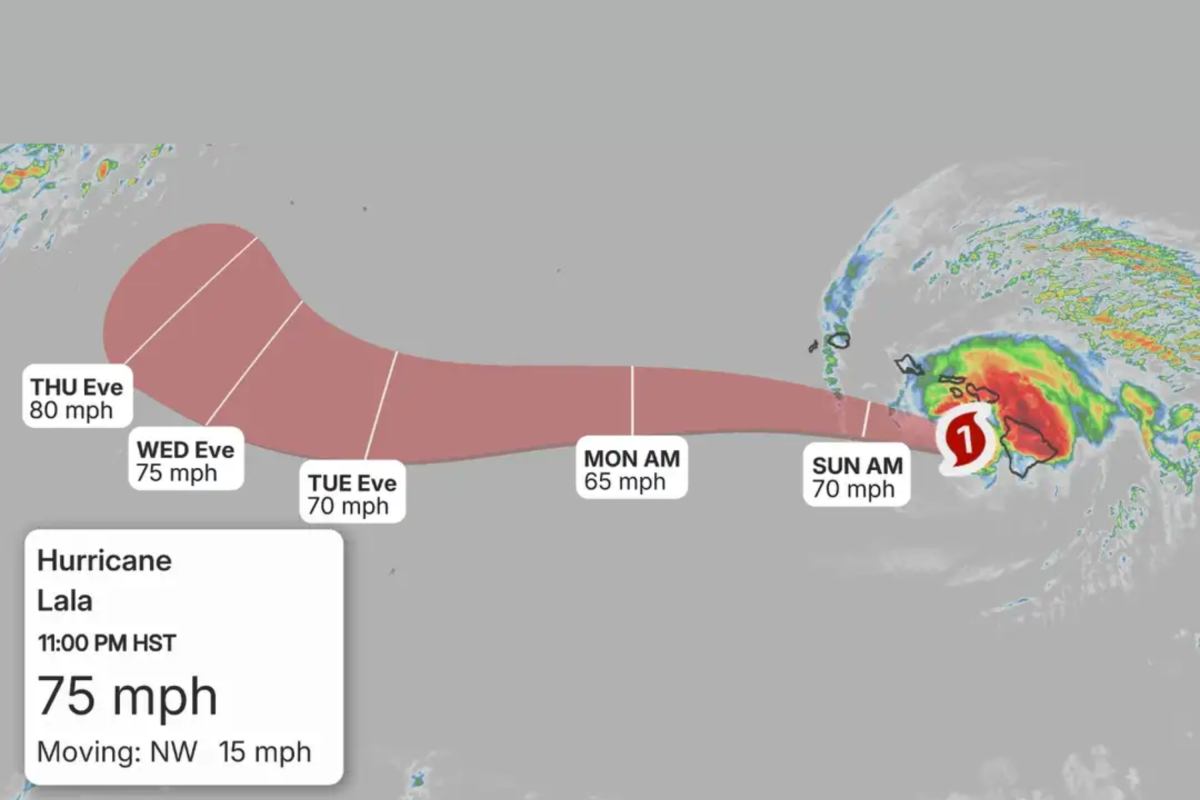
When Hurricane Lala arrived over the weekend, it did not announce itself softly. It came with a roar of wind, sheets of rain, and a sense of urgency that sent families scrambling for supplies, boarding up windows, and checking on neighbors. For millions across Hawaii, the storm was not just another weather alert; it was a frightening and personal reminder of how quickly life can be interrupted by nature. Forecasters had been tracking Lala for days, and by Saturday the storm had officially strengthened into a hurricane, packing maximum sustained winds of 75 miles per hour as it moved near Hawaii Island. Although that made it a Category 1 on the Saffir-Simpson scale, the dangers did not come from wind speed alone. The National Hurricane Center warned of life-threatening flooding, catastrophic rainfall, landslides, and dangerously high surf across multiple islands. Lala’s forward track was expected to carry it westward across the island chain, affecting Maui County, Oahu, and Kauai in succession. For residents, that meant the anxious waiting was far from over. The rainfall forecasts were staggering: ten to twenty inches across parts of the Big Island, with isolated totals reaching twenty-five inches, while eastern Maui could see eight to twelve inches. Those numbers are hard to grasp until water begins rising over roadways and streaming down hillsides. In mountainous terrain, the ground simply cannot absorb that much water at once, and forecasters knew the consequences could be devastating. As the storm moved west-northwest, weather trackers continued to monitor its every shift, while families across the state braced for another night of howling winds and pounding rain. There was no escaping the tension in the air—both the meteorological kind and the emotional kind. This was not a storm to take lightly, and officials made that clear from the beginning.
Paragraph 2
The physical toll of Hurricane Lala became visible quickly, especially along Hawaii Island’s Hamakua Coast. There, strong winds toppled trees onto power infrastructure, snapping utility poles and damaging a forty-two-mile stretch of transmission lines. In some communities, the sound of cracking branches and groaning transformers filled the night as gusts approached ninety miles per hour. Even more striking were the readings from the summit of Mauna Kea, where forecasters recorded a maximum wind speed of up to 154 miles per hour—a reminder that in Hawaii’s high elevation, the storm’s fury was even more extreme. For everyday residents, the damage meant more than broken poles and scattered debris; it meant roads closed, lights out, and isolation. Transportation across the islands was severely disrupted. The Hawaii Department of Transportation closed Hilo International Airport and temporarily shut commercial ports on Hawaii Island, Maui County, and Kauai as conditions deteriorated. Flooding turned familiar streets into fast-moving rivers. Downed trees made some neighborhoods completely impassable. On Hawaii Island, districts that are usually defined by their lush beauty and tight-knit communities—Hilo, Puna, Hamakua, and Ka’u—were suddenly cut off from one another. People could not get to work, to the grocery store, or, in some cases, to check on loved ones. The wind did not care about schedules or plans. It tore through the landscape with a kind of indifferent power, leaving behind a trail of broken branches, shattered windows, and twisted metal. For residents, watching the storm unfold felt like standing at the edge of something wild and uncontrollable. In the middle of it all, families huddled together, listening to the storm rage outside, wondering whether their roofs would hold and whether the flooding would reach their doors. The human cost of such a storm is not measured only in damaged infrastructure, but in sleepless nights and the quiet fear that comes when nature reminds us how small we truly are.
Paragraph 3
As the rain continued to fall without pause, emergency shelters opened across the affected islands, offering a safe place for those who had evacuated or simply needed to get out of the storm’s path. Local officials urged residents to stay off the roads, avoid floodwaters, and never touch downed power lines—advice that was repeated again and again through emergency alerts. But even with those warnings, the force of the flooding proved overwhelming in some areas. Hawaii County officials reported multiple rescues of people trapped in stranded vehicles as water rose faster than anyone expected. In the Kaʻū District, torrential rainfall destroyed two homes in Naalehu, leaving families displaced and stunned by how quickly everything changed. Tragically, authorities also confirmed at least one storm-related death after a car crash near South Point on Hawaii Island. That loss was a painful reminder that no amount of preparation can eliminate the risks of such a powerful storm. Governor Josh Green responded with a message of resolve and reassurance, acknowledging the storm’s impact while emphasizing that state agencies had mobilized personnel and resources across Hawaii. “Hurricane Lala is now impacting our state, and the safety of our people remains our highest priority,” he said in a statement. “National Guard, law enforcement, transportation, health and emergency personnel are working around the clock, with resources positioned statewide to support our communities.” Those words were intended to comfort, but for many residents they were also a call to action—to stay inside, to look after one another, and to trust that help was on the way. The storm brought out both the best and the hardest parts of island life: a deep sense of community, yes, but also the painful recognition of vulnerability. Neighbors checked on elderly residents who lived alone, while volunteers helped clear debris from driveways and bus stops. In the midst of the chaos, small moments of kindness flickered like candlelight in the dark. Still, the emotional weight was heavy. Watching homes fill with water, seeing roads disappear beneath muddy currents, and learning that a life had been lost—all of it left a mark on the entire community. The road to recovery would not be simple or quick, but for now, the immediate priority was simple: survive the storm and keep each other safe.
Paragraph 4
Behind the scenes, the Hawaiian Electric Company, known as HECO, was facing one of the most challenging moments in its recent history. Hurricane-force winds had damaged transmission and distribution infrastructure across its five-island service territory, causing widespread outages and plunging large swaths of the state into darkness. By Saturday evening, more than 88,000 customers were without power, a number that felt staggering even for a community accustomed to storm-related disruptions. The outages were distributed across the state: approximately 63,270 customers on Hawaii Island, 15,260 in Maui County, and 9,500 on Oahu. For those numbers to make any sense, it helps to think about what losing electricity really means in everyday life. It means the refrigerator stops humming, the lights go out, and the phone battery slowly drains. It means grandparents cannot run their oxygen machines without a generator, parents cannot keep babies comfortable, and families cannot cook the food they bought in preparation. The hardest-hit areas included the east and south sides of Hawaii Island, along with Waimea and Honokaa. In Maui County, all of West Maui and parts of Upcountry and South Maui lost power. On Oahu, neighborhoods including Aina Haina, Kaimuki, Kalihi, Mapunapuna, Manoa, and Nuuanu were plunged into blackout conditions. In those communities, the absence of electricity was more than an inconvenience; it was a constant reminder of how far the storm’s reach extended. People sat in the dark, listening to battery-powered radios and checking flashlights, uncertain when normalcy would return. Businesses closed early, schools canceled sessions, and the hum of generators became the background music of neighborhoods struggling to stay functional. For many, the hardest part was the uncertainty. No one could say with confidence when the lights would come back on, and every hour without power seemed to stretch longer than the last. The storm had not only taken their electricity; it had taken away a sense of security and control.
Paragraph 5
Restoring power was never going to be quick, and HECO made clear that the weather itself was standing in the way. In a press release, the utility explained that restoration work had to halt whenever conditions became too dangerous for crews. On Hawaii Island, hazardous road conditions such as flooding and downed trees prompted the Hawaii County Civil Defense Agency to ask crews to stay off the roads entirely. For utility workers, this was an agonizing situation; they knew that thousands of families were waiting for their help, but they also understood that rushing into dangerous conditions could put their own lives at risk. On Maui, officials warned customers to prepare for prolonged overnight outages because severe winds prevented damage assessments from beginning on key transmission lines serving West Maui. Meanwhile, on Hawaii Island, repairs would take additional time because crews first needed to inspect that forty-two-mile transmission corridor badly damaged by fallen trees and collapsed structures. The irony was not lost on residents: the same winds that knocked out the power were also preventing crews from fixing it. Despite those challenges, HECO reported that more than 67,100 customers had already been restored by Saturday evening, a testament to the dedication of teams working around the clock. The utility also said that mutual-aid crews from outside Hawaii were expected to join the restoration effort once storm conditions improved, bringing in extra hands, equipment, and experience from other states. Still, the company could not offer a statewide estimate for full restoration. So much depended on the weather, the extent of damage, and whether crews could safely access affected areas. For families still sitting in the dark, that uncertainty was difficult to accept. They appreciated the efforts, but they also wanted answers. When would their children have light to do homework by? When would the refrigerator be safe to open? When could they stop worrying about how long the food would last? The lack of concrete answers made the waiting even harder. Yet there was also a quiet understanding that safety mattered more than speed, and that the men and women working to restore power were doing everything they could under extraordinarily difficult circumstances.
Paragraph 6
As Hurricane Lala continued its westward track, emergency managers urged residents across the Hawaiian Islands to remain sheltered, monitor official forecasts, and prepare for additional flooding, high surf, and power disruptions through the weekend. The storm was not finished yet, and the message from officials was clear: do not let your guard down. Even as the wind began to ease in some areas, the threat of flash flooding and landslides remained, especially in saturated mountain valleys where the ground had already absorbed days of rain. High surf continued to crash against shorelines, making beaches dangerous and roads near the coast unpredictable. For many residents, the coming days would be marked by cleanup, repairs, and the slow process of assessing what had been lost. But there was also a sense of resilience that seemed to grow stronger with every tree that fell and every road that flooded. Hawaii is no stranger to storms, and the people who live there have learned to adapt, to support one another, and to rebuild. In shelters, strangers became friends, sharing food, water, and stories. In neighborhoods, people with chainsaws cleared driveways for elderly neighbors. In utility offices and emergency command centers, exhausted workers pushed through fatigue to help bring the islands back to life. The storm had tested them, but it had not broken them. It would take time to restore power to every home, to repair every road, and to heal every scar left by the floodwaters. But the sun always returns after the rain, and with it comes the stubborn hope that communities hold onto in the most difficult moments. For now, families stayed inside, listened to the wind, and waited for the sky to clear. They kept their phones charged, their flashlights nearby, and their hearts open to the kindness of neighbors. Hurricane Lala had brought destruction and loss, but it had also revealed the strength of a community determined to face the storm together. In the end, that strength would be the quiet, steady force that carried Hawaii through the darkest hours and into the long work of recovery.