

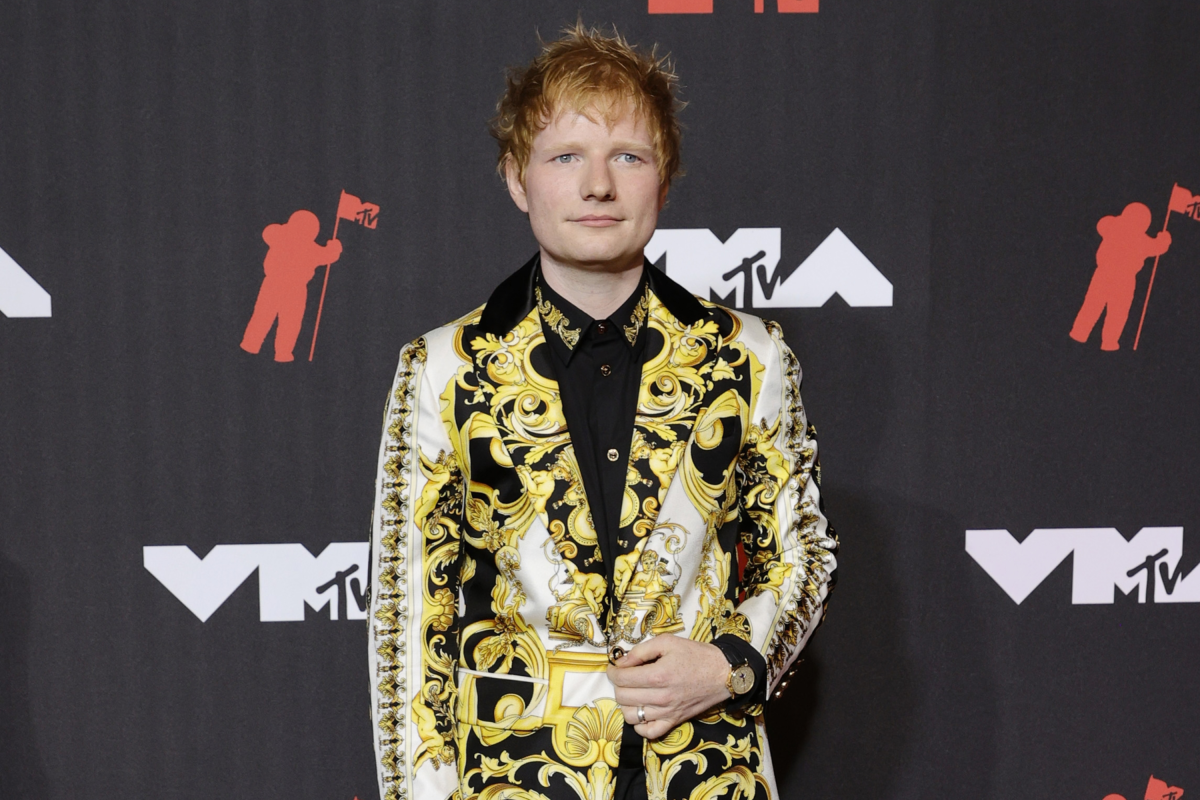
For years, Ed Sheeran has occupied a rare place in pop culture. He is the guy with the guitar, the ginger hair, and the catalog of love songs that sound equally at home at weddings, funerals, and supermarket checkouts. He has sold out stadiums, collected Grammys, and managed to seem like the kind of celebrity you could imagine chatting with at a village pub. But the past month has been a brutal reminder that even the warmest public persona can be pulled into a storm it never asked for. Sheeran has lost more than 439,000 Instagram followers in the last thirty days, and according to Social Blade data, the biggest losses came precisely when the Macklemore controversy erupted. On September 15 alone, his account shed nearly 150,000 followers, and the next day another 98,000 followed. That kind of drop is not just a number; it is a sign that the man who once seemed above the messy divisions of modern politics has been dragged into the center of one of the most polarizing debates of our time. Reputation expert Eric Schiffer, chair of Reputation Management Consultants, told Newsweek that the fallout poses a “danger” to Sheeran’s career because it has connected the singer to a highly charged political argument. Newsweek reached out to Sheeran’s representative via email for comment on Tuesday and awaits a response, but the silence itself feels telling: there may be no easy way to explain this one away.
The trouble began when Macklemore, whose real name is Benjamin Haggerty, was removed from the Loop Tour after making pro-Palestinian remarks at a New Jersey concert. For Sheeran, a musician who has historically stayed out of political commentary, the decision must have seemed like an impossible choice. On one hand, he had a headlining tour to protect and a fanbase that spans every demographic imaginable. On the other hand, removing Macklemore opened the door to accusations that he was silencing free speech, caving to outside pressure, and picking sides in a conflict that has no easy answers. The backlash was immediate and fierce. Activists and fellow musicians criticized the move, and a number of supporting acts withdrew in solidarity. The Irish folk group Beoga, Irish singer Aaron Rowe, and Danish pop band Lukas Graham all stepped away from scheduled appearances. Finneas, the Oscar-winning producer and brother of Billie Eilish, later pulled out of plans to join Sheeran’s South American tour dates. What had started as a routine concert lineup suddenly became a political symbol. Sheeran, the affable hitmaker who wrote “Perfect” and “Shape of You,” found himself at the center of a debate about free speech, the war in Gaza, and the responsibility of artists in times of global crisis. It was exactly the kind of controversy he had spent his career avoiding, and there was no chorus or bridge that could make it go away.
Reputation expert Eric Schiffer did not mince words about the damage. “Ed Sheeran’s lethally stupid for how he’s managed this controversy, and it’s a danger to his career,” he told Newsweek. Schiffer argued that Sheeran had tried to position himself as someone outside politics, but that became impossible once he was actively involved in a dispute tied to Macklemore and the Israel-Gaza debate. “He took a political position originally by hiring Macklemore,” Schiffer said. The context here is not simple. Macklemore has a complicated history: back in 2014, he faced criticism and accusations of antisemitism after wearing a costume during a Seattle performance that some observers said evoked antisemitic stereotypes. He denied any antisemitic intent at the time, explaining that the outfit was part of a theatrical disguise. But in the current climate, that history added another layer to the story. Schiffer argued that Sheeran has managed to alienate people across the political spectrum. Some fans believe he should have stood by Macklemore, while others are upset that he brought a controversial figure onto the tour in the first place. The 35-year-old singer, who once seemed to exist in a bubble of feel-good acoustic pop, now finds himself criticized from all angles. Schiffer’s advice was blunt: “The best thing Sheeran can do now is shut his mouth, truly stay out of politics and stay focused on singing.” It is the kind of advice that might have worked a generation ago, but in an era when every Instagram post, every ticket sale, and every tour decision is scrutinized, staying out of politics is easier said than done.
Sheeran’s response came during an emotional speech in Philadelphia. Standing alone before a packed crowd at Lincoln Financial Field on Saturday, he addressed the controversy directly. The singer admitted he had made mistakes while trying to navigate the situation and apologized to fans. “I’ve had to take and make difficult decisions, and I am making mistakes, and I’m so, so sorry,” he told concertgoers. The vulnerability on stage felt raw, a far cry from the polished, safe image he usually presents. Later, Sheeran became visibly emotional while thanking fans for their support. “The world is a scary place right now; America is a scary place right now. This gives hope. Thank you so much, Philadelphia,” he said. He also acknowledged that some audience members may not have expected political remarks at a concert. “I understand that people have children here. And I understand that families didn’t buy a ticket to hear that first bit of the show, but that was something that I felt like I needed to say.” Although Sheeran has historically avoided public political commentary, he used his Philadelphia speech to discuss the conflict directly. He called the October 7, 2023, attack on Israel “horrific,” but he also condemned the crisis in Gaza. “What is happening in Gaza is catastrophic and unjustifiable and disproportionate,” he said. He referenced conditions in the West Bank as well, framing his comments as concern for civilians rather than support for a political movement. It was a brave and risky moment, but it was also a clear sign that the old Ed Sheeran, the one who could glide through life with a smile and a catchy melody, had been forced to confront the world in a way he had never done before.
The reaction to the controversy continued to grow far beyond the music industry. Outside the Philadelphia concert, demonstrators gathered to protest Macklemore’s removal, while some attendees argued that political disputes should remain separate from live performances. The debate also became a lightning rod for public figures. English broadcaster Piers Morgan said on X that he agreed with some of Sheeran’s observations about both the October 7 attack and the situation in Gaza but argued the singer should never have felt compelled to make a public statement. On TMZ, Representative Alexandria Ocasio-Cortez characterized the dispute as part of a larger conversation about whether powerful interests can influence what artists are allowed to say. Support for Macklemore also came from entertainers and activists, including Kneecap, Hannah Einbinder, and others who criticized the decision to remove him from the tour. On Instagram, climate activist Greta Thunberg wrote: “This is not about Ed Sheeran, it is about the people dying on the ground, holding those complicit accountable and applying that pressure on everyone responsible.” Musician John Legend defended outspoken criticism of U.S. policy regarding the conflict and said more people are reassessing long-held views on Israel and Gaza. “I think more and more people are realizing that we’ve been on the wrong side of history on a lot of the actions that our government has supported and funded and armed,” Legend said during a conversation with Bevy Smith on SiriusXM’s Bevelations. “I’ve been talking about for years, and it wasn’t kind of sensationalized in the way that Macklemore and his statement has been, but I’ve been talking about this for a long time. And I’m glad that more and more people are coming to that realization, and I think even our politicians are realizing, they’re hearing from us, that we can’t continue to fund this. We can’t continue to fund apartheid; we can’t continue to fund genocide.” With opinions coming from every direction, the controversy became a mirror of the broader divisions in society, and Sheeran was standing right in the middle of it.
Amid the fallout, attention has increasingly turned to charity and relief efforts. Macklemore recently pledged one million dollars for Palestinian relief efforts and challenged New England Patriots owner Robert Kraft to match the contribution. Kraft, who also owns Gillette Stadium, emerged as a central figure in the debate after organizations linked to him supported efforts to remove Macklemore from Sheeran’s tour over the rapper’s comments about Israel and Gaza. A spokesperson for Kraft later said both Kraft and Sheeran had agreed to donate two million dollars each, though the recipients have not been publicly identified. Sheeran told fans he is consulting people from different perspectives as he considers ways to support victims affected by the conflict. It is a hopeful development, a sign that maybe something constructive can emerge from all the anger and division. But the damage to Sheeran’s brand is real, and it remains to be seen whether the donations will be enough to repair the trust he has lost. The coming months will reveal whether he can return to the music that made him famous, or whether this chapter follows him for a long time. What is clear is that the sweet, uncomplicated singer of love songs has been forced to learn a hard lesson: in today’s world, nobody gets to stay neutral forever. And once you step into the storm, it is very hard to find your way back to the quiet place where you used to live.