


1. The Bitter Chill of Lambeau
The cold seeped through the frozen turf of Lambeau Field, but the sharper sting came from another kind of chill—the hollow feeling of a season slipping away. For the Dallas Cowboys, this wasn’t just another cross-conference matchup; it was a stark, unforgiving examination of who they really are. The final score, 23-13, flattered them in ways the game itself did not. Under the bright, unforgiving lights of “Sunday Night Football,” the Cowboys walked off the field with their heads down, the silence in the visiting locker room broken only by the muffled sounds of pads being tossed into bags and the quiet, frustrated sighs of grown men who knew they had let another opportunity slip through their fingers. This was their second consecutive loss in the national spotlight, a bitter pill to swallow for a franchise that has built its identity on the grandeur of primetime. The week leading up to the game had been filled with talk of resilience, of fixing the small mistakes, of playing a cleaner brand of football. But when the moment arrived, the same haunting issues resurfaced: missed assignments, dropped passes, and a defense that bent until it broke at the most critical junctures. The scoreboard showed a ten-point deficit, but in the hearts of the players and the millions of fans watching from living rooms across the country, it felt far more lopsided. The bright green of the field, once a cathedral of football history, seemed to mock them, a reminder that here, in this hallowed ground, the Cowboys had come up short yet again. The only comfort, if it could be called that, was that the season was not over. But at 2-4, the margin for error had evaporated entirely, and the weight of that reality pressed down on every shoulder that trudged through the tunnel and onto the team bus. This was a gut-check moment, the kind that defines a season, and the Cowboys had just failed their first test of true adversity.
2. A Tale of Two Halves and a Hundred Small Heartbreaks
To understand the Cowboys’ defeat, one had to look beyond the raw numbers and into the agonizing, granular details that tell the true story of a football game. The offense, led by Dak Prescott, moved the ball with intermittent flashes of brilliance, but those flashes were invariably extinguished by self-inflicted wounds. A holding penalty on third-and-short, a miscommunication between quarterback and receiver on a deep route that hung in the air like an impossible promise, a costly fumble deep in Packers territory that flipped the momentum entirely—these were the silent killers, the tiny cuts that bled out the team’s confidence. The defense, meanwhile, fought valiantly in spurts, stuffing the run early and pressuring Green Bay’s quarterback into hurried throws. But the Packers, patient and methodical, exploited mismatches in the secondary over the middle of the field, converting third-and-longs with surgical precision that left the Dallas sideline shaking its collective head in disbelief. There was a sequence in the third quarter that seemed to epitomize the entire evening: down by just a touchdown, the Cowboys forced a punt, but a roughing-the-kicker penalty extended the drive, and four plays later, the Packers were in the end zone, the air completely sucked out of the Cowboys’ comeback hopes. In those moments of high leverage, the team that had spent all week talking about avoiding “the recurring nightmares” made the same haunting mistakes. Players like CeeDee Lamb fought for extra yards, his facemask showing the strain of a man willing his team to victory, but even his heroic efforts were undermined by a dropped fourth-down pass that would have given Dallas a lifeline. The sideline, normally a hive of energetic coaching, was a picture of grim resignation. Each player wore a mask of pure frustration, swapping stories of “almosts” and “if onlys” as the clock wound down, leaving them all to contemplate the perverse reality that in the NFL, the difference between triumph and despair is often measured in inches and fractions of a second, and on this night, the Cowboys found themselves on the wrong side of every one of those margins.
3. A Coach’s Confession and the Echo of Accountability
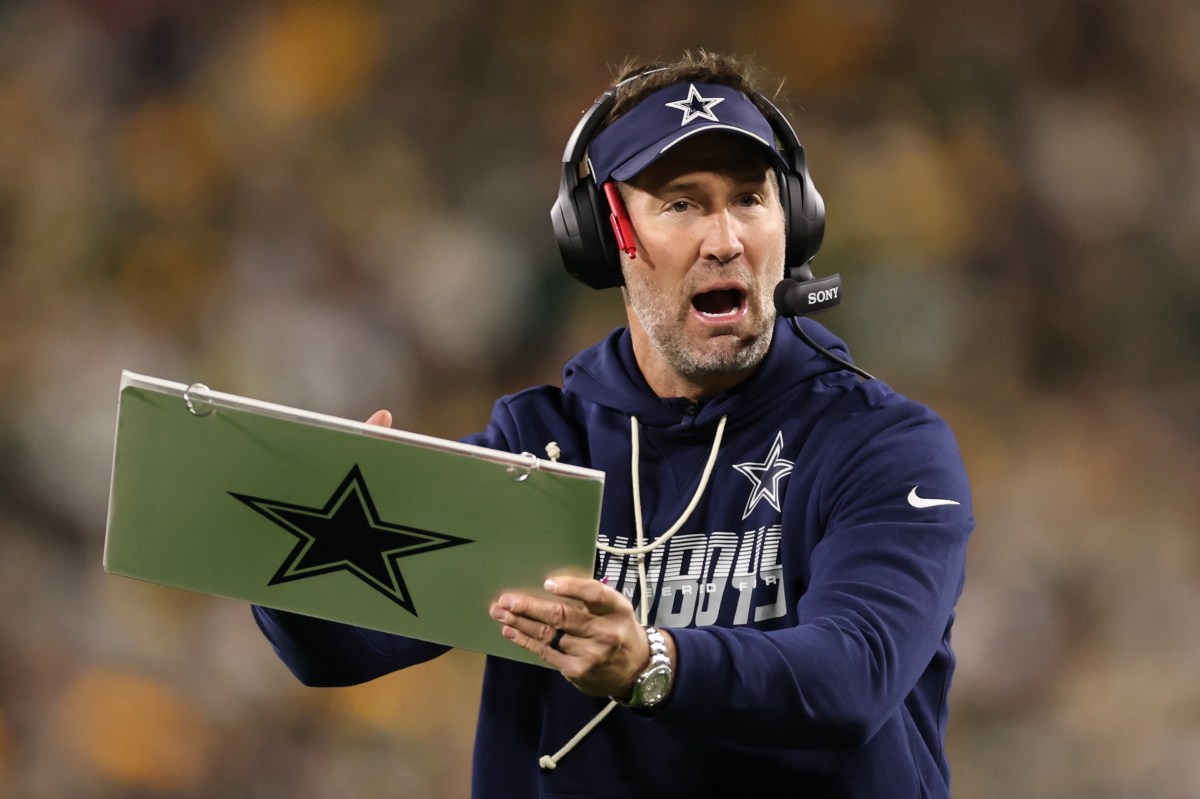
In the aftermath of the defeat, Brian Schottenheimer stood before the media with a weariness that belied his outwardly composed demeanor. Gone was the fiery, rah-rah energy that characterized his initial press conferences; in its place was a somber, honest assessment that resonated with anyone who has ever faced a pivotal moment of crisis. “We’re in a hole. We put ourselves there, and there’s one way out of it,” he said, his voice carrying the weight of a man who understands that words are cheap until they’re backed by action. His message to his players was simple, devoid of excuses: they must work, they must find solutions, and they cannot afford to repeat the same egregious errors that have become a recurring theme. This was not a coach deflecting blame onto the officials or the schedule; this was a man looking in the mirror and acknowledging his own shortcomings. When he added, “We got to clean it up. Lost two games in a row. Haven’t played well,” he paused, letting the gravity of the situation settle in. “Got to take a hard look at it. And that starts with me.” In that moment, Schottenheimer humanized himself, stripping away the protective layers of coach-speak to reveal a leader who genuinely feels the burden of every mistake made on the field. He knows that the fans in Dallas are passionate, unforgiving, and starved for success, and he understands that the clock is ticking on his tenure. His accountability is both admirable and necessary, but empty words without substantive changes will only add to the growing chorus of doubters. The challenge now lies not in his ability to identify problems, but in his capacity to inspire his players to execute with the precision and discipline that has been sorely lacking. He is, by all accounts, a forward-thinking coach, but the results on the field paint a different picture, and the gap between intention and execution is widening by the week. As he left the podium, his expression was one of a man preparing for a long, sleepless night—not just thinking about the next game, but about the entire identity of a football team that is teetering on the brink of irrelevance.
4. The 2-4 Reality: A Descent into the Abyss of Mediocrity
The Cowboys’ record, 2-4, is not merely a statistic; it is a living, breathing narrative of a season spiraling into a crisis of confidence. To be a fan of this storied franchise is to live in a state of perpetual high anxiety, where every victory is treated as a precursor to a championship and every loss is mourned as a tragedy of Shakespearean proportions. The opening weeks of the 2026 season were filled with cautious optimism, the belief that a revamped offensive line and a young, hungry defense could overcome the ghosts of playoffs past. But those hopes have been systematically dismantled by inconsistent play, and the reality of the situation is stark: the Cowboys are currently a below-average team in a division that is far from a cakewalk. The hole they have dug for themselves is not insurmountable—there are twelve games left in the regular season—but every week that passes without a signature win makes the climb steeper. The psychological toll is evident in the body language of the players, their post-game comments dwindling from defiant pronouncements to terse, measured responses. The national media, ever ready to pounce on the Cowboys’ misery, have transformed their narratives into a daily soap opera, questioning everything from the offensive play-calling to the morale of the locker room. Fans, who have shelled out thousands of dollars for season tickets and merchandise, find themselves questioning their faith, wondering if this is truly the year they can finally return to the NFC Championship game for the first time in over three decades. The 2-4 start evokes painful memories of other infamous Cowboys seasons that promised much and delivered little, and it feeds into a broader, unsettling narrative about a franchise that has become synonymous with regular-season mediocrity and playoff futility. To pull out of this tailspin, the Cowboys need more than just a change in tactics; they need a fundamental shift in mindset, a rediscovery of the gritty, street-fighting mentality that has eluded them in crucial moments. But such transformations are rarely linear, and the path forward is riddled with the same potholes that have caused them to stumble. The season is not over, but time is of the essence, and the need for immediate, tangible results has never been more acute.
5. The Eagles Loom: A Monday Night Reckoning
If the season is a rollercoaster, then the Cowboys are about to encounter the steepest drop yet. Their next test comes on “Monday Night Football” against the Philadelphia Eagles, a team that, based on recent history, has had their number in high-stakes encounters. The mere mention of the Eagles ignites a visceral hatred in the hearts of Cowboys faithful, and a third straight primetime appearance adds an extra layer of enormity to an already critical clash. For Schottenheimer and his staff, this is not just another game; it is a referendum on their ability to prepare a team to compete under the brightest of spotlights. The Eagles boast a ferocious pass rush and a dynamic offense, and the Cowboys will be facing them at a time when their own confidence is at its lowest ebb. Yet, within this adversity lies a strange opportunity: there is nothing left to lose, so the team can play with the kind of reckless abandon that often fuels surprising upsets. The narrative leading into the game will be dominated by talk of redemption, of proving the doubters wrong, of showing that the character of this team is not defined by its losses. But talk is cheap, and the Cowboys have been burned before by players who say all the right things in press conferences and then fail to execute when the whistle blows. The coaches will preach discipline, the players will promise focus, but the true test will come when the Eagles’ quarterback drops back to pass on third-and-long, or when the Cowboys’ offense faces a critical fourth down in the fourth quarter. The memories of last week’s failures will either haunt them or galvanize them, and it remains to be seen which path they will choose. For the fans tuning in from Dallas, this is more than a football game; it is a chance to exorcise the demons of a disappointing start, to reclaim some sense of pride. The schedule makers, in their infinite wisdom, have given the Cowboys the perfect opportunity to salvage their season, but they have also given them the perfect opportunity to sink deeper into the abyss. The result will not only determine their record, but also their identity for the remainder of the year.
6. The Long Road Back: Finding a Mirror and a Way Forward
As the Cowboys board their flight home, the reality of their situation is unavoidable. They are a team at a crossroads, staring into the abyss of a lost season while holding the faint hope of a miraculous turnaround. The path forward is not a secret; it lies in the mundane, unglamorous work of practice, of film study, of correcting the fundamental errors that have plagued them. Schottenheimer’s words, “there’s definitely time to pull out of it,” are not just a cliché; they are a genuine statement of mathematical truth. Twelve games remain, and in the NFL, any team can get hot, string together a streak, and sneak into the playoffs where anything can happen. But that kind of run requires a level of consistency and execution that has been glaringly absent. The players must look inward, not outward, and find the source of their collective frustration and convert it into fuel. Leaders like Dak Prescott need to elevate their game, but they also need to lift the spirits of their teammates, creating a culture of unwavering resilience in the face of adversity. The offensive line must find a way to protect their quarterback, and the defense must learn to close out drives with the same ferocity they show early in games. These are not complex calculations, but they are deeply human challenges that require character, commitment, and an almost stubborn refusal to accept mediocrity. The fans, as fickle as they may be, are ready to forgive a loss if they see heart, a willingness to fight until the final whistle. What they cannot abide is the sight of a team crumbling under pressure, making the same mistakes week after week. This is the moment for the Cowboys to define themselves, to prove that the scars of this early-season turmoil have not paralyzed them, but instead have forged them into something stronger. The road back from 2-4 is long and winding, filled with landmines and opportunities, but it is a road that has been traveled before by greater teams than this one. The question is not whether they are capable, but whether they have the will to reach down into the depths of their own character and pull out a performance that will shift the narrative. As the plane cuts through the night sky, the season hangs in the balance, and the only certainty is that the next twelve games will tell us everything we need to know about the true soul of the Dallas Cowboys.