



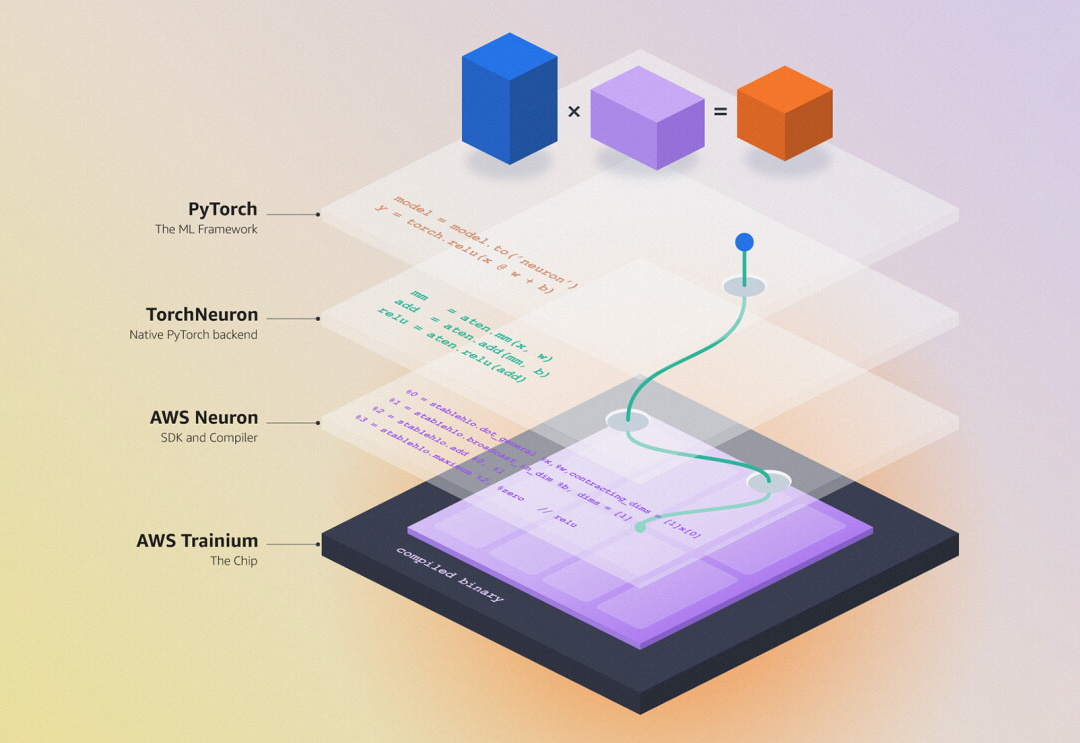
Swapping one AI chip for another has long felt like moving to a new country: even if you speak the local language, you still have to navigate unfamiliar roads, customs, and hidden fees. For years, developers who wanted to use Amazon’s custom Trainium chips instead of Nvidia’s industry-standard hardware had to rewrite their PyTorch code to speak Amazon’s proprietary language. That kind of engineering work can take months, and for many teams it just isn’t worth the cost. Amazon thinks it has finally solved that problem with a new software tool called TorchNeuron. Announced as a public beta on Monday, TorchNeuron sits right between PyTorch and Trainium, acting like a universal translator. It lets developers take code they’ve already written in PyTorch—the open-source deep learning framework used by a huge slice of the AI world—and run it on Trainium after what Amazon describes as a basic configuration change. No rewrites. No months of porting. Just a toggle, and the same model is suddenly running on different hardware. Colin Brace, vice president of technology software at Annapurna Labs, Amazon’s chip-design unit, put it simply: “If you know PyTorch, then you know Trainium.” The tool has been in private beta since late last year, with more than 30 companies and internal Amazon teams testing it. Now it’s open to all developers, and Amazon plans to release it as open-source software in conjunction with the PyTorch Conference in San Jose. The timing is no accident. Amazon is trying to make a very compelling pitch: you don’t have to abandon the tools you love to break free from Nvidia.
To understand why TorchNeuron matters, you have to understand just how deeply Nvidia is woven into the fabric of modern AI. Nvidia dominates the market for AI chips not only because its hardware is powerful, but because its CUDA platform became the default foundation for AI software. Over the past decade, developers built libraries, optimizers, and entire workflows around CUDA, and that ecosystem is a moat. Even when competitors like Amazon and Google produced excellent chips, the software that ran on them was different. Adapting a model to run on non-Nvidia hardware could take months of gnarly engineering, and for many companies the cost simply outweighed the savings. That’s why so many stayed put, even as alternatives multiplied. Amazon, Google, and Microsoft have all spent billions developing their own silicon, but they’ve also struggled to break the software habit. TorchNeuron is Amazon’s most direct attempt yet to make that habit irrelevant. Instead of asking developers to change their code, Amazon is changing the layer between the code and the chip. If PyTorch code can run natively on Trainium, then the CUDA lock-in loses its power, at least for the huge portion of AI work built around PyTorch. Brace emphasized that Amazon has “always been about choice,” pointing to the fact that AWS offers Intel processors alongside its own Graviton chips. The company’s broader strategy is becoming clear: make it as easy as possible to use Amazon’s chips, then let their price and performance speak for themselves. It’s a quiet but determined assault on the status quo, and Amazon isn’t the only one wielding this kind of weapon.
The competitive landscape is heating up fast. Google, which has started selling its TPU chips directly to outside customers, is working on a similar project called TorchTPU that would let developers run PyTorch code natively on those chips with minimal changes. Microsoft announced last week that it plans to run most of its AI services on its homegrown Maia chips rather than Nvidia hardware. Amazon, meanwhile, is reportedly in talks to acquire Decart, a startup that builds software to help developers move AI models designed for Nvidia chips to alternatives like Trainium. Decart already runs its own AI models on Trainium, and Nvidia is an investor in the startup—a delicious irony that underscores just how tangled the relationships are. Amazon’s financial commitments to Trainium are staggering. Anthropic, in which Amazon has invested billions, uses Trainium for training and running its Claude models. OpenAI agreed in February to use 2 gigawatts of Trainium capacity as part of a deal involving a $50 billion investment from Amazon. These are not small experiments; they are industrial-scale endorsements. In his annual shareholder letter in April, Amazon CEO Andy Jassy wrote that the company’s chip business, including Trainium and Graviton, had an annual revenue run rate of more than $20 billion. He estimated that figure would be around $50 billion if the chips were sold by a standalone company to AWS and other customers. Jassy even hinted that Amazon might eventually sell racks of chips to third parties, writing, “There’s so much demand for our chips that it’s quite possible we’ll sell racks of them to third parties in the future.” TorchNeuron is the software key that could unlock that future.
Amazon’s chip journey began in 2015, when it quietly acquired Annapurna Labs, an Israeli chipmaker, for a reported $350 million. That small team went on to design Graviton processors and then Trainium, Amazon’s purpose-built AI chips. For a long time, the hardware was arguably ahead of the software ecosystem around it. Trainium could crunch through AI workloads efficiently and cheaply, but getting code to run on it was a barrier. With TorchNeuron, Amazon is finally chipping away at that barrier. The early results are genuinely encouraging. Deepgram, a San Francisco startup that makes speech AI, tested Trainium during the private beta and found that it processed about 60% more audio per dollar than the GPU setup the company had been using. Deepgram is now running Trainium in production, which is a strong signal that the tool isn’t just a toy for demos. Inside Amazon, the Prime Video team used TorchNeuron to build Prime 360, an AI system that reconstructs NBA plays in 3D so viewers can watch replays from angles no traditional camera could capture. The feature, which runs on Trainium, will appear on select Prime Video broadcasts this NBA season. That’s the kind of flashy, consumer-facing application that helps sell the story. But the real proof of quality might be in Amazon’s nightly test routine. To make sure TorchNeuron works with the enormous variety of AI models that developers actually build, Amazon runs the software every night against more than 100,000 models from Hugging Face, the popular online hub for open-source AI. That’s a massive, continuous stress test, and it’s a sign that Amazon is serious about compatibility, not just in theory but at a scale that mirrors the real world.
The technical story behind TorchNeuron is as much about PyTorch as it is about Amazon. PyTorch has matured significantly in recent years, and its maintainers have been working to make the framework less dependent on any one kind of hardware. Amazon has actually contributed to that effort, removing code that tied PyTorch to specific chips. The newer versions of PyTorch can detect which hardware they’re running on, which means that in some cases developers don’t need to change their code at all. TorchNeuron takes that a step further by providing a smooth bridge between PyTorch’s flexible programming model and Trainium’s specialized architecture. For developers, it feels less like porting an application and more like changing a setting in a configuration file. You keep your model architecture, your training loops, your inference pipeline—all the stuff you spent months building—and Trainium simply becomes the engine underneath. Brace described TorchNeuron as “an accelerant” for Amazon’s goal of wide chip adoption, and that’s exactly what it is. It removes friction. It lowers the learning curve. It makes the decision to switch less about engineering effort and more about cost, performance, and trust. The timing also reflects a broader shift in the AI hardware market. Nvidia is still the dominant player, and it remains one of the most valuable companies in the world, but the cracks in its armor are starting to show. Cloud providers don’t want to be held hostage to one vendor, especially one whose chips are expensive and in short supply. Customers are looking for alternatives, and Amazon is positioning TorchNeuron as the easiest way to explore them.
In the end, TorchNeuron is a big deal because it attacks the deepest problem in the AI hardware market: the software moat. Nvidia didn’t win just by making faster chips; it won by making a whole ecosystem that made life easier for developers. Any challenger has to offer comparable performance and price, but they also have to offer a painless path to switching. With TorchNeuron, Amazon is essentially saying that path is now a single step. That doesn’t mean Nvidia is doomed—far from it. Amazon and other cloud giants remain some of Nvidia’s biggest customers, and Nvidia’s hardware is still deeply embedded in countless workflows. But TorchNeuron does mean that the future of AI computing is no longer a one-way street. Developers will have a genuine choice, and that choice will force everyone to compete on merit. For Amazon, the bet is that if you make it easy enough for people to run their existing code on Trainium, they’ll eventually see the benefits of lower costs and tighter integration with AWS. The tool is open source, which is a clever move in itself: it invites the global developer community to improve it, audit it, and trust it in a way they never would a proprietary black box. And by partnering with big names like Anthropic and OpenAI, Amazon is making sure Trainium has real-world credibility, not just theoretical potential. TorchNeuron is still early—public bets are rarely finished products—but it represents a genuine turning point. The question is no longer whether Amazon has a chip that can compete with Nvidia. The question is whether the world is finally ready to switch. With TorchNeuron, Amazon is betting that, this time, the answer will be yes.