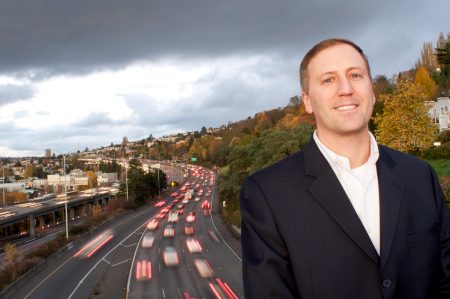





Some weeks, the future feels less like a steady march and more like a blur. This was one of those weeks. The top GeekWire stories of Oct. 11–17, 2026, carried a common thread: artificial intelligence is no longer just a tool we use; it is becoming a teammate, a rival, a source of hope, and a source of anxiety all at once. The week’s most intriguing human story was Peter Lee’s decision to leave his longtime post at Microsoft Research and join the Mercedes Formula 1 team in a newly created AI advisor role. For decades, Lee helped shape Microsoft’s scientific agenda, but he is trading the conference rooms of Redmond for the pit lanes of Monaco. His job won’t be to drive the car or design the engine; it will be to figure out how AI can help solve the team’s hardest physics problems, build predictive models for race strategy, and help F1’s regulators understand how to govern a sport increasingly influenced by algorithms. For a technologist like Lee, the appeal must be the puzzle. A modern F1 car generates a torrent of data — tire temperatures, aerodynamic loads, fuel burn, track conditions, driver inputs — all of it moving in real time. The question is whether an algorithm can make sense of that chaos faster and more cleverly than a human engineer. It’s a reminder that the most exciting AI careers aren’t just at tech companies anymore. They’re wherever human performance meets machine intelligence, and in F1, that happens at two hundred miles per hour. The move also signals something bigger: even the most tradition-bound institutions, like global motorsport, are deciding that AI is not something to fear but something to steer. And if a Formula 1 team needs an AI advisor, what does that say about the rest of us? We’re all going to need someone — or something — to help us navigate the algorithms accelerating through our own lives.
Politics and tech collided this week in ways that felt both familiar and uncomfortable. The Washington Post obtained a donor list for President Trump’s White House ballroom project, and there, alongside the usual names, were three of the biggest companies in technology. Microsoft committed $10 million, while Amazon and T-Mobile each committed $5 million. On the surface, these are generous gifts to restore or enhance a historic space. But because the donations aren’t subject to campaign finance limits or disclosure requirements, they raise an obvious question: Is this philanthropy or something closer to a transaction? The companies would no doubt say they’re simply supporting the President’s vision for the White House. But when a company like Microsoft is simultaneously fighting regulatory battles, competing for government contracts, and trying to maintain good relationships with the administration, a $10 million check to a presidential project is bound to be read as more than a gesture. The same week, Microsoft president Brad Smith went public with a different kind of frustration. In an interview with Politico, he claimed that someone in the government “failed to inform the vice president accurately about our numbers” before Microsoft was blocked from sponsoring foreign workers for permanent residency. Smith’s words were blunt, and they captured the tension that runs through every tech company’s relationship with Washington. They need the government to understand the reality of their workforce, their business, their contributions. Too often, Smith suggested, decisions are made based on bad information, and companies are left to clean up the mess. The two stories together tell a larger story: tech companies have never been more powerful, more visible, or more dependent on the political world. They can write large checks and issue sharp rebukes, but they can’t control what the government decides to do with the money or the message. That’s a humbling position for companies used to being in charge.
On the consumer side, the week was about the battle for the most intimate pieces of real estate in our lives: the space where we plan a vacation and the countertop where we ask a speaker to turn on the lights. Booking Holdings, the company behind some of the world’s biggest travel sites, is launching a Seattle-based startup called Vayo, led by serial entrepreneur Mike Fridgen. The bet is that a dedicated AI agent built for travel can do what general-purpose assistants from OpenAI and Meta cannot: understand the messy, emotional, constantly shifting reality of a trip. Anyone who has tried to use a chatbot to plan a family vacation knows the problem. The AI suggests a hotel that’s too far from the airport, a restaurant that’s closed on Mondays, a flight itinerary that somehow connects through three cities. Vayo wants to be the AI that actually gets you out the door and into the right hotel room. It’s a clever bet, because travel is one of the few categories where people will happily hand over control if it means less friction. Meanwhile, Apple entered the smart home display market with the $299 HomeView, a device aimed squarely at Amazon’s Echo Show. Apple also introduced new LG-made cameras, a video doorbell, and a smart lock, all competing with Amazon-owned Ring. The timing makes sense. Amazon has long dominated smart speakers, with about two-thirds of U.S. owners, while Apple sits at just 7%. But Apple’s strategy has never been about being first; it’s about being the brand people trust with their privacy and their homes. The HomeView is a bet that there’s room for a premium, privacy-conscious alternative to the Amazon ecosystem. For consumers, this is good news. Competition in the smart home means better devices, lower prices, and, hopefully, fewer creepy privacy violations. But it also means choosing sides in a battle that will be fought one kitchen at a time. Do you want a display that knows your Amazon shopping list, or one that promises to keep your data to itself? The answer probably says more about your personality than you’d like to admit.
Some of the week’s most human stories came from the aisles of a grocery store. A robot named Tally, equipped with cameras, is rolling through stores to scan shelves, and it is provoking exactly the kind of mixed emotions that define this moment in technology. On one hand, it’s pure Jetsons. A little robot quietly doing the tedious work of checking inventory, so a store can restock the oat milk before you notice it’s gone. On the other hand, there’s the anxiety. If a robot can scan shelves, will it eventually replace the stocker? The cashier? The manager? And there’s the privacy question. A camera-laden robot moving through a public store is watching everything, and even if the company says it’s only looking at products, shoppers can’t help but feel the gaze. Tally is a small object, but it carries a big burden: it’s a symbol of automation’s promise and its threat. Behind the scenes, Amazon made a move that could make that kind of AI even faster. The Wall Street Journal reported that Amazon is in talks to buy Decart, a startup that makes software to help AI models run faster on different kinds of chips, including Amazon’s own Trainium processor. The price: around $7 billion. Decart has already worked with Amazon Web Services on its newest chip, so a deal would be a natural next step. For Amazon, this is about reducing its dependence on Nvidia, the company whose GPUs power most AI today. If Amazon can make its own chips work better, it can offer AI services at lower prices and with higher margins. For the rest of us, this kind of behind-the-scenes infrastructure spending matters because it determines how fast, how cheap, and how accessible AI becomes. The robot in the grocery store is just the visible tip of a vast, invisible supply chain of chips, software, and data centers. The more efficient that supply chain becomes, the more likely it is that a Tally-like robot shows up in your neighborhood — and the more important it is to decide what we want it to see.
Perhaps the most hopeful story of the week came from the labs of UW Medicine’s Institute for Protein Design, where Nobel laureate David Baker and his team used AI to engineer reusable molecular “scissors” that can destroy target proteins linked to diseases like Alzheimer’s and ALS. The science is elegant. Most drug molecules work by latching onto a protein and blocking it. These new proteases are different: they chop the target up, and then they do it again, and again. Because they’re reusable, they could treat complex diseases at much lower doses, with fewer side effects and, ideally, with better results. It’s easy to get lost in the jargon, but the human meaning is simple. For millions of families watching a loved one slip away into Alzheimer’s, or facing the brutal progression of ALS, this is the kind of research that feels like a light in the dark. It won’t produce a drug tomorrow, but it shows that AI can do more than recommend movies or scan grocery shelves. It can help scientists understand the fundamental machinery of disease and design tools to repair it. In a separate but related story, Microsoft announced that its homegrown Maia chips will handle most of the AI work behind Copilot and its other products, with the new Maia 300 rolling out in 2027. The company says the new chip does more AI work with the same amount of electricity as the GPU-based systems that power most AI today. This is a quiet but significant shift. If Microsoft can rely on its own silicon, it controls its own destiny, and it can offer AI services that are faster, cheaper, and more energy-efficient. In a world where everyone is worried about AI’s carbon footprint, the Maia 300 is a reminder that the future of AI isn’t just about software breakthroughs. It’s about the physical infrastructure — the chips, the power, the cooling — that makes the magic possible. Put the two stories together, and you have a picture of AI’s double nature. It can be a force for healing and understanding, and it can be an engine of efficiency. The question is whether we’ll use it wisely.
Finally, a little local news with a twist. LinkedIn published its list of Seattle’s hottest startups, and it included companies headquartered in California and Texas. At GeekWire, we did a little digging and found a geography problem hiding in plain sight. The issue, as far as we could tell, is that LinkedIn’s methodology counts remote workers and satellite offices as evidence that a company is part of the local startup scene. So a startup founded in San Francisco with a few dozen employees in Seattle can make the list, while a truly Seattle-born company might be overlooked if its workforce is distributed across the country. The result is a list that feels less like a map of Seattle’s innovation economy and more like a reflection of how blurry geography has become in the remote work era. Is a company “from Seattle” if its payroll department is here but its founders are in Austin? Does a Seattle address matter if the team only comes together for offsites? These aren’t just semantic questions. They matter to local investors, to policymakers trying to build a tech hub, and to job seekers who want to work at the next big thing without moving to the Bay Area. The LinkedIn list may have intended to celebrate Seattle, but it ended up highlighting how hard it is to define a city’s startup scene in a world where talent is everywhere and offices are optional. It’s a fitting note to end the week on. The stories of Oct. 11–17, 2026, were full of boundaries shifting and blurring: AI moving into Formula 1, corporate money flowing into presidential projects, robots patrolling grocery stores, chips replacing chips, and a list of local startups that didn’t know where it lived. None of it fits neatly into old categories. That’s unsettling, but it’s also exciting. If you want to keep up with the blur, the best way is to subscribe to the GeekWire Weekly email newsletter, which delivers these stories and more to your inbox every Sunday. You can sign up at GeekWire.com, and we’ll see you next week.