



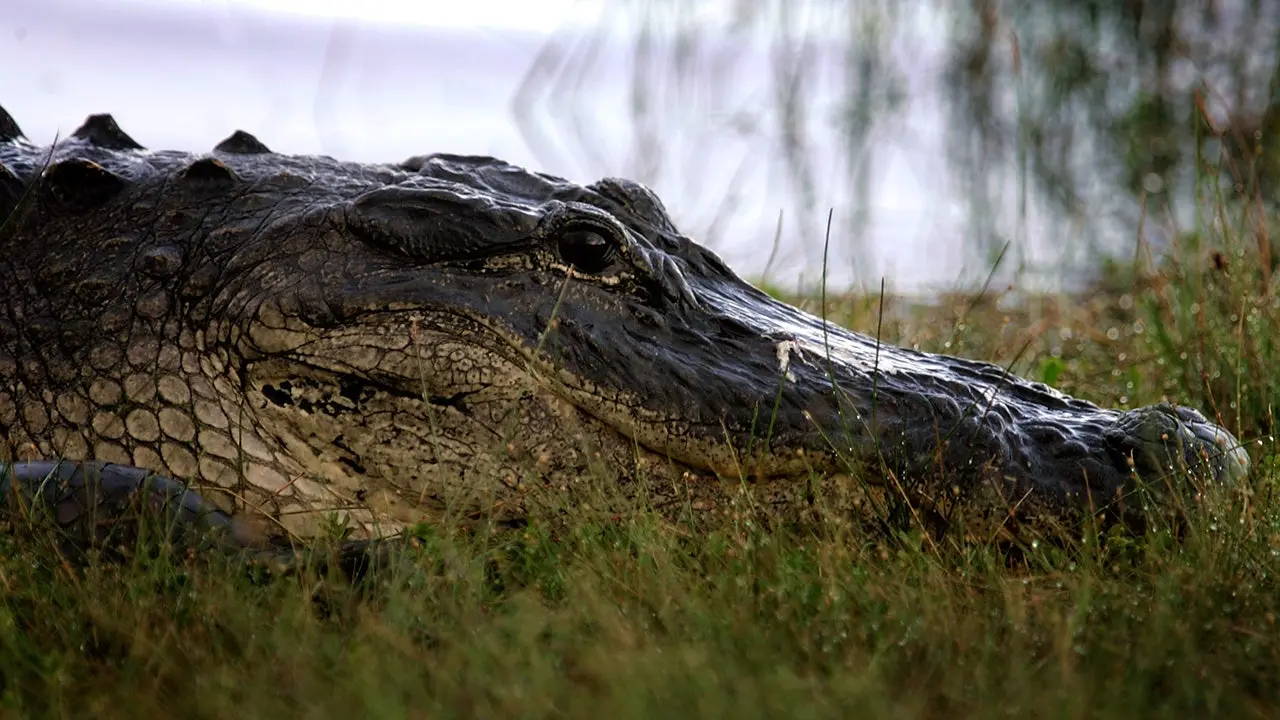
The quiet shores of Lake Apopka, just outside the bustling tourist corridors of Orlando, became the scene of a profound tragedy on Friday afternoon. A 71-year-old man, identified as Steven Hamilton, had gone to the water’s edge to fish, likely expecting a peaceful hour or two in the Florida sunshine. Instead, around 5 p.m., a nearly 12-foot alligator attacked him in the shallow waters near Winter Garden. The suddenness of the encounter is almost impossible to absorb: one moment, a retiree enjoying a simple pastime; the next, a nightmare that no family could ever prepare for. Neighbors and strangers alike have been left shaken, not only by the violence of the attack but by the reminder that even familiar, everyday landscapes can hide ancient dangers. The Winter Garden Police Department reported the incident, and emergency crews were dispatched immediately, but the reality of the situation was even more terrifying than initially understood. As first responders arrived, they found not only the enormous alligator responsible but other alligators closing in on the area as well. The water, which had always seemed so calm and inviting, had become a chaotic and perilous zone. For those who live near Lake Apopka, the attack has turned a beloved community spot into a place of mourning and wariness, a poignant reminder that nature’s wildness does not always announce itself before striking.
The efforts to save Steven Hamilton were valiant but ultimately unsuccessful. Winter Garden Fire Chief Jose Gainza explained to local reporters that rescue crews were unable to reach the man in time because of the presence of additional alligators in the water. It is a detail that chills the heart: rescue workers, trained to run toward danger, had to hold back because the lake was alive with more predators. Hamilton’s body was eventually recovered by 7 p.m., the evening light fading over a scene that no first responder will ever forget. The delay in recovery must have been agonizing for his loved ones, who likely waited on the shore with dread and hope colliding. The Florida Fish and Wildlife Conservation Commission, known as FWC, released a statement expressing their deepest sympathies to the family and loved ones of the victim, calling the loss a difficult time. But words of sympathy, however sincere, can never fill the void left by such a sudden and violent death. The men and women who responded to the emergency faced a situation that will stay with them for the rest of their lives. They were not just doing a job; they were confronting the raw, unforgiving power of the natural world, and they were forced to make impossible decisions in a matter of minutes. The memory of that afternoon will likely haunt the community for years, a stark and sorrowful chapter in the region’s history.
In the aftermath of the attack, authorities moved swiftly to address the immediate threat. The alligator that had attacked Hamilton was located, trapped, and killed, according to Winter Garden Police Chief Michael Mason. For many, this is a necessary step to prevent another tragedy; for others, it is a somber act that underscores the complexity of human-wildlife conflicts. Chief Mason spoke candidly about the situation, revealing that Lake Apopka “has tons of alligators in it.” He acknowledged that authorities had not been aware, before the attack, that a gator of this size was lurking so close to the shore. His advice to the public was simple and heartfelt: “Always be aware of your surroundings. Always be safe. Wildlife: Respect it. Keep your distance. It looks like it’s docile, it looks like your Florida emblem, but it can be dangerous.” Those words carry a special weight now, after a man has lost his life. They are a reminder that Florida’s beloved state reptile is not a cartoon character or a harmless sunbather on a log. It is a powerful predator, capable of incredible speed and force when provoked, startled, or acting on instinct. The decision to kill the alligator was not made lightly, and it will not bring Steven Hamilton back. But in the minds of many, it was a necessary measure to reassure residents that the immediate danger had been removed, even as the broader risk of living alongside alligators remains.
Fatal alligator attacks are extraordinarily rare in Florida, but they are not unheard of, and each one leaves an indelible mark on the state’s consciousness. According to state data, Hamilton’s death is the 34th fatal alligator attack in Florida since 1948, a staggering number when considered over more than seven decades, yet a tiny fraction of the millions of encounters between humans and alligators that occur every year. Still, for the families affected, statistics offer no comfort. Earlier this year, in June, 31-year-old Brittany Clark was killed by an alligator near her home in Oviedo, a suburban community not far from Orlando. Her death, which the state wildlife officials later confirmed involved a 13-foot gator and a horrifying “death roll,” sent shockwaves through the region. And in May of last year, 61-year-old Cynthia Diekema lost her life when an alligator tipped her out of her canoe, plunging her into the water in a terrible accident. Each of these women had a story, a family, and a life that was cut short in a matter of moments. Now Steven Hamilton joins that sad list. The frequency of these rare but devastating incidents is enough to make Floridians pause and consider the wild spaces that border their neighborhoods and recreational areas. For every sunny photo of an alligator basking on a golf course or swimming lazily in a retention pond, there is a hidden potential for danger that residents are taught to respect from a young age. Yet no amount of caution can fully prepare a person for the unpredictable nature of a wild animal.
The broader lesson from this tragedy is one that wildlife officials have repeated for years, but it always feels more urgent after a loss like this. Alligators are found all over Florida, in freshwater lakes, rivers, marshes, and even drainage ditches. They are most active during the warmer months, and they can be especially territorial during mating season. People who live in alligator country are urged to swim only in designated areas, to keep pets away from the water’s edge, and to never feed alligators, as feeding them causes them to lose their natural fear of humans. But even when these rules are followed, there is an element of risk that cannot be entirely eliminated. This attack occurred in a lake that is known to be home to many alligators, yet the man was merely fishing along the shore, an activity that countless people engage in every day without incident. The randomness of such events is what makes them so terrifying. It is easy to imagine oneself in that same position, standing at the water’s edge, casting a line, and looking down at the water without any real sense of alarm. The truth is that alligators are masters of camouflage, able to remain motionless underwater while waiting for an opportunity. By the time a person sees them, it is often too late. Lawrence W. “Mason” maybe not. This is why officials stress the importance of constantly scanning the water, staying at least 10 feet away from the shoreline, and never turning one’s back on the water for extended periods. It is advice that sounds almost paranoid, but for those who have lived in Florida for long, it becomes second nature—yet even seasoned Floridians can be caught off guard.
As the sun sets over Lake Apopka, the community is left to process a loss that feels deeply personal. Steven Hamilton was not just a statistic in a wildlife report; he was a father, a grandfather, a friend, a neighbor, a man who loved the outdoors and chose a quiet fishing trip over a busy day inside. His death is a reminder of the fragility of life and the unpredictability of nature. It is also a call to action for better awareness, better warning systems, and perhaps better management of the alligator population in areas where people live and recreate. But in the immediate aftermath, what matters most is not policy or debate; it is compassion. The FWC, local police, and emergency responders have all expressed their condolences, but no amount of official sympathy can ease the pain of a family that has lost someone they love. The alligator that killed Hamilton has been removed, but the grief remains. For the residents of Winter Garden and the wider Orlando area, this tragedy will linger in the mind every time someone walks near the lake. It will be mentioned in hushed tones at community gatherings and remembered in the quiet prayers of those who never knew the man but still feel the weight of his loss. And perhaps, in time, his story will serve as a powerful reminder to respect the wild world around us, to keep a safe distance, and to hold our loved ones a little closer. Because in the end, we cannot control the wild, but we can control how we honor those taken by it—by remembering them, by learning from their deaths, and by living each day with the same love for life that Steven Hamilton seemed to have when he set out to fish that afternoon.