
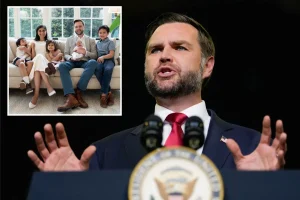


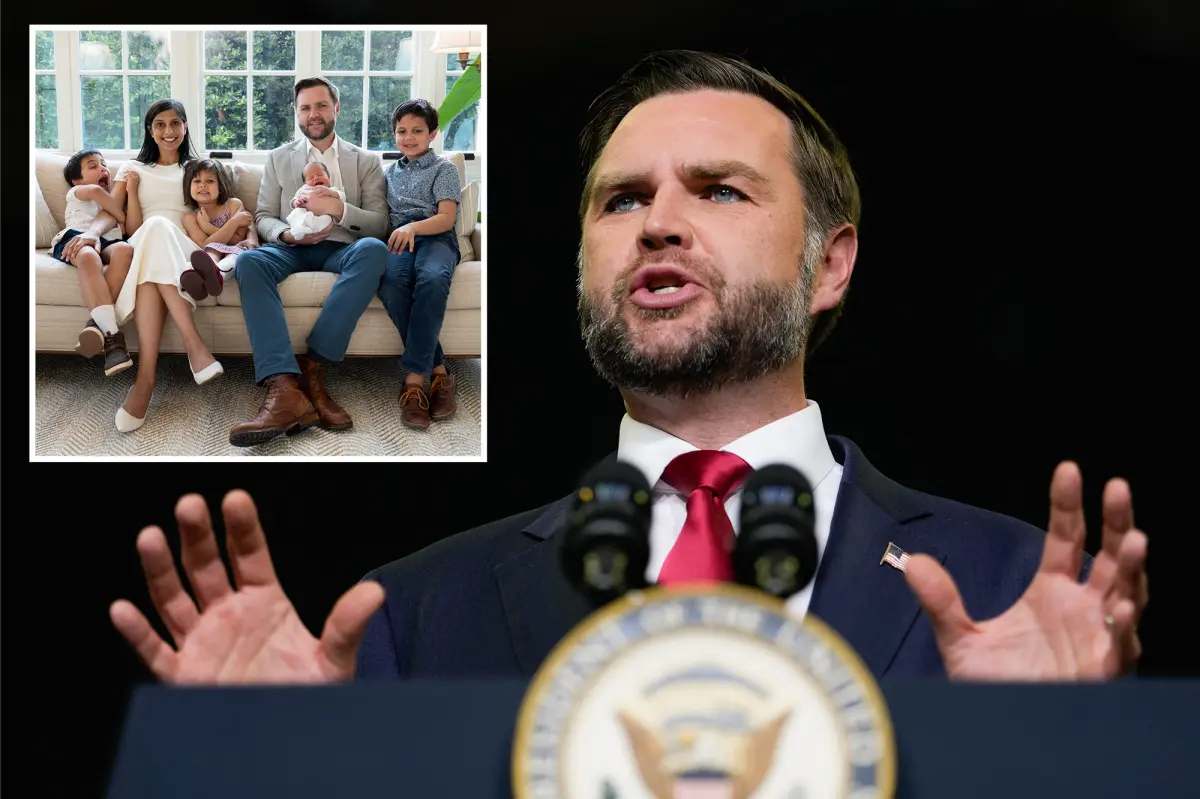
Vice President JD Vance stood in front of a CBS News town hall audience in Michigan and did something politicians rarely do: he allowed a little doubt to creep in. When asked about 2028, he didn’t offer the usual scripted “I’m focused on the job at hand” and leave it there. Instead, he admitted that there is a real chance he won’t run for president at all. “Of course there’s a chance,” he said. It wasn’t a throwaway line. It was a window into a man who, by every early indicator, is the Republican frontrunner to succeed Donald Trump, but who is also a husband and father of four young children trying to figure out whether the prize is worth the price. The reason, he suggested, was not a lack of ambition or a fear of the fight. It was the people he goes home to at night. “We’ve got four little kids, my wife has never loved politics. She loves public service,” he explained. In that single sentence, Vance drew a distinction that many Washington operatives would prefer to ignore: between the exhausting, performative, relentless business of politics and the quieter, more meaningful work of actually serving people. The vice president has spent his time in office trying to do as much good as possible, he said. But the question of whether to take that work to its highest level is not one he can answer alone. It belongs to his wife, Usha, as much as to him. And right now, she is not sold on the idea.
Vance’s admission was also a confession about how he makes decisions. He told the audience that he has yet to make up his mind about a potential White House bid, and then he offered a rare glimpse into his personal psychology. “The way that I think about life, big life decisions — my wife will tell you this: I’m a procrastinator. I hate thinking about it,” he said. There is something almost relatable about that, especially for anyone who has ever stared at a major crossroads and wished the choice would simply make itself. But for a man widely expected to be the next leader of the Republican Party, procrastination is a luxury. The political world likes certainty. Donors want commitments. Voters want clarity. And the media wants a timeline. Vance, by contrast, seems content to live in the unresolved space between now and later. He indicated that he plans to give the question more serious consideration after the November midterm elections, rather than commit to a campaign while the Trump administration is still navigating its current agenda. That is a reasonable answer, even a disciplined one. It suggests he wants to finish the job he has rather than begin campaigning for the next one. But it also reveals something deeper: that he doesn’t view the presidency as an inevitable destination. It is a choice, one that will be made with his family’s needs in mind, not just his own ambitions. And for someone who has spent his entire political career being described as a man in a hurry, that’s a surprising place to find himself.
The political context makes Vance’s hesitation all the more striking. By every measurable indicator, he is the early favorite to become the Republican nominee in 2028. President Trump himself has described Vance as his “most likely” successor, a blessing that in today’s Republican Party carries enormous weight. The RealClear Polling average gives him a 15-point advantage over Secretary of State Marco Rubio in a hypothetical primary, with 39% support more than two years out from the election. President Trump’s son, Donald Jr., is third with 11% support. Those numbers would make most politicians giddy. They would be holding rallies, courting donors, and dropping hints at every stop. Vance, instead, is openly floating the possibility of stepping aside. That is not the behavior of a man who is simply being modest. It is the behavior of someone who understands that winning the nomination and winning the presidency are not the same as living a good life. The job would mean even more time away from his wife and children, more scrutiny, more pressure, more nights spent in hotel rooms and campaign buses instead of at the dinner table. It would also mean asking Usha Vance to take on an even bigger role in public life, a role she has never been entirely comfortable with. The second lady has made it clear that she supports her husband, but she has also made it clear that she is not a traditional political spouse. She doesn’t live for the spotlight. She doesn’t pretend to agree with everything he says. And she has never pretended that politics is her dream. That is a reality Vance cannot ignore, and he doesn’t seem to want to.
Usha Vance’s perspective is perhaps the most humanizing part of this entire story. In a March interview with NBC News, she acknowledged that she sometimes holds views that do not fit neatly within traditional political camps. “Sometimes I have thoughts that fit very comfortably into one side or another,” she said. “Sometimes I have views that are way more idiosyncratic.” That is a remarkable thing for the wife of a sitting vice president to say, especially in an era when political spouses are expected to be loyal soldiers and disciplined messengers. But Usha has never played that role. She has a law degree from Yale, a career of her own, and a mind that refuses to be reduced to a talking point. She also made clear that she sees herself as a sounding board for her husband rather than a political operative. “I’m not his staffer. I’m not involved in this in any professional sense,” she said, adding that there is “no exception that we are going to see eye to eye on everything.” That kind of honesty is refreshing, but it also points to the tension at the heart of a presidential campaign. A candidate’s spouse is expected to stand by their side, smile at the right moments, and offer unconditional support. Usha Vance is not built that way. She is built to challenge, to question, and to tell her husband the truth even when it’s uncomfortable. That makes her an invaluable partner in private life, but it could make a national campaign a complicated experience for both of them. Vance knows this. He knows that his wife loves public service, but not the machinery of politics. And he knows that asking her to spend four years on a presidential campaign would be asking her to sacrifice something fundamental about who she is.
The family’s growing size only adds to the weight of the decision. Vance and Usha now have four young children: Ewan, nine, Vivek, six, Mirabel, four, and the youngest, Alec, who was born on July 19. A presidential campaign with four small children is not just a political challenge; it is a logistical and emotional marathon. There are school drop-offs and bedtime routines, birthday parties and doctor’s appointments, moments of childhood that cannot be replayed or recovered. Every candidate with young kids faces the same painful tradeoff, but few have been as honest about it as Vance has been. Usha said in March that a 2028 presidential campaign was not yet a priority in their household, explaining that her husband was focused on the midterm elections and the demands of his current job. “If you come back in 2027 and ask me, I’ll have a better sense of, you know, what he’s thinking in that way,” she told NBC News. That comment is telling. It suggests that the decision is not being made in boardrooms or on the campaign trail, but in quiet conversations between a husband and wife who are trying to protect their children from the harsh realities of public life. It also suggests that Usha is not going to be pressured into supporting a campaign she doesn’t believe in. If she and Vance decide to run, it will be because they have made the choice together, on their own terms, with their eyes open. And if they decide not to run, it will be because they chose their family over the world’s most powerful job.
For now, Vance’s political future remains an open question, even as early polling puts him ahead of potential Republican rivals. That is unusual in a political culture that demands certainty and punishes hesitation. But it is also a reminder that behind every presidential candidate is a human being with doubts, fears, and a family that has to live with the consequences. Vance may be the frontrunner, but he is also a father who has to decide whether he is willing to miss more of his children’s lives. He is a husband who has to decide whether he is willing to ask his wife to endure something she has never loved. He is a man who has to decide whether the presidency is something he truly wants, or just something the polls say he should want. “Of course there’s a chance” he won’t run. That sentence, so simple and so honest, may end up being the most important thing he has said since taking office. Because it means he is not taking the path for granted. It means he is still thinking, still weighing, still human. In the end, that may be exactly what makes him worthy of the office — even if he never seeks it.