


Seattle has become a city on two wheels in ways that would have seemed almost unimaginable just a few years ago. According to a GeekWire report by Kurt Schlosser published on Oct. 15, 2026, Lime riders in Seattle have already logged more than 10.5 million trips so far this year, passing the company’s entire 2025 ridership total with more than two months still left on the calendar. That number is not just a corporate metric or a data point for transit planners; it represents millions of individual decisions to step outside, unlock a bright green bike or scooter, and navigate the city’s hills, bridges, and busy streets without a car. It is the parent running late to daycare, the barista heading to an early shift, the software engineer gliding toward a ferry terminal, the tourist exploring Pioneer Square, and the sports fan weaving through a crowd of tens of thousands. The milestone is especially striking because it arrives in a city known for its rain, its steep inclines, and its long love affair with the automobile. Yet Lime’s regional director of government relations, Hayden Harvey, said the company is proud of its partnership with the Seattle Department of Transportation, which has spent years building the program and infrastructure that make such ridership possible. In fact, Lime’s CEO has called Seattle “the next micromobility-first city,” a phrase that captures how deeply shared vehicles have become woven into the urban fabric. The record ridership is not an accident or a one-time spike; it is the result of deliberate investment, operational grit, and a cultural shift in how Seattleites think about getting around. As the numbers climbed through summer and into autumn, every ride became a small vote for a future with fewer single-occupancy cars and more shared, electric, two-wheeled mobility. These are not just trips; they are stories of people reclaiming their streets, saving money, avoiding parking headaches, and enjoying a little fresh air along the way.
The summer of 2026 provided the biggest boost, and it came with a soundtrack of roaring crowds and vuvuzelas. When the FIFA World Cup came to Seattle, the city turned into a global stage, and Lime’s bikes and scooters became part of the show. Between the tournament matches and the surrounding festivities, Lime accounted for more than 1.7 million trips. The absolute peak came on June 19, when the United States faced Australia. On that day, Lime recorded an all-time single-day high of 83,000 rides. It was a record that felt inevitable in the moment: fans poured into the streets, many joining a “march to the match” that was joined by Seahawks legend Marshawn Lynch. Lynch, known for his love of Seattle and his larger-than-life personality, added a dose of civic pride to an already electric atmosphere. Instead of sitting in traffic or squeezing onto packed transit, thousands of fans unlocked Lime vehicles and rolled toward the stadium together. The scene was part block party, part transportation revolution. Bikes and scooters zipped through closed streets, past food trucks, flags, and banners, while visitors from around the world got their first taste of Seattle’s hills and waterfront. The single-day record shattered the previous high-water mark of nearly 60,000 rides, which had been set just a few months earlier during the Seahawks’ Super Bowl parade. To put that in perspective, four of Lime’s top five all-time ridership days in Seattle happened during the World Cup stretch. But the tournament was not just about one day. It created a sustained rhythm of big crowds, late nights, and early mornings, as locals and visitors alike discovered that a shared e-bike was often the fastest, most fun way to move through a city under celebration. For many, the memory of that summer will be forever tied to the hum of electric motors and the sight of thousands of two-wheeled vehicles streaming toward the stadium.
Before the World Cup, the Seahawks’ Super Bowl parade in February had been the defining moment for micromobility in Seattle. On that day, nearly 60,000 trips were taken on Lime bikes and scooters, as fans streamed toward the parade route to cheer on their team. It was a record at the time and a vivid demonstration of how shared two-wheeled vehicles could absorb the kind of crowd that would otherwise create gridlock. But the World Cup quickly made that milestone seem modest. The contrast between the two events tells a larger story about Seattle’s relationship with Lime. Event days are spectacular, but they are only part of the picture. The reason ridership has surpassed 2025’s full-year total by October is that people are not just using Lime for parties and championships; they are using it for the everyday grind. The morning commute, the midday errand, the trip to a doctor’s appointment, the ride home after a late dinner — these are the trips that add up. Lime’s data shows that the devices have become a reliable part of the city’s transit network, complementing buses, light rail, and ferries rather than competing with them. Riders often combine modes: take the train partway, then scoot the last mile. Others use Lime instead of a car for short trips that would have been impossible to park near downtown. The result is a more flexible, more human-scale transportation system. The fact that the city’s top ridership days are all tied to major events is exciting, but the deeper success is that the service has become mundane in the best possible way. It is simply what people do. And that is exactly what city planners and mobility advocates have been hoping for. It means the infrastructure is being used, the pricing is acceptable, and the cultural resistance to riding in the rain has finally begun to melt away.
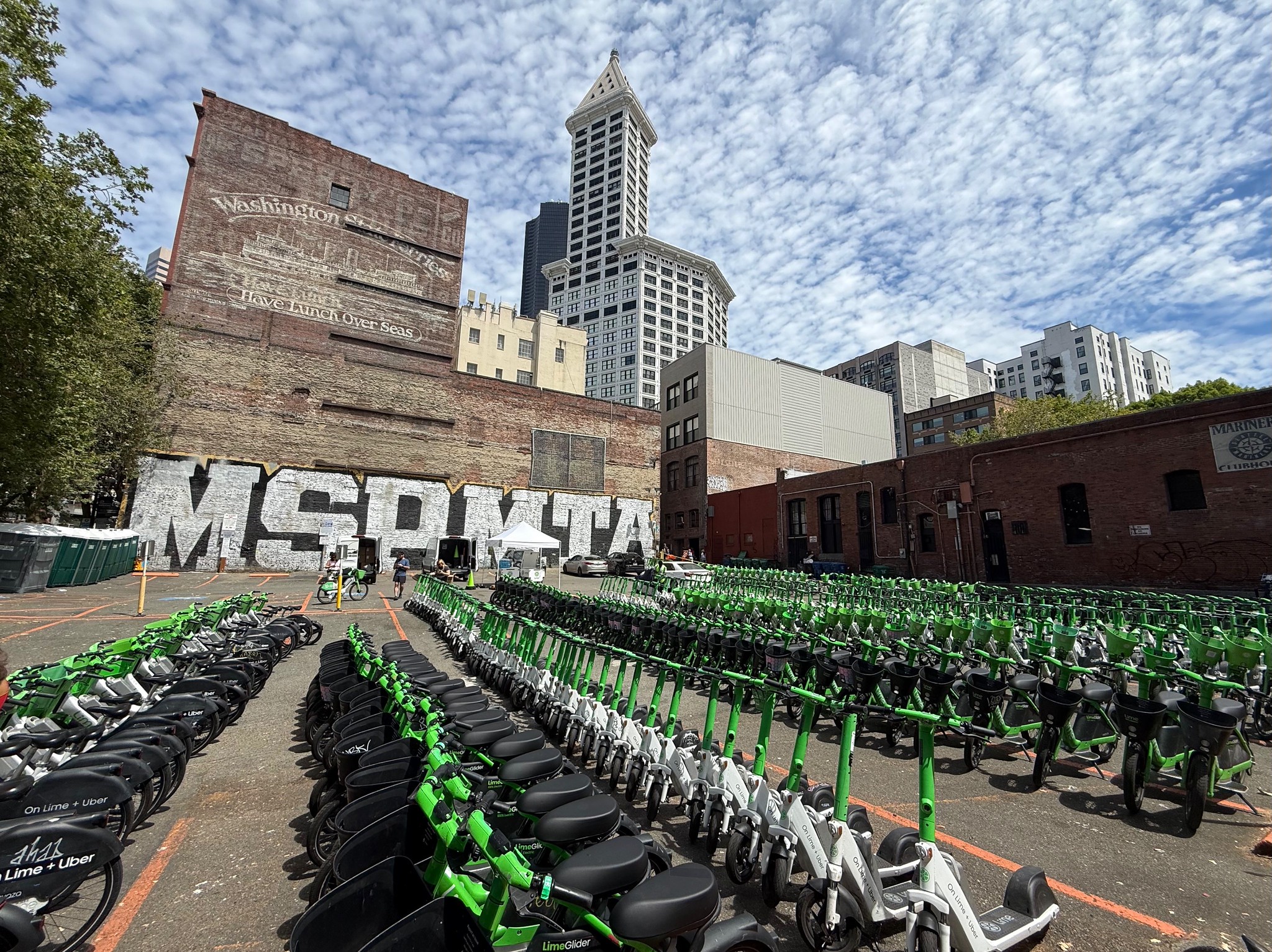
Lime’s record-setting volume is also a reflection of its unique position in Seattle. After rival operators exited the market, Lime became the exclusive vendor in the City of Seattle’s micromobility share program. That means every shared e-bike and scooter you see on Seattle streets is a Lime vehicle. The company has scaled its fleet to 15,000 active devices, all of which are serviced and staged out of a sprawling warehouse south of downtown in the Georgetown neighborhood. The warehouse is the beating heart of the operation. On a typical day, dozens of workers charge batteries, tighten bolts, replace tires, and clean mud off fenders. During major events, the pace becomes frantic. A related GeekWire story took readers inside the warehouse, where 15,000 bikes and scooters were prepped for the World Cup surge. Staff worked in shifts to ensure that every device was ready to be deployed to the right part of the city at the right time. The logistics are complex: vehicles need to be available near stadiums, transit stations, dense neighborhoods, and popular destinations, but not in the way of pedestrians or emergency vehicles. Lime’s operations team monitors demand in real time, dispatching vans to rebalance fleets as riders leave vehicles in unexpected places. It is a choreography that most users never see, but it is essential to making the service feel seamless. Being the only vendor also brings responsibility. There is no competing app to fall back on if a bike is broken or a scooter is out of battery. Lime has responded by investing heavily in maintenance and durability, knowing that a single bad experience can send a rider back to their car. The exclusive arrangement has been debated in some circles, but the ridership numbers suggest that, at least for now, it is working. And for riders, the simplicity of one app, one brand, and one reliable network is a big part of the appeal.
To keep the momentum going, Lime is focusing on affordability and inclusion. The company already offers LimeAccess, a program designed for low-income riders, and its LimePrime subscription — priced at $5.99 per month — has become enormously popular, with more than 38,000 monthly subscribers in Seattle. LimePrime offers perks like reduced ride fees and free unlocks, making the service more predictable for people who ride regularly. This week, Lime added another tool: a commuter-hours pricing pilot that lowers per-minute rates during daytime travel windows. The idea is simple: make it cheaper to ride when people are actually trying to get to work or run errands, not just when they are heading out for fun. This is a deliberate strategy to convert event riders into daily commuters. The World Cup and the Seahawks parade brought thousands of new users to the platform, but Lime knows that a first ride is just the beginning. If the price is right and the experience is good, that user might become a regular. The affordability push matters in a city where the cost of living is high and owning a car is expensive. For many residents, a Lime subscription is a bargain compared with parking, gas, insurance, and maintenance. For others, it is a lifeline — a way to get to a job interview, a class, or a grocery store without relying on someone else. The new pricing pilot is being rolled out carefully, with Lime monitoring how it affects both ridership and revenue. But the message to Seattle is clear: the company wants to be more than a novelty; it wants to be a part of everyday life. Harvey, the regional director, emphasized gratitude to riders who “choose day in and day out; rain or shine, two wheeled transportation instead of four.” That phrase captures the emotional core of the service. It is not just about efficiency. It is about pride, independence, and a willingness to embrace the elements. It is about looking at a rainy forecast and deciding that a scooter ride is still better than sitting in traffic.
Looking ahead, the numbers suggest that Seattle is well on its way to becoming the “micromobility-first city” that Lime’s CEO envisions. But that label is not just about Lime. It is about the partnership with SDOT, the city’s commitment to protected bike lanes and safe streets, and the willingness of residents to try something new. The record ridership would not have been possible without years of planning, infrastructure investment, and community engagement. SDOT has worked to create a network of routes that connect neighborhoods and make riding feel safer, and Lime has responded by placing its vehicles where they are most useful. The result is a virtuous cycle: more riders mean more political support for bike lanes, which means more riders. The World Cup proved that Seattle can handle enormous crowds without grinding to a halt, as long as people have alternatives to cars. The Seahawks parade proved that joy and mobility can go hand in hand. And the quiet Tuesday-morning commutes prove that micromobility is not a fad. As October rolls on and the days grow shorter and wetter, Lime riders are still going. They are bundled up, wearing rain jackets and gloves, unlocking bikes and scooters to get where they need to go. The 10.5 million trips are a milestone, but they are also a beginning. Every ride is a small statement about the kind of city Seattle wants to be: connected, accessible, and less dependent on the automobile. The challenge now is to keep building on that momentum — to make sure that the infrastructure, the pricing, and the culture continue to support two-wheeled transportation. If the first ten and a half million trips are any indication, Seattle is ready to ride. The streets will keep humming with electric motors, the hills will keep testing riders’ legs, and the rain will keep falling. But the people of Seattle have made their choice, and it is one that points toward a greener, more human future.