



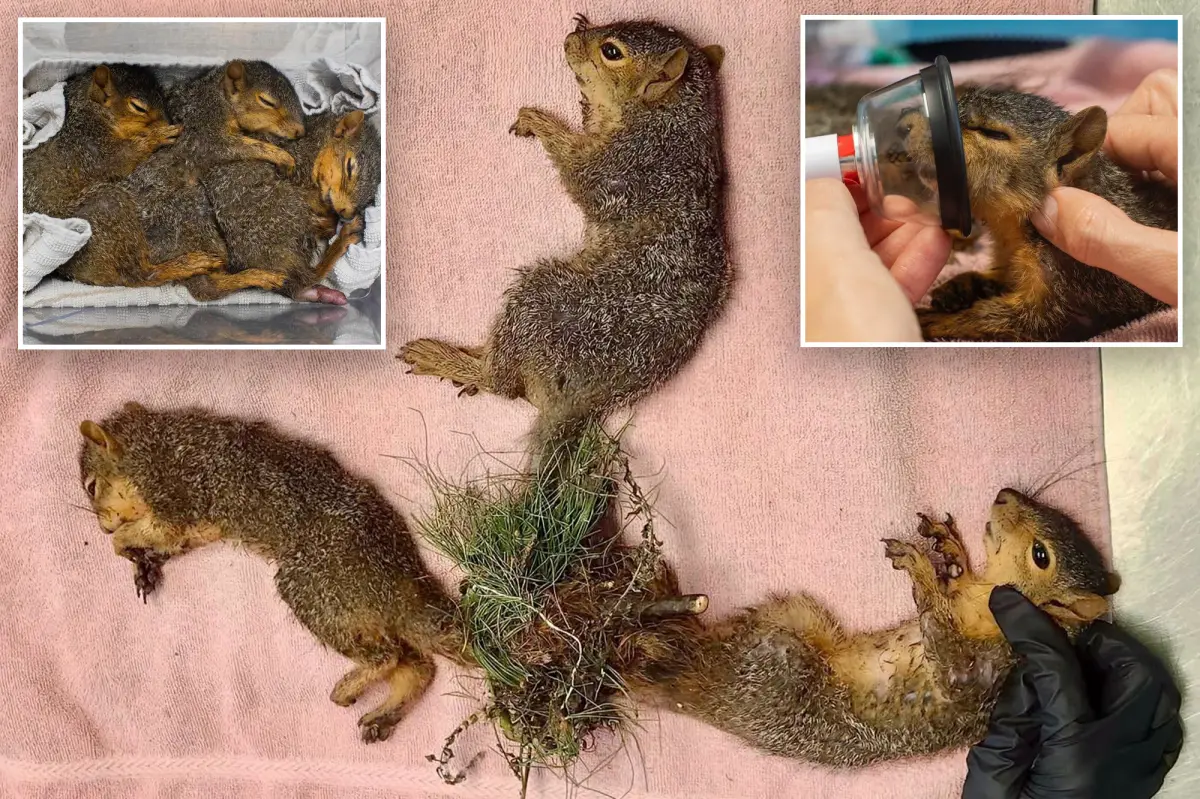
In the quiet moments before dawn, a small cardboard box arrived at ReWilding Indiana’s wildlife hospital. Inside, not one, but three tiny bundles of fur, barely 12 weeks old, lay tangled together, their tails fused into a knot. It was a sight so strange that even experienced wildlife rehabilitators had to pause. The three baby squirrels had been discovered by a good Samaritan in the wild, and they were literally inseparable. Their tails had become woven together with grass, leaves, and stray hair until the fibers tightened into an unbreakable bond. The condition is known as a “squirrel king,” a rare phenomenon that echoes the old legend of the “rat king.” For these three, survival depended on getting them apart, but nature had made them one. The rescue team knew immediately that this would require surgery, and even then, there was no guarantee the squirrels would keep their tails. Yet in that first moment, the priority was simply to offer comfort, warmth, and a gentle voice, because these frightened little animals had no idea why they were stuck, or why the world had suddenly become so strange. They had likely spent their entire short lives pressed against one another, unable to roam freely, unable to climb, unable to be normal young squirrels. Now, in a quiet room with soft bedding and careful hands, they were finally safe.
A squirrel king is not a myth, but it is extraordinarily uncommon. It happens when two or more baby squirrels share a nest and their tails become entangled in nesting materials. The nest is a cozy mixture of grass, leaves, moss, and sometimes animal fur, and if a few strands wrap around the sensitive tips of tiny tails, the movements of the babies can pull the knot tighter and tighter. Over time, the tails heal around the binding, but the squirrels remain fused, unable to separate. The name “squirrel king” comes from the older and even rarer “rat king,” a term used in European folklore for a cluster of rodents whose tails were knotted together. People once believed this was a sinister omen, but in truth it is a tragic accident. For the three squirrels now in ReWilding Indiana’s care, the condition had already caused serious damage by the time they arrived. Their tails were not just matted; they were damaged, with circulation compromised and tissue beginning to fail. Jennifer Hancock, the director of wildlife rehabilitation, explained that the good Samaritan had done exactly the right thing by bringing them in. But the team had to make a heartbreaking choice. Because of all the damage, the tails could not be saved. The squirrels would need amputations, leaving only about an inch of tail each. It was the only way to ensure they could survive, but it meant they would have to face the world without one of nature’s most remarkable tools. For the rescue team, there was no joy in this decision, only the quiet understanding that sometimes saving a life means accepting a permanent change.
A squirrel’s tail is not just a decoration. It is a parachute, a blanket, a communication flag, and a balancing pole all in one. When a squirrel leaps from a branch, its tail acts as a counterbalance, shifting with astonishing speed to help land safely. When the wind blows cold, the squirrel wraps its tail around its body like a down-filled scarf. When danger approaches, a flick of the tail signals alarm to other squirrels. And when a squirrel is walking along a narrow fence, the tail helps it stay steady, almost like a tightrope walker’s pole. Losing such an important part of the body is no small thing. The three young squirrels, now named Charles, Solomon, and Francesca after royalty, have to learn a new way of moving through the world. They are only 12 weeks old, still teenagers in squirrel terms, and their brains are wonderfully adaptable. But the road ahead is uncertain. The surgery itself was delicate, but the real test is how these squirrels will cope with their new bodies. They will never have the full, elegant plume of a wild squirrel. Their movements may be a little clumsier, their landings a little less precise. Yet the rescue team believes that with time, patience, and careful rehabilitation, these three can still live rich and meaningful lives, whether in the wild or in a protected setting. It is a reminder that disability is not the end of a story; it is simply a new chapter, written in a different way.
In the days after surgery, the rescue staff watched anxiously. Would the squirrels be depressed? Would they refuse to eat? Would they even be able to climb? The first signs were encouraging. Charles, Solomon, and Francesca woke from their recovery with bright eyes and healthy appetites. They began eating and drinking with enthusiasm, as if relieved to finally be free from the painful knot that had held them together. Soon they were climbing all over their cage, exploring every corner, wrestling with each other as young squirrels love to do. Hancock described their progress with a smile in her voice: “They’re doing really well. Eating and drinking great, and climbing all over their cage.” To help them adjust, the team filled their enclosure with hammocks and toys. The hammocks are especially important because they give the squirrels a soft, safe place to rest, and they also challenge the squirrels to climb and balance without the aid of a long tail. Watching them scramble up the mesh walls and leap from platform to platform, it is easy to forget that these are animals that have just undergone a major surgery. Their resilience is remarkable. They seem not to know that they are supposed to be disadvantaged. They simply get on with the business of being squirrels, chasing each other’s stumpy tails, grooming their fur, and chattering with the sassy confidence of creatures that have already survived the impossible. Their joy is a quiet lesson for all of us about adapting to circumstances we never chose.
But the rescue is not over yet. The real test will come when the squirrels move to an outdoor enclosure, a large space filled with branches, climbing structures, and natural challenges. There, the rehabilitation team will watch to see how the squirrels handle their lack of tail in a bigger, more demanding environment. Can they still jump from branch to branch with accuracy? Can they balance on narrow ledges? Can they gather food and avoid predators without the warning flick of a tail? These are questions that cannot be answered in a small cage. Indiana’s weather is famously unpredictable, with cold winters and sudden temperature swings, so the rescue will likely keep the squirrels through the winter. This gives the animals more time to heal, grow stronger, and adapt to their new bodies. It also gives the rehabilitation team a chance to assess their chances of survival in the wild. Hancock is careful not to promise anything. She says it is possible that none of the squirrels will be released, but some or all three could be if they adjust well. The decision will be made not by humans, but by the squirrels themselves, through their behavior, their confidence, and their ability to thrive. It is a slow, thoughtful process, and it is exactly how wildlife rehabilitation should work. The goal is not just to save animals, but to give them the best possible future, whatever that may look like. For Charles, Solomon, and Francesca, that future is still being written, one small climb at a time.
For ReWilding Indiana, this is the first case of squirrel king they have ever treated, a reminder that nature is full of strange and unexpected stories. It is easy to think of wildlife as orderly, but the natural world is messy, chaotic, and often heartbreakingly cruel. Yet it is also resilient. These three little squirrels, named for kings and queens, have already shown a courage that is difficult to put into words. They came into this world tangled together, trapped by accident, and they will never be quite like other squirrels. But they are alive, they are eating, they are climbing, and they are playing. Their future is uncertain, but it is full of possibility. Whether they are released into the wild or find a permanent home under human care, they will have been given a second chance. And that is the heart of wildlife rehabilitation. It is not about changing nature or fixing every problem. It is about stepping in when we can, offering a gentle hand, and then stepping back to let the animals live their lives. Charles, Solomon, and Francesca have already taught everyone around them a lesson about patience, adaptability, and the sheer stubborn will to live. Their tails may be short, but their story is one of the longest and most beautiful that ReWilding Indiana will ever tell.