


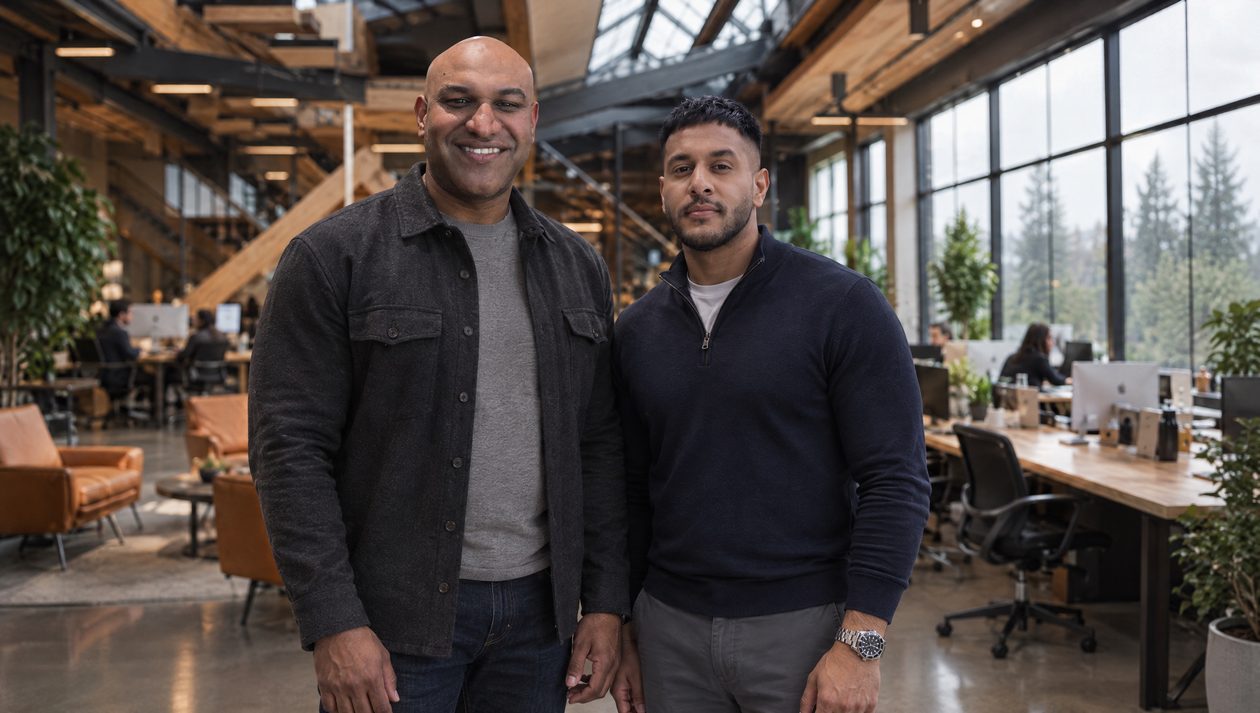
Imagine spending a fortune on a billboard, then not knowing whether anyone who saw it actually walked into your store. On the web, that is the daily reality for countless companies: they invest heavily in advertising, social media, search, and slick content to drive traffic, but traffic alone does not pay the bills. Bellevue, Wash.-based startup Zeacon wants to close that gap. Co-founded by Kris Naidu and Jay Gounder in 2023, Zeacon builds AI tools that connect what businesses show people online with what those people actually do and whether they buy. The platform can generate video content from product photos, personalize website experiences in real time, track engagement, and identify bot traffic. It also tries to understand how both humans and AI agents navigate websites, an increasingly important capability as artificial intelligence changes the way people discover and interact with businesses. With $6 million in friends and family funding and a team of 13, Zeacon is still small, but its ambition is broad. As Naidu puts it, “We help businesses deploy AI agents that optimize their entire digital funnel, with an initial focus on video.” These agents can autonomously generate videos without prompting, publish them across social media and websites, personalize the experience for each visitor, and continuously analyze and optimize performance. But the real goal is not more content or more traffic; it is conversion. Zeacon is obsessed with turning the attention companies have already paid for into actual sales.
The core problem Zeacon is solving is not creative production; it is the disconnect between marketing and buying. Brands put real money into advertising and produce beautiful videos, but the website where customers are supposed to make a purchase often feels disconnected from all that effort. A visitor might watch a compelling product video on social media, click through, arrive on a generic landing page, and leave because nothing feels relevant or persuasive. Zeacon’s platform brings that marketing content directly onto the website, personalizes it to the individual visitor, and connects engagement to buying behavior. It can also create new videos from product photos and website data, and perhaps more importantly, it can create videos based on what has actually converted in the past. “We are obsessed with helping businesses turn the attention they already paid for into sales,” Naidu says. What surprised him and Gounder after talking to customers is how much opportunity already exists within the assets companies have. Businesses are sitting on videos, product photos, website traffic, and customer data, but they have no way to connect them. A marketing team wants to know: Which content helps people buy? Where are we losing customers? What should we create next? That feedback reinforced Zeacon’s belief that the real value is not generating more stuff; it is turning information into a decision a company can act on. It is also why Zeacon pays attention to bots. In an age when automated agents roam the internet, not all traffic is equal, and not every signal is real. By separating humans from bots and analyzing how AI agents move through a website, Zeacon gives businesses a clearer, more honest picture of what drives conversions and what needs to be fixed.
Artificial intelligence has changed not just what Zeacon builds, but how the company thinks about its mission. Zeacon can understand website and product information, generate video from pictures without prompting, choose relevant content for a visitor, and let teams ask questions about performance in plain English. But the deeper shift is that AI makes it possible to create a self-improving system. “We’re building those capabilities together: create, personalize, measure, and learn,” Naidu says. Each result can inform the next decision. That is a much bigger opportunity than simply making content faster. It means helping a business continuously improve how it sells. Traditional marketing tools often give you a dashboard after the fact, full of metrics but short on meaning. Zeacon wants to close the loop in real time. AI agents can publish content, track how people respond, adjust the experience, and learn what works, all without waiting for a human to analyze spreadsheets. “AI changed what we could take off the customer’s plate,” Naidu explains. In a world where AI-powered search and recommendation agents are becoming the new gatekeepers of discovery, businesses need to be legible to machines as well as humans. Zeacon’s focus on identifying bots and understanding how AI agents navigate websites is not just about security or fraud; it is about making content accessible, relevant, and useful in an automated, attention-scarce economy. If an AI research assistant is deciding whether to recommend your product, the way it reads your website matters as much as the way a human does. Zeacon is building for that future.
One thing Naidu says people misunderstand about Zeacon, and about AI companies in general, is that revenue alone does not tell you how valuable a startup is. Revenue matters because it proves customers will pay, but data deserves equal attention because data determines what the system can learn and how useful it becomes. “At Zeacon, we care about the connection between visitor behavior, content, and conversion,” Naidu says. The advantage comes from the quality of the data and the ability to turn it into better customer outcomes. His advice to investors is to ask what a company is learning with every deployment, not just what it earns. That is how you understand true growth value. Many startups can generate revenue by selling features that save time or produce flashy content, but if there is no feedback loop, the business is standing on one leg. Zeacon’s long-term bet is that every interaction on a website, every video viewed, every pause, every click, every conversion or abandonment, becomes a signal. The more the platform is used, the smarter its agents become. Naidu also warns against being too focused on near-term value. “Upfront value without long term vision affects companies,” he says. Zeacon is focused on delivering a product that adds real value now but cannot be easily replaced later. In other words, the moat is not content generation; it is learning. If an AI tool can create a video in seconds but does not know which video persuaded someone to buy, anyone can copy that tool. But if the AI learns that your customers respond better to a certain product angle, price point, or emotional tone, that proprietary insight becomes difficult to replicate. For Zeacon, data is not just an input; it is the product itself.
The toughest decision Naidu has made in the past year was not about raising money or choosing a market; it was deciding what to say no to. When your technology opens up many opportunities, it is tempting to pursue all of them. But customers need you to solve their problem well. Zeacon’s focus is on helping businesses use video and data to improve the website experience and grow sales, and every opportunity is judged against that purpose, even when it is exciting. The data helped Zeacon understand the entire flow of users, and that led to a realization. “We realized it was not just about providing outcomes for sales but helping customers fix issues within their website journey and using content to help fill gaps for the desired outcomes,” Naidu says. That is a subtle but important expansion: Zeacon does not just tell you that you lost sales; it helps uncover why. Maybe a form is too long, a product description is confusing, or a video fails to answer a common objection. In that way, content becomes a way to repair broken parts of the customer journey. Naidu’s advice to other entrepreneurs is direct and grounded: focus. He says, “Get close to your customers, understand the problem they will pay you to solve, and keep delivering against it. Do not confuse more features with more value. Make something customers use, trust, and want to keep. It is hard, but being focused is the key to winning.” He credits Zeacon Chairman Michael John Phillips, the former CEO of Russell Investments, with teaching him about leadership, alignment, and leading teams. Naidu is the kind of founder who reads The Prince, listens to Forrest Frank, and drinks four shots over ice with two percent milk; disciplined, determined, and unapologetically focused.
For Naidu, the ultimate sign of success is not an acquisition or a huge valuation. “We’ll know our company has made it when Zeacon is recognized for creating a new business science on relating content and user behavior to actual business outcomes.” That statement captures the startup’s larger vision: replacing guesswork with a causal understanding of marketing. Zeacon wants to answer not just “did you get more traffic?” but “which content triggered a sale, why, and for whom?” It wants to make every dollar of advertising accountable to customer behavior and, ultimately, to revenue. The elevator pitch is simple: businesses can deploy AI agents to optimize their entire digital funnel, starting with video. The agents generate, publish, personalize, identify bots, analyze, and optimize. But the deeper promise is accountability. Marketing budgets are often wasted on attractive content that moves no one. Zeacon wants to change that by turning websites into living, learning storefronts that respond to every visitor in real time. As AI reshapes the internet, the winners will be those who listen to their data, treat each visitor as a unique human being, and are willing to adapt based on what people actually do. For Kris Naidu and Jay Gounder, Zeacon represents a more honest way to do business. The company may be young, but it has already moved from building a feature to building a learning system. If it is right, the businesses that embrace this new science of content and behavior will not just attract more attention. They will finally understand what to do with it, and they will turn that attention into sales, one conversion at a time.