


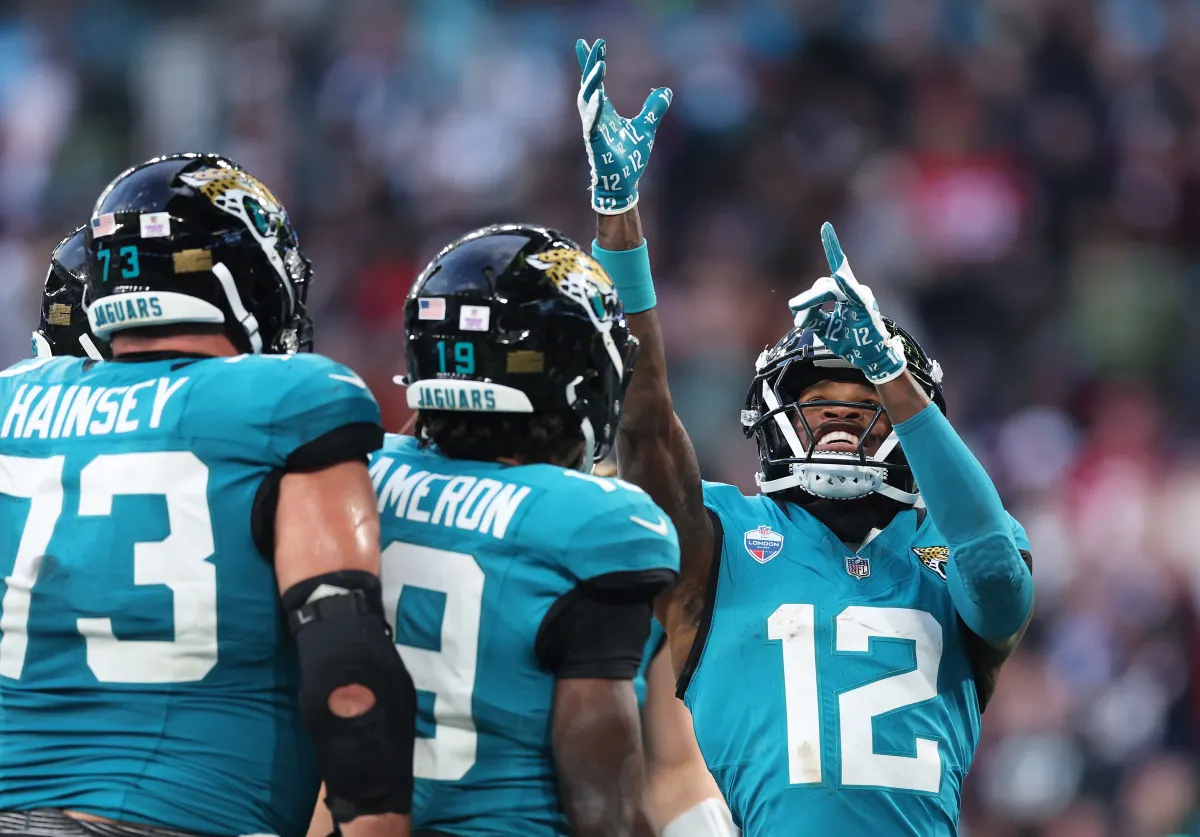
When the Jacksonville Jaguars traded up in last year’s NFL draft to select Travis Hunter, they were not just adding a talented rookie to the roster. They were making a bold declaration about what football can look like. Hunter arrived as the Heisman Trophy winner, a generational athlete who had spent his college years doing something that modern players are rarely allowed to do: playing every meaningful snap on both sides of the ball. He was a wide receiver and a cornerback, a scoring threat and a defensive eraser, all in one dazzling package. That made him one of the most talked-about prospects in years, but it also made him a fascinating experiment. Some scouts saw the next Deion Sanders. Others worried that the NFL’s speed, size, and tactical complexity would force Hunter to eventually surrender one side of his game. The debate followed him across the Atlantic, too, as the Jaguars arrived in London for their second international game of the season against the Houston Texans. Wembley Stadium was buzzing with the unique energy that only a transatlantic football spectacle can create, a sea of jerseys, flags, and nervous anticipation. For the Jaguars, this was a chance to make a statement in the AFC South. But for Hunter, it was something more personal. He had been a headline his entire football life, but he still needed to prove that his two-way magic could translate to the professional stage. As the game began, that stage seemed enormous. By the time it ended, Hunter had turned that enormous stage into his own private highlight film. He had not simply played two positions. He had done something that no one in the NFL had done in 24 years, and he had done it in front of a global audience that will not soon forget it.
In the fourth quarter, with the score tight and the pressure mounting, Jaguars quarterback Trevor Lawrence dropped back and looked toward the end zone. He found Hunter, who had worked his way into a small pocket of space near the goal line. Lawrence fired a seven-yard strike, and Hunter secured it with the kind of calm precision that separates great receivers from ordinary ones. It was his first touchdown of the NFL season, a moment that had been waiting for him since the season opener, and it pulled the Jaguars within three points of the Texans. But Hunter had no time to linger on the celebration. He was needed on the other side of the ball. The very next Houston possession gave him an opportunity to remind everyone why he had been such a unique draft prospect. Texans quarterback C.J. Stroud tried to move the ball against Jacksonville’s defense, and at one point he targeted wide receiver Xavier Hutchinson. Hunter, now lined up as a cornerback, read the play with the same instincts that made him a star receiver. He broke on the throw, positioned his body perfectly, and intercepted the pass as if he had been playing defense his entire life. Touchdown and interception, in the same game, by the same player. It was one of those rare feats that makes fans stop and ask, “Wait, how long has it been since that happened?” The answer was stunning: 24 years. The last player to do it was Brian Dawkins, a Super Bowl champion and Hall of Famer. And before Dawkins, Roy Green had accomplished the same double in 1981 while with the St. Louis Cardinals franchise that eventually became the Arizona Cardinals. Those are not ordinary names. Those are legends.
To understand how truly special Hunter’s achievement was, it helps to consider just how much the NFL has changed since Dawkins pulled off the same feat. Back then, players were still allowed to be hybrids in a way that feels almost foreign to today’s game. Dawkins was a safety known for fierce hits and unrelenting energy, but he also had the athleticism to contribute on offense when his team needed him. Roy Green did the same in a different era, playing wide receiver and defensive back in the early eighties, long before the league became a collection of hyper-specialized skill sets. In the modern NFL, players are expected to fit into neat boxes. A cornerback spends his week studying opposing receivers. A wide receiver works on timing and route running. The idea of one player being truly elite at both jobs seems almost impossible, because the mental toll alone would break most athletes. Yet Hunter made it look natural. He scored a touchdown with the concentration of a veteran receiver, then intercepted a pass with the instincts of a seasoned defensive back. He did not just survive the switch between roles; he thrived in both. That is what made Sunday’s performance so much more than a statistical curiosity. It was a reminder that the human body, and the human mind, are capable of more than modern football often asks of them. Hunter’s name now sits alongside Dawkins and Green, two men who played the game in completely different eras but shared that same rare ability to do two jobs at once. That is not the kind of company you stumble into by accident. It is the kind of company that is reserved for players who refuse to be limited by convention.
The game itself was a dramatic back-and-forth battle that deserved a stage like Wembley. Houston came into the matchup with questions of their own, but they played with urgency from the opening whistle. The Texans managed to build a 17-14 lead by halftime, and after the break they continued to press their advantage, outscoring the Jaguars 14-7 in the third quarter. That left Jacksonville chasing the game in the fourth quarter, which is exactly when Hunter delivered his two signature moments. His touchdown gave the Jaguars renewed hope, and his interception handed them a chance to steal the game. But football is rarely kind to individual heroics without team support. Despite Hunter’s incredible effort, the Jaguars could not finish the job. The Texans held on for a 34-31 victory, celebrating a second straight win after a season full of struggles. For Jacksonville, it was a crushing way to lose. Hunter finished the game with four receptions for 49 yards and a touchdown to go along with three tackles and that beautiful interception. The numbers were almost perfect, a box score that looked like something from a video game. But as Hunter stood on the sideline after the final whistle, there was no joy in his face. He had made history, but he had also lost a divisional game, and for a competitor like him, that loss was all that mattered. He was not thinking about the record books. He was thinking about the throws he could not complete, the tackles he could not make, and the result he could not change. That is what makes him so compelling as a player. He wants it all, and he wants it every week.
There were plenty of skeptics when the Jaguars made Hunter their centerpiece. Some wondered if playing both positions would wear him down by November. Others questioned whether he could really be great at both jobs or whether he would simply be average at each one. Those concerns were not unreasonable. The NFL season is long and brutal, and the mental workload of playing on both offense and defense is enormous. But Sunday’s performance offered the most powerful response that Hunter could provide. He did not just line up on both sides of the ball; he made game-altering plays on both sides of the ball. He gave his team a lifeline in the fourth quarter as a receiver, then he gave them the ball again as a cornerback. That is not a gimmick. That is a competitive weapon. The Jaguars now know that they can trust him in high-leverage moments, and that knowledge opens up countless possibilities for their coaching staff. They can move him around on offense, use him as a decoy, feature him in the red zone, and still rely on him to make key defensive plays in the same game. Opposing teams will have to prepare for a player who exists in two worlds at once, and that is an uncomfortable reality for any coordinator. There is still a long season ahead, and Hunter will face difficult weeks, injuries, and inevitable mistakes. But he has shown that he is not just a marketing story or a draft-day gamble. He is a legitimate two-way talent in a league that thought it had seen the last of them.
Looking ahead, Hunter’s rare achievement will become a defining moment of his young career, but it is also something more. It is a glimpse of what the NFL could look like if coaches were willing to blur the lines between positions, and it is a reminder that the sport is still full of surprises. The Jaguars may have lost the game, but they found something valuable in the loss: proof that their vision for Hunter is real. They have a player who can change the outcome from either side of the ball, and that is an exciting foundation to build on. Hunter will need time to develop, and the Jaguars will need to manage his workload carefully, but the possibilities are tantalizing. He is not the first player to do what he did, but he may be the first in a new generation of athletes who refuse to be categorized. In an era of specialists, he is a throwback, but with modern speed, athleticism, and polish. The loss to Houston stings, and there will be more disappointments along the way. But for one afternoon in London, Travis Hunter gave everyone a reason to believe that football can still produce the impossible. He caught a touchdown and intercepted a pass in the same game, a feat that had not happened in 24 years, and he did it with the poise of someone who knew exactly how special it was. The NFL is better when players like him are allowed to show the world what they can do, and Sunday was proof that the world is watching.