


The Dream That Died in Los Angeles
Back in the summer, when the NFL schedule first dropped and Los Angeles began to map out its football future, there was something in the air that felt almost magical. The Super Bowl was heading to SoFi Stadium, the gleaming, spaceship-like venue that both the Rams and the Chargers call home, and the natural thought—the one fans whispered to each other with a giddy mix of hope and disbelief—was simple: what if both L.A. teams made it there? An all-Los Angeles Super Bowl, played right in their own backyard, with all the pageantry, the celebrity-studded halftime show, the traffic nightmares, and the glory that would come with it. The Rams had already proven they could climb that mountain, having hoisted the Lombardi Trophy just a few years earlier. The Chargers, meanwhile, appeared to be a sleeping giant finally stirring awake. Justin Herbert, the rocket-armed, impossibly composed franchise quarterback, was entering the prime of his career. Jim Harbaugh, the khaki-wearing, intensity-maximalist coach who seemed to manufacture winning wherever he went, had arrived with a mandate to turn this talented-but-underachieving franchise into a legitimate contender. The ingredients for a Hollywood ending were all there, laid out like a screenplay written in the clouds. But six weeks into the real season, that script has been ripped up, torn apart, and tossed into the Pacific. The two Los Angeles teams have combined for a brutal 2-10 record, an almost laughable collapse for a city that was supposed to be the center of the football universe in February. The Rams have stumbled through a series of frustrating, demoralizing losses that have left their fan base shaking their heads. And the Chargers, the team that was supposed to be the city’s great hope, have yet to win a single game. The Super Bowl fantasy hasn’t just faded; it has been replaced by something far grittier—a coaching crisis, a struggling franchise quarterback, and a fan base wondering if the dream will ever be anything more than a punchline.
The Crisis Behind the Bye
Now, as the Chargers enter their bye week, there is no relaxation, no celebration, no quiet period of healing and planning. There is only a thick, suffocating cloud of tension hanging over the organization. Teams typically use their bye week to rest, recharge, and take a step back from the grind of the season. The Chargers, however, are using theirs for something far more urgent: emergency triage. At 0-6, they are the last winless team in the league, a distinction that carries with it a special kind of sting, especially for a franchise that spent the entire offseason telling anyone who would listen that this year would be different. And to make matters worse, the timing could not be more brutal. The loss to the Kansas City Chiefs on Sunday, a 22-6 defeat that wasn’t even as close as the score suggests, felt like the final straw for many fans. The defense, to its credit, did its job for much of the afternoon, keeping the Chargers within striking distance. But the offense, the unit that was supposed to be the engine of this team, failed to generate anything resembling life. Three field goals, zero touchdowns, another missed opportunity in the red zone, another afternoon of Herbert throwing into coverage and scrambling for his life. The frustration was visible on the sideline, where players stared blankly into the distance, the weight of the season pressing down on their shoulders. For a team with Mike Williams out, Keenan Allen aging, and a receiving corps that has struggled to create separation, the problems feel structural, not incidental. Now, with the bye staring them in the face, the question is no longer if changes will come, but when and who will be the first to go. General manager Tom Telesco is gone from past regimes, but this coaching staff is of Harbaugh’s making—which means whatever happens next is deeply personal, deeply tied to his reputation, and deeply watched by a football world that is waiting to see how he handles the first real adversity of his tenure in Los Angeles.
The Offensive Coordinator Under the Microscope
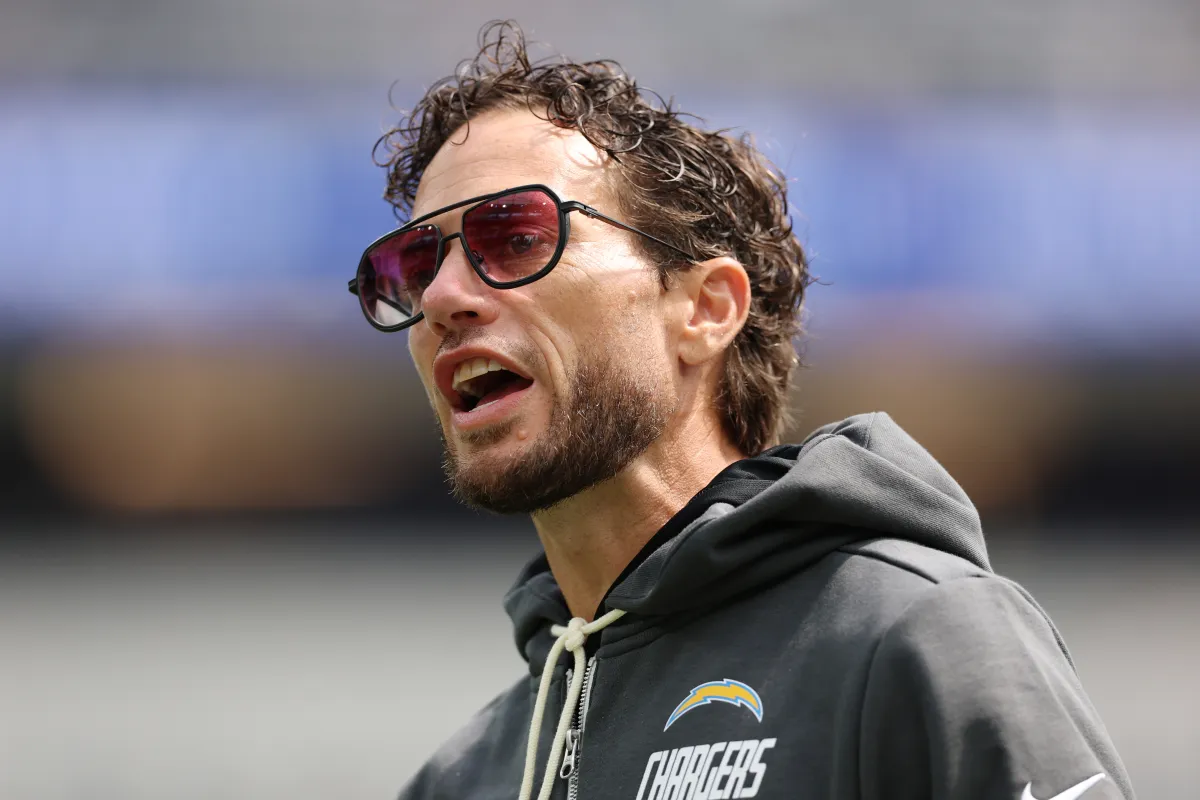
At the center of the storm is first-year offensive coordinator Mike McDaniel, whose tenure has been nothing short of disastrous. McDaniel, who was brought in to modernize the Chargers’ attack and unlock the full potential of a quarterback like Justin Herbert, has instead watched his unit sputter, stall, and collapse in a way that has made even the most patient observers uncomfortable. Through six games, the Chargers are averaging an anemic 15 points per contest—a number that ranks near the bottom of the league and a far cry from the explosive, high-flying offense that fans were promised when Harbaugh took the job. The loss to Kansas City on Sunday was the nadir, a performance that featured none of the creativity, sharpness, or execution that the coaching staff had been preaching all year. Plays came in late, protection broke down, receivers ran sloppy routes, and Herbert, the man who was supposed to be elevated by this system, looked like a shell of himself, constantly under pressure and unable to find any rhythm. The statistics tell a grim story: Herbert entered the day having thrown five touchdowns against seven interceptions, a ratio that would have been unthinkable for him just a year ago. On Sunday, he threw for 204 yards and another interception, adding to a highlight reel of poor decisions and uncharacteristic errors. Making matters worse, the coaching staff’s decisions have been questioned at nearly every turn—fourth down calls that were too aggressive in the wrong moments, conservative play-calling in crucial situations, and a seeming inability to adjust to what opposing defenses are doing. As the losses have piled up, so has the heat on McDaniel. What was once a quiet murmur has become a roar, and according to Mike Florio of Pro Football Talk, there is growing buzz around the league that the Chargers are preparing to make a change—and make it soon.
The Familiar Face Waiting in the Wings
If the Chargers do indeed pull the trigger, the name doing the rounds in league circles is Adam Gase, a familiar figure to anyone who followed the AFC East over the past decade. Gase, who currently serves as a pass game specialist on the Chargers’ staff, is a former head coach of both the Miami Dolphins and the New York Jets, and while his head-coaching record was far from spectacular, his offensive mind has long been respected in coaching circles. Gase was the man behind Peyton Manning’s record-breaking season in Denver, when the Broncos lit up the scoreboard like a pinball machine, and he has a reputation for designing schemes that get the ball out quick and into the hands of playmakers in space. That kind of approach is exactly what a struggling Herbert needs right now—someone who can simplify things, build confidence, and put him in positions to succeed rather than asking him to throw into tight windows or hold the ball in a collapsing pocket. The irony, of course, is that Gase is already in the building, already watching the same practices, already seeing the same breakdowns that have made this offense so ineffective. That familiarity could be a double-edged sword: he knows the problems intimately, but he is also part of the very system that created them. Yet in the NFL, when a season is slipping away, teams often reach for the most familiar option rather than the most creative one, and Gase fits that mold perfectly. He is a known commodity, a coach who has been in the big chair before, someone who can walk into the meeting room and immediately command respect from players who know they are running out of time to save their season. Whether that’s the right move is a matter of fierce debate—Gase’s tenure with the Jets, in particular, was marred by dysfunction and quarterback stagnation—but in the midst of a winless spiral, the Chargers are not thinking about long-term resume; they are thinking about survival.
The Heavy Burden on No. 10
It is impossible to tell this story without talking about Justin Herbert, because his fall from grace is perhaps the most disturbing element of this entire mess. Here is a man who, not long ago, was universally regarded as a top-five quarterback in the league, a generational talent with a howitzer for an arm and a calm demeanor that reminded old-timers of Peyton Manning. He was the reason so many experts picked the Chargers to make noise in the AFC, the reason so many fans purchased season tickets in a new stadium, the reason so many analysts declared Los Angeles the most dangerous dark-horse team in football. And now, six weeks into the season, Herbert looks like a stranger in his own skin. The yips—or whatever you want to call it—have taken hold. His mechanics are off, his footwork has become hesitant, his reads are slow, and too often he is holding onto the ball, waiting for a play that never comes, before taking a sack or throwing into double coverage. His interceptions have become a recurring nightmare, each one more head-scratching than the last. The worst part is that the problem appears to be as much mental as physical; you can see it in his eyes, in the way he slumps on the bench, in the way he walks off the field after another failed drive. Herbert did not get this bad overnight, and he will not get better overnight, but the patience of the organization and the city is wearing thin. The narrative around him has shifted from “future MVP” to “what’s wrong with him?” in the space of a few Sunday afternoons. And while much of the blame should rightly fall on the offensive line, the coaching staff, and a receiving corps that hasn’t consistently gotten open, Herbert is the face of the franchise, which means he carries the weight of every loss, every bad throw, every disappointing afternoon. He is not a robot; he is a 26-year-old man who loves the game, who cares deeply about his teammates, and who is currently experiencing what it feels like to lose control of something he once wielded with effortless precision.
Harbaugh’s Heartfelt Reckoning and the Uncertainty Ahead
In the aftermath of the loss to Kansas City, Jim Harbaugh stood at the podium in a quiet, reflective mood that felt different from his usual feisty, brimming-with-confidence self. There was no rousing sermon about “toughness” or “getting back to the basics,” no defiant promise of better days or grand proclamations about the character of his football team. Instead, there was something rawer—a coach realizing that his grand plan has gone off the rails, and that the people he is responsible for are hurting. “We’re going to look at everything,” he said softly. “I feel bad for our players, our team, our coaches, our fans. And the offense needs to be addressed.” Those words hung in the air like a confession. For the first time, Harbaugh publicly acknowledged that the status quo is unacceptable, that changes may be coming, and that he takes the failures personally. It was a human moment from a coach often caricatured as a relentless, single-minded machine. Behind the scenes, the pressure is mounting. Harbaugh is a proud man, a coach who built his reputation on transforming programs and elevating quarterbacks, and watching his offense disintegrate in front of millions of viewers has to be a deeply personal failure for him. The bye week now becomes a mirror, a period of brutal self-examination where every play, every call, every decision will be scrutinized. Whether the Chargers fire McDaniel, promote Gase, or make some other yet-unknown move, the message is clear: the current approach is not working. What happens next is anyone’s guess—this is the NFL, where fortunes can turn in a single week, but they can also spiral into irrelevance. For Chargers fans, many of whom have lived through decades of heartbreak, this season feels like another chapter in a painful book they’ve read too many times. But for Harbaugh, for Herbert, and for a franchise desperate to prove it belongs among the league’s elite, the next few days will define not just the season, but perhaps the entire trajectory of their time in Los Angeles. The dream of an all-L.A. Super Bowl is officially dead, but what rises from its ashes—a phoenix, or a wrecking ball—remains to be seen.