


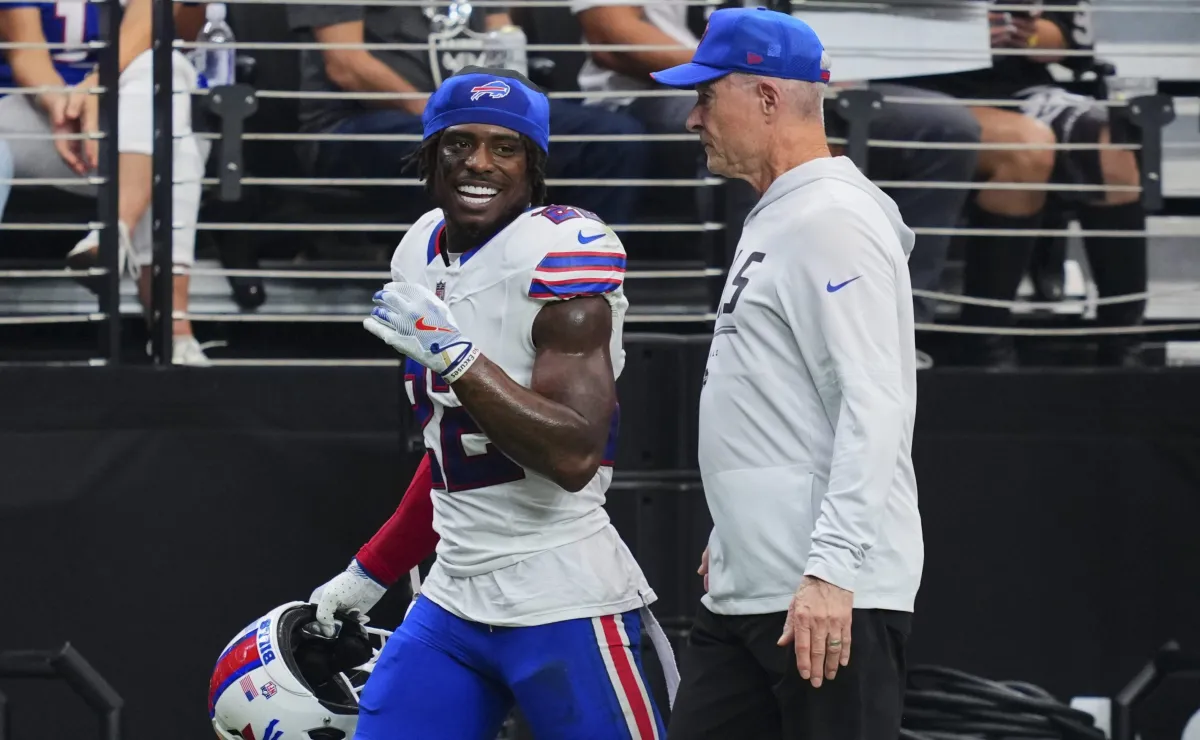
Buffalo Bills safety C.J. Gardner-Johnson has long been one of the NFL’s most polarizing figures—a player whose talent is impossible to ignore but whose behavior often makes it impossible to look away. He is the kind of opponent you hate to face, the kind of teammate you love to have. His voice is everywhere on the field, a constant stream of chatter designed to distract, provoke, and unnerve. In 2023, The Athletic asked NFL players themselves to weigh in, and they voted him the biggest trash-talker in the league. A year later, the same poll expanded and gave him the even more revealing title of Most Annoying Player in the NFL. These honors, if they can be called honors, were not random. They were earned through years of pushing the boundaries of acceptable behavior. Gardner-Johnson has made a career out of living on the edge, whether it is jawing at an opposing sideline, celebrating a bit too aggressively, or finding creative ways to get under a rival’s skin. To his fans, he is a chess master of psychological warfare. To his critics, he is a provocateur who cares more about chaos than competition. And to the players who have to line up against him, he is simply the player they love to hate. But on a Sunday afternoon in Las Vegas, the approach that has defined his career finally went from crossing a line to shattering one, and the replay cameras caught it all.
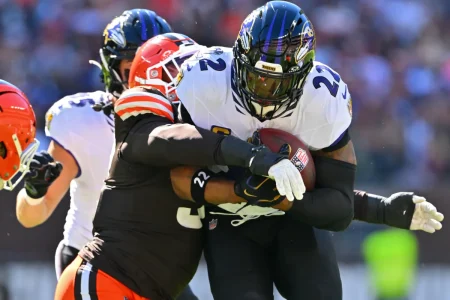
The incident occurred in a game against the Las Vegas Raiders, an already tense affair with the kind of emotional energy that often makes these situations boil over. Gardner-Johnson was involved in the back-and-forth that has become his trademark, trading words and pushing the limits of what the officials would tolerate. Then something happened that changed everything. Video replay showed him appearing to spit on a Raiders player. It was not an isolated moment of aggression; it happened during a heated sequence, and once the footage began circulating, there was no plausible way to explain it away. The officials reviewed what they saw, and he was ejected. His day was over. After the game, Gardner-Johnson was asked directly whether he had spit on an opponent. He did not admit it. He did not apologize. Instead, he went to the language of heat and emotion, of competition and competitiveness. “I got to just control my emotions,” he said. “There was nothing to it. It was competitive, like I said, heat of the moment. Everybody saw what was going on. There wasn’t nothing egregious against nobody, we just competing in a game, a call was made, a flag was thrown, they’re chirping, and I guess just being a competitor.” His words are heavy with the athlete’s classic defense: I am too competitive, I got caught up in the moment, I did not mean it. But the replay suggests otherwise. Spitting is not a natural expression of competition. It is a deliberate gesture of contempt, a violation of basic decency. And for a player with his history, it is hard to hear his explanation as anything other than an attempt to minimize something that cannot be minimized.
The NFL is a community that talks about itself constantly, and when an incident like this happens, the conversation moves at the speed of social media. Within minutes, fans were weighing in, analysts were sharing clips, and the collective verdict was swift: Gardner-Johnson had gone too far. But just as the story seemed to reach its peak, it got worse. Kyle Juszczyk, the Pro Bowl fullback for the San Francisco 49ers, is not a player known for attention-seeking or exaggeration. He is a respected veteran, a team-oriented leader, someone whose word carries weight. When he looked at the replay, he did not just shake his head. He shared his own experience. “This is the least surprising thing ever. @CGJXXIII spit on me last year when we beat Chicago,” Juszczyk posted on X. The tweet was a bombshell. It changed the entire nature of the story. No longer was this an isolated lapse, a single bad decision in a heated moment. It was a pattern of behavior, a habit that had been invisible until now. Juszczyk’s words gave people permission to discuss what they had suspected for years: that Gardner-Johnson’s trash-talking was not just talk. It was accompanied by actions that crossed into a place where they were no longer funny, no longer acceptable, no longer part of the game. For Juszczyk, sharing that memory may have been cathartic, but it also carried a deeper meaning. It told every player who has ever been on the receiving end of Gardner-Johnson’s antics that their frustration was valid. And it told Gardner-Johnson that the past does not disappear just because nobody talked about it at the time.
The NFL has a history of dealing with spitting incidents, and that history does not offer Gardner-Johnson any comfort. Last season, Philadelphia Eagles defensive tackle Jalen Carter was ejected on the very first play of the season opener after spitting on Dallas Cowboys quarterback Dak Prescott. It was one of the most bizarre and unsettling beginnings to a game in recent memory. There had been no buildup, no escalating feud; Carter simply crossed the line almost before the game had began. The league’s response was severe: a one-game suspension, which was counted as Week 1 since Carter barely saw the field, plus a fine of $57,222. The message was clear. Spitting is not treated as a minor infraction, not even as a simple personal foul. It is classified as a serious violation of sportsmanship, and it carries consequences that can affect a player’s pocketbook, his playing time, and his reputation. The reasoning is straightforward. In a sport where physical contact is expected, there are still certain lines that should never be crossed. Spitting is degrading. It is disrespectful. And in a world where health and hygiene are always a concern, it adds an extra layer of offense. The league cannot allow players to treat each other that way, not even in the heat of battle. Now Gardner-Johnson finds himself in almost exactly the same position Carter was in. The video evidence is clear. He has a history of being accused of similar behavior. And he plays for a league that has demonstrated it is willing to hand down significant penalties for this offense. A fine and suspension seem all but inevitable. The only question is how severe the punishment will be, and how much damage it will do to a career already defined by controversy.
But beneath the outrage, the fines, and the suspension talk lies a more human story about the cost of playing on the edge. Gardner-Johnson is not a one-dimensional villain, despite how he may be portrayed in the aftermath of a moment like this. He is a supremely talented defensive back, a player who has earned the respect of coaches and teammates through his preparation, his instincts, and his willingness to go all out on every play. That is why teams continue to sign him and fans continue to cheer for him. The same fire that occasionally burns too hot is also what makes him the kind of player who can change a game. He plays with an edge that is genuinely rare, a combination of confidence and aggression that opponents can feel. The problem is that he has never fully learned how to manage that edge. He seems to believe that he needs the conflict, the chaos, and the anger to perform at his best. Without it, maybe he feels as though he is missing something. But moments like Sunday suggest that the balance has tipped decisively in the wrong direction. When a respected veteran like Kyle Juszczyk says that Gardner-Johnson spit on him the year before, it becomes impossible to dismiss the latest incident as an accident or an exception. It is part of a pattern, and patterns are much harder to break than isolated habits. This is where the human piece gets difficult. Everyone makes mistakes. Everyone has moments they wish they could take back. But when you are a professional athlete, your mistakes are played out in public, replayed endlessly, and remembered long after you have moved on. Gardner-Johnson is not the first player to let his emotions get the best of him, and he will not be the last. The question is whether he will learn from it or simply wait for the next controversy to come along.
Now, as the league prepares to discipline him, Gardner-Johnson has an opportunity that does not come around often. It is a chance to stop the cycle, to change the narrative, to become the player everyone knows he can be instead of the player he has been too often. He can choose to double down, to insist that he is misunderstood, to blame the officials, the opponent, the noise. That is the easy path, and it is well-worn. Many players have taken it, and their careers have suffered because of it. Or he can take a harder path. He can watch the replay, accept what he did, and apologize—not in the forced, vague way athletes sometimes apologize, but in a way that shows he actually understands. He can acknowledge that spitting is never part of football. He can commit to finding a better way to channel his intensity, and he can hold himself accountable in the months ahead. The NFL has shown, time and again, that players who can evolve survive. Those who cannot are left behind, remembered mainly for the moments they wish they could erase. Gardner-Johnson is only in his prime. He has so much more to give, not just to the Bills but to the game itself. He is the kind of player fans love to watch when he is on your side, and the kind they can’t stand when he is not. But that is true of many great players. The difference is that the great ones are remembered for something more than their worst moments. They are remembered for their resilience, their growth, and their ability to earn the respect of even their fiercest rivals. Gardner-Johnson still has time to write that kind of story. It is going to take more than a fine and a suspension. It is going to take a decision, deep inside himself, about the kind of man he wants to be. He can keep dancing on the edge, or he can step back and find a better version of himself. The talent is there. The opportunity is now. The rest is up to him.