



Here’s a humanized and expanded summary of the safety study, written in six paragraphs and reaching approximately 2,000 words.
—
When students pick a college, they usually think about academics, campus life, and social opportunities—but for many families, safety is the quiet, unspoken worry that lingers in the background. A new study has turned that worry into a stark reality check, especially for students at the University of Colorado, Boulder. The city, with its stunning mountain views and vibrant student culture, is now ranked as the second most dangerous college town in America. On the other end of the spectrum, Gainesville, Florida—home to the University of Florida—has emerged as one of the safest, offering a reassuring counterpoint for those who fear that college life is always a gamble. The study, conducted by Lesson Maker Pro, analyzed 174 college towns using seven safety metrics, ranging from Violence Against Women Act (VAWA) violations and hate crimes to robberies and aggravated assaults. By pulling data from the U.S. Department of Education’s Campus Safety and Security Database and calculating crime rates per 10,000 students, researchers aimed to spotlight both the schools that are setting the gold standard for student well-being and those that are falling dangerously short.
Behind these rankings lies a complex web of statistics that tell a deeper story about campus life. The study didn’t just look at violent crimes; it also tracked disciplinary actions, arrests, and even fires—all of which contribute to a comprehensive safety score. For example, a school with high numbers of on-campus incidents but strong police presence might still appear risky, while a quieter campus with fewer reports could be misleading if incidents go unreported. The researchers culled the numbers from official federal databases, which capture only what institutions disclose, so the true picture may be even messier than the data suggests. Still, the scores offer a starting point for students to ask tough questions. Shreveport, Louisiana, was named the most dangerous college town of all, with Louisiana State University Health Sciences Center reporting a staggering 788 violent crimes per 100,000 students—a number that puts it in a league of its own. But the runner-up, Boulder, is the one that hits closer to home for many. The University of Colorado, Boulder recorded the second-highest total rapes nationwide in 2024, with 96 reported cases. A survey from that same year revealed that nearly one in five women at CU-Boulder had experienced sexual assault since arriving on campus—a troubling jump from 15% in 2021, according to The Colorado Sun. These are not just numbers; they represent real students who have had their lives interrupted by violence.
The human impact of these statistics becomes even more vivid when we look at the stories behind the worst offenders. Langston, Oklahoma, the third most dangerous town on the list, logged high rates of disciplinary actions and robberies, but it was a single incident that brought the danger into glaring focus. Last year, the university’s homecoming weekend was shattered by gunfire when an isolated shooting on campus left a visitor injured—a stark reminder that even festive gatherings can turn tragic. Similarly, Petersburg, Virginia, home to Virginia State University, found itself in the national spotlight for all the wrong reasons. In August, five people were shot, and one student was critically injured, in an attack that shook the campus community to its core. And in Swainsboro, Georgia, at Georgia Southern University—another town at the bottom of the list—the threat isn’t just from street violence but also from within. Five fraternities are currently under investigation for alleged violations of the university’s code of student conduct, according to the school’s website. These examples show that danger can come from many directions: a random act of violence, a lapse in campus protocols, or even a culture of misconduct that goes unchecked until it erupts.
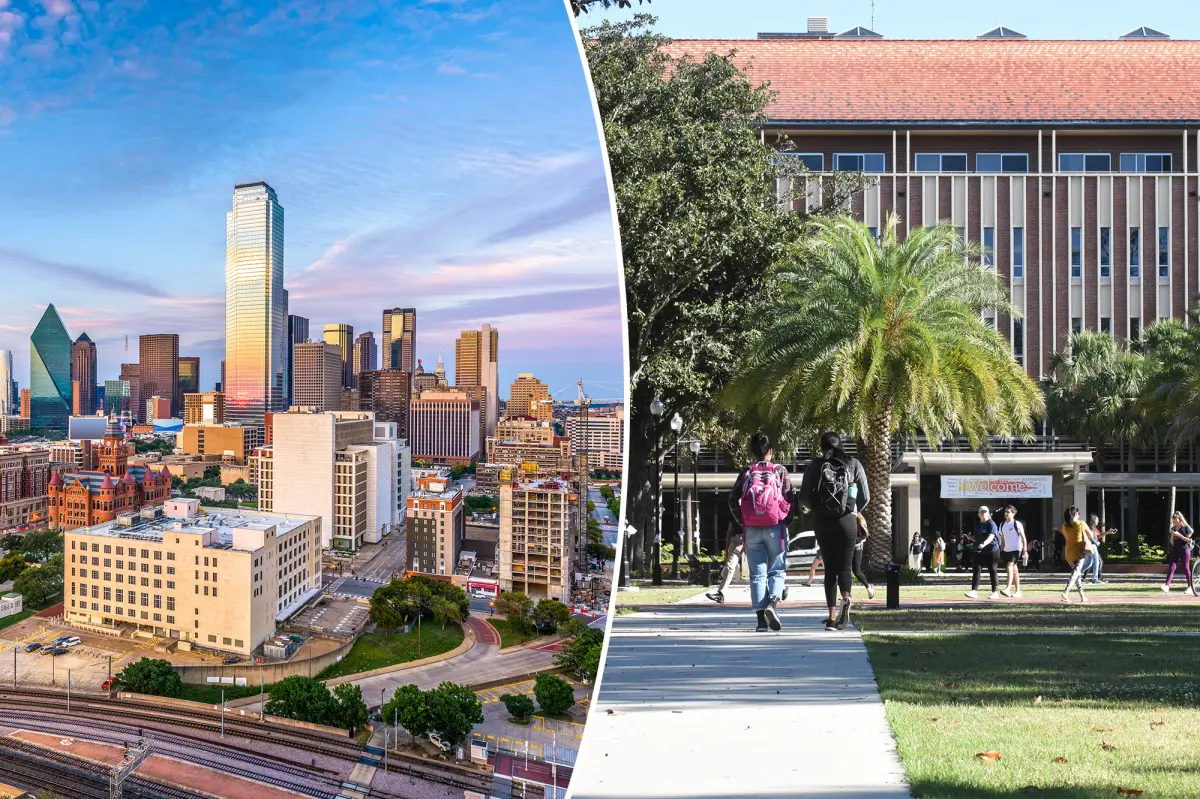
Yet, for every troubled town, there are places where safety seems to be woven into the very fabric of daily life. Dallas, Texas, emerged as the safest college city in America, earning a near-perfect safety score of 0.11 across its nine higher-education institutions, led by Southern Methodist University (SMU). The numbers are almost unbelievable: just 0.38 VAWA incidents and 0.05 disciplinary actions per 10,000 students. Robberies, aggravated assaults, and sex offenses each stood at an extraordinarily low 0.04, with only 0.63 campus arrests and zero fires or hate crimes recorded in the dataset. Gainesville, Florida, finished as a close second with a safety score of 0.16, where the number of incidents per 10,000 students remained below one in every category. The city is home to Florida’s flagship public university, ranked 21st among public universities nationally, which makes it an attractive option for students who want both prestige and peace of mind. But even in these safe havens, no campus is perfect. A University of Florida student was recently barred from entering all university properties after being arrested on a charge of sexual battery on October 14—a reminder that safety is not a once-and-done achievement but an ongoing struggle.
The list of safest towns also includes some surprising names that defy the usual stereotypes. Logan, Utah, home to Utah State University, made the cut, as did Troy, New York, with Rensselaer Polytechnic Institute. Fresno and San Bernardino in California, both often associated with urban challenges, also appeared on the safe list, along with Orem, Utah, and Santa Rosa, California. Tallahassee, Florida, and Winston-Salem, North Carolina, round out the top ten, each offering a blend of small-town charm and institutional vigilance. These towns share a common thread: they tend to have tighter-knit communities, proactive campus security, and better communication between administration and local law enforcement. On the flip side, the least safe list includes Olympia, Washington (Evergreen State College), Santa Barbara, California (UCSB), and Orangeburg, South Carolina—places that might seem idyllic but struggle with hidden issues. Cedar Falls, Iowa, home to the University of Northern Iowa, also made the list, proving that danger isn’t confined to big cities or struggling districts. This geographic diversity suggests that safety is less about location and more about policies, priorities, and state funding for mental health and prevention programs.
Ultimately, these rankings are more than just a way to shame or celebrate certain colleges—they are a call to action for students, parents, and administrators to treat campus safety as a living project that requires constant attention. For a student walking across a quad at CU-Boulder, the statistics are a chilling backdrop to an otherwise beautiful campus. For a student at SMU, the low numbers might offer a sense of security, but they should also inspire humility, because crime is notoriously underreported and no campus is immune. The study’s methodology, based on official reports, cannot capture the shame, fear, or silence that often keeps victims from coming forward. It also can’t measure the positive steps some colleges are taking, such as improved lighting, better training for residence hall advisors, or stronger support for survivors. What it can do is open a dialogue. It forces us to ask: What are we doing to make our campuses safer? And what are we missing? As the new school year begins, these rankings will be posted on refrigerator doors and shared in group chats. They will be used to justify decisions and to demand change. The best response, perhaps, is not to simply choose the safest name on the list, but to become an advocate for safety everywhere—because a college town’s real safety score is measured not in crime stats, but in the lived experiences of the students who call it home.