


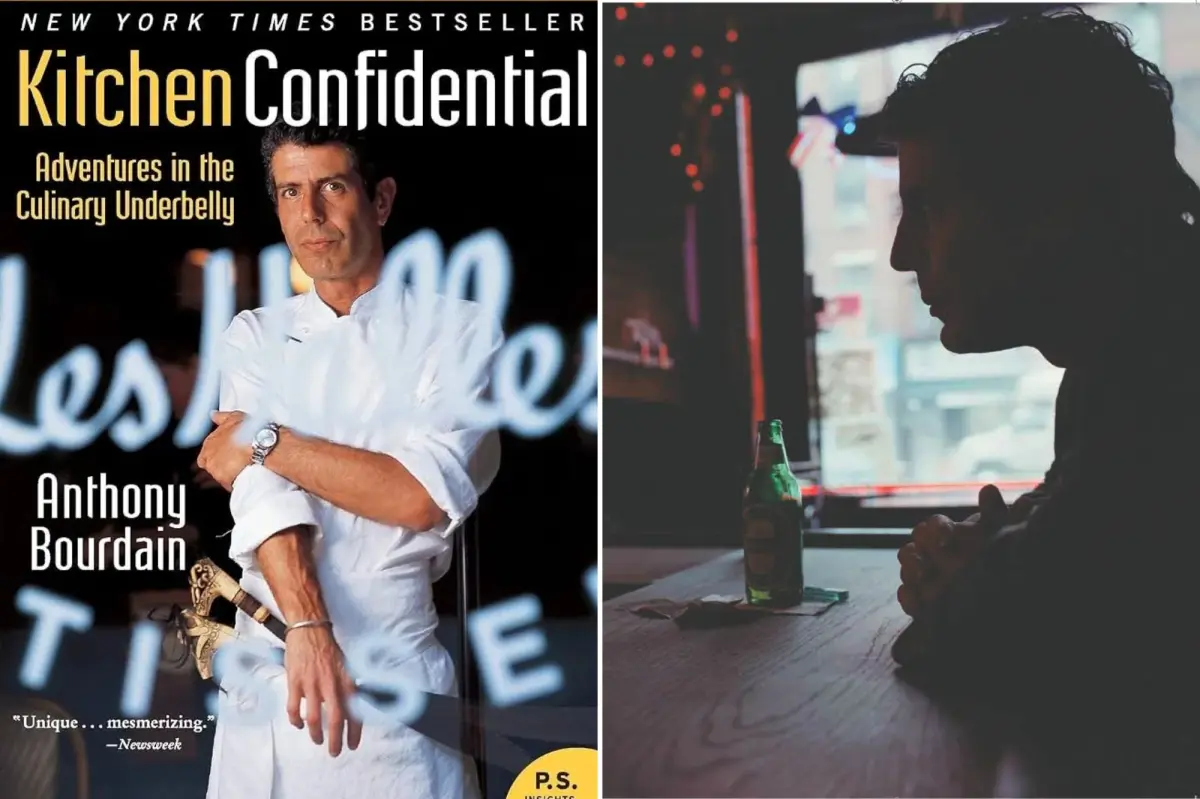
When Kitchen Confidential first appeared in 2000, the American economy was roaring, and with it the restaurant and travel industries were soaring into a new era of culinary adventure. Anthony Bourdain was not yet a household name; he was a Manhattan chef with a druggy past, a checkered career, and a story to tell that no one had ever told quite this way. His book, a memoir-in-essays, landed with the force of a cleaver hitting a cutting board. For decades, there had been a wide gulf between the chandeliered dining rooms of Le Cirque and the glorious, greasy chaos of Papaya King, between people who studied wine lists and people who just wanted a good meal without pretension. Bourdain tore down that wall. He brought the hungry middle of America to the table, promising that food, and writing about food, could be entertaining, profane, and wildly fun. The book sold more than a million copies, was translated into twenty-eight languages, and rocketed Bourdain from anonymity to celebrity. It also gave him a nearly two-decade career as an Emmy-winning television host on A Cook’s Tour, No Reservations, The Layover, and Parts Unknown. Before his death by suicide in 2018 while filming in France, Bourdain wrote many more books, but none of them would ever unseat Kitchen Confidential as the work that defined his legacy. He was a hilariously gifted truth-teller, a man who dared to show the world the mayhem, exhaustion, tenderness, and debauchery to be found behind the swinging doors that once obscured New York’s restaurant secrets. For a generation of cooks and eaters, the book was not just a confession; it was a love letter to a life lived in heat, noise, and grease.
Like all classics, Kitchen Confidential has had a rich afterlife. In 2012, Ecco, his longtime publisher, released an annotated edition with Bourdain’s handwritten margin notes, which now exhorted readers to “eat the f–king fish on Monday already!” and insisted that “many of the best meals are in places with filthy bathrooms”—charming reversals of the positions he had staked out in the original edition. In 2024, Ecco returned with yet another version, featuring sixteen pages of personal photos selected and captioned by Laurie Woolever, who had been Bourdain’s assistant from 2009 until his death and who had kept a treasure trove of photographs from their years together. That edition also included a new foreword by chef Eric Ripert, Bourdain’s longtime friend, who had made a brief appearance in the recent biopic Tony, starring Dominic Sessa as a young, aimless Bourdain. Now, coasting on a wave of positive reviews for the film and a general renewed fascination with the chef-author, Bourdain’s most celebrated work has once again been repackaged, this time by the Folio Society, a UK-based art publisher that specializes in making books into objects of beauty. The latest edition features new color portraits of the chef, a gilded edge, and a breathtaking $130 price tag. It also contains a new foreword by Joel Rose, Bourdain’s longtime friend, mentor, and occasional collaborator. Together, Rose and Bourdain wrote the Get Jiro! graphic novels, which have been adapted into an animated series that premiered on Adult Swim earlier this month. Rose was the first person to publish Bourdain’s writing, in Between C&D, a scrappy literary magazine he ran out of his Alphabet City apartment in the 1980s. He first met Bourdain in 1984, when Bourdain was an active heroin user and a journeyman chef who rarely stayed in one job for more than a year. “He confided in me how precarious things were in his life,” Rose writes. “Financially, professionally, emotionally… He spoke of his confusion, his need to do something, his desire to accomplish something, write something, get s–t out.” Fifteen years later, Rose’s then-wife, Karen Rinaldi, was editor-in-chief and publisher at Bloomsbury USA, and it was she who commissioned Kitchen Confidential. There is something deeply fitting about the fact that the book that made Bourdain famous came into being through the exact kind of messy, loyal network of relationships he always insisted mattered most.
Reading Kitchen Confidential today, you are struck not by how dated it is but by how much still rings true. The specific ingredients Bourdain held sacred—veal demi-glace, chive sticks, a perfect vinaigrette—may have gone out of fashion, but the spirit of kitchen life is immediately legible to anyone who has ever worked in a restaurant. Bourdain’s stories are laced with hedonism and excess, and they glorify the particular satisfaction that comes from doing a brutally difficult job with skill, speed, and nerve. His descriptions of kitchen life are timeless: re-combining leftovers into buffet items or dubious specials, the after-work rituals of shared drinks and laughter, and the eternal, glorious war between cooks and servers. The industry he described more than a quarter-century ago is recognizably the same place where young cooks still cut their hands, scream at the fry cook, and feel a jolt of pride when the last ticket of the night is finally served. Of course, some things have changed for the better. Many once-lawless kitchens now enforce stricter standards of conduct. The obligatory shift drink has disappeared from many restaurants, and managers are finally confronting the sexual harassment that was once so normalized it was treated as room tone. Bourdain himself was not frozen in time. In late 2017, at the height of the #MeToo movement, after his former friends Mario Batali and Ken Friedman faced allegations of sexual misconduct, he published an open letter disavowing the lightness with which he had once treated the handsy hijinks of cooks. “To the extent that my work in Kitchen Confidential celebrated or prolonged a culture that allowed the kind of grotesque behaviors we’re hearing about all too frequently,” he wrote, “is something I think about daily, with real remorse.” It was a rare and difficult public confession, and it remains one of the reasons his work feels alive: he did not expect to be forgiven, but he refused to be static.
Eight years after his death, revisiting Bourdain has become a cottage industry, or as Laurie Woolever half-jokingly calls it, the Bourdain Industrial Complex. His television shows are available on streaming platforms, and his face graces T-shirts, hats, prayer candles, urban murals, memes, and an endless expanse of tattooed skin. Roadrunner, Morgan Neville’s 2021 documentary, tried to map the emotional terrain that led Bourdain to suicide. Charles Leerhsen’s unauthorized biography, Down and Out in Paradise, dug into the same wounds from a different angle. Woolever herself is part of this complex: she conducted dozens of interviews with Bourdain’s associates for the oral history Bourdain, and her own 2025 memoir, Care and Feeding, includes stories about working for him and co-authoring two books with him—Appetites, a 2016 cookbook, and World Travel: An Irreverent Guide, published posthumously in 2021. There is clearly a market. Caroline O’Kane, a financial counselor from Westfield, New Jersey, and a self-professed Bourdain fan, puts it well: “I think people underestimated his reach when he was still here. In a time when influencers get to endlessly travel, we now glorify the guy who worked hard in a hot kitchen and seemingly could not be bought. It’s no wonder his legacy is idealized now more than ever.” That idealization is complicated, of course. Bourdain was someone who loved luxury and filth in equal measure, who could enjoy a $400 dinner one night and a gas station hot dog the next, who was both profoundly generous and at times difficult and dismissive. But his fans see in him what they want to see: a man who was not performing for the algorithm, who went where his curiosity led him, and who seemed to believe that a shared meal was the most honest form of connection.
Would Bourdain have wanted his book turned into a $130 collector’s item with gilded pages? The question is impossible to answer, and the confident cries of “Tony would have hated this” say more about his fans than about him. Jeremy Solly, former head of marketing for Powell’s Books in Portland, Oregon, and a Bourdain fan, does not think the expensive edition will struggle to find an audience. “I don’t think it’s unreasonable; new books today start around $40,” he points out. “For those who aren’t sensitive to price or are willing to invest in something they love, there is a market for it. I own a first-printing hardback of Kitchen Confidential, and I wouldn’t hesitate to get a beautiful new, limited edition.” Yet every new film, book, essay, or consumer good that evokes Bourdain prompts a segment of his vast fan base to insist that he would have hated it, as if he were a punk freegan communist rather than a former chef who understood the world of commerce intimately. Bourdain knew that commodities are bought and sold, that fame is a transaction, and that art and commerce have always been tangled up together. The man once suggested, on his own television show, that his remains should be fed into a wood-chipper and sprayed into Harrods department store at high noon. That is not the statement of a purist; it is the joke of a complicated, unsentimental soul who liked to puncture his own illusions. To reduce him to a saint of anti-capitalism is to ignore the fact that he was also a businessman, a brand, and a performer—and that he was smart enough to know the difference between authenticity and purity.
In the end, Laurie Woolever has no financial stake in the success of any edition of Kitchen Confidential, but she has little patience for those who presume to know what Bourdain would have made of the posthumous economy around him. She knew him as a boss, a friend, a co-author, and a man full of contradictions. He took pride in personally beheading chickens for dinner on a Congo riverboat, and he also loved KFC and Popeye’s, two of the most multinational corporations imaginable. He loved both a tattered paperback and a high-priced work of art. He could be warm and encouraging, then suddenly cold and dismissive. He could glamorize the bad old days of the restaurant industry and then apologize for the damage those days caused. That complexity is why his legacy resists easy packaging. We can buy the $130 edition or find a dog-eared used copy; we can watch his old shows or argue about his choices; we can remember the tragedy of his death while celebrating the way he taught us to taste the world. Woolever’s own work, including her memoir Care and Feeding and her recent cookbook Essentially Basque, co-authored with chef Ryan Bartlow, is part of that continuing conversation. But the real point is that Kitchen Confidential remains a book about human beings—hungry, flawed, exhausted, exalted—and that is why readers keep coming back to it. More than two decades later, it still makes us hungry, not just for food, but for honesty, for adventure, for a life lived with the senses wide open. No price tag can cheapen that, and no avalanche of merchandise can exhaust it. Maybe the best way to honor Bourdain is to stop trying to speak for him and instead follow his example: eat boldly, travel widely, love completely, and always leave room for the messy, beautiful contradictions that make us who we are.