



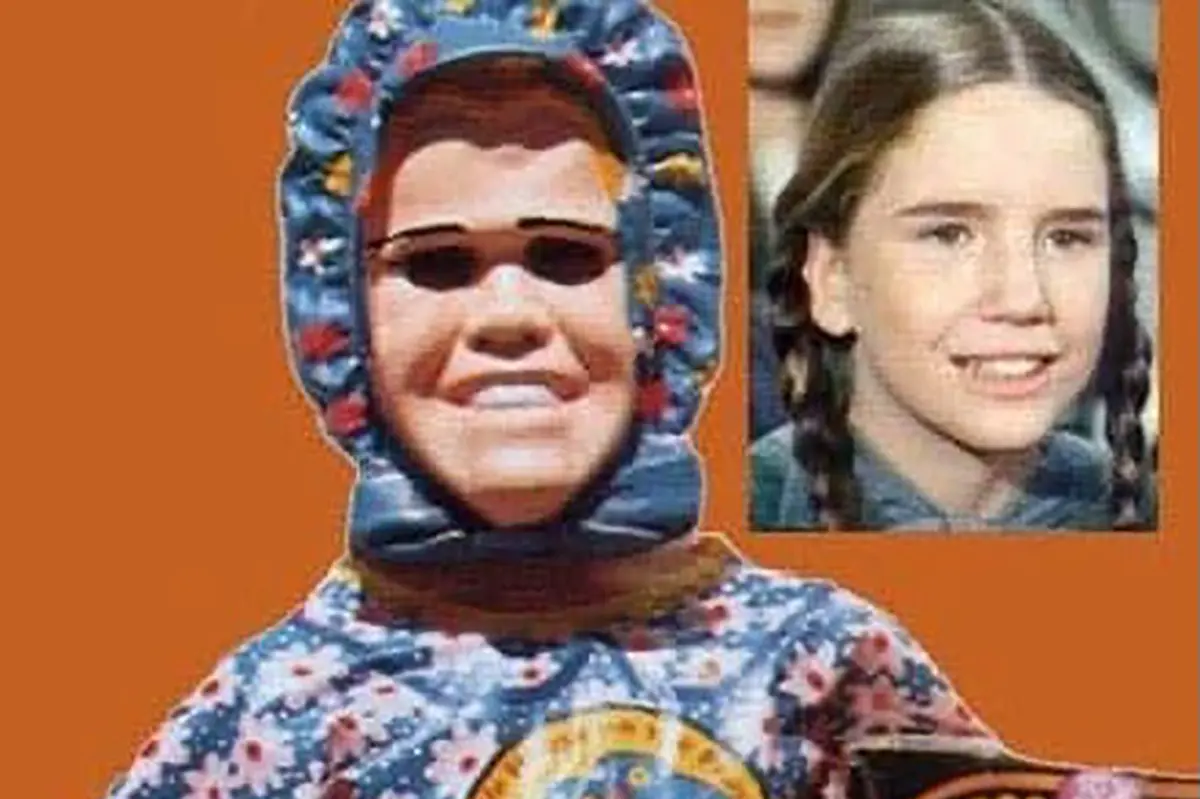
Sometimes the past comes back to us in unexpected ways, and for actress Melissa Gilbert, it arrived with braids, a vinyl smock, and a plastic face that looked nothing like her. Gilbert, now 62, is best known as Laura Ingalls from Little House on the Prairie, the beloved television series that defined her childhood and launched her into stardom. But when she recently uncovered a piece of 1970s TV memorabilia—a Famous Faces Halloween mask of her character—she admitted she was genuinely “horrified.” Posting side-by-side photos on Instagram, she placed an image of herself as young Laura next to the mass-produced mask, and the comparison was both hilarious and deeply unsettling. The mask featured braided hair and a pioneer-style bonnet, but its face was a strange, rubbery approximation of human features, far more in line with a comic-book monster than with the sweet, determined pioneer girl audiences had adored. “Of all the awards and accolades I have received: an Emmy, Theater World Award, Star on the Walk of Fame, nothing has flattered me more than this spot-on, beautifully conceived and wildly convincing costume,” she playfully wrote, demonstrating that she could laugh at herself and at the oddities of a time when licensed merchandise was not always polished or even remotely accurate. She called the mask “not-ready-for-primetime,” and her fans immediately understood exactly what she meant. The whole post turned into a celebration of the wonderfully imperfect world of seventies childhood, where a beloved television character could be reduced to a goofy-looking plastic mask that somehow made everyone feel warm, nostalgic, and both strangely honored and irreverently amused.
Gilbert’s own reaction to the mask was especially charming because she managed to find both affection and absurdity in it. She admitted that the first time she saw the face, when she was trick-or-treating as a child, she honestly wondered whether she might be related to Lou Ferrigno, the famously muscular actor who played The Incredible Hulk. “Wow, could Lou Ferrigno be my birth father?” she joked, claiming that the mask looked far more like the green-skinned superhero than it did like her. Her followers eagerly joined the game, spinning off with a series of increasingly funny suggestions about whose face might actually have been used in the factory. One person said, “Someone at the factory said, ‘Just put braids on the left over Six Million Dollar Man masks,’” referencing the popular seventies show starring Lee Majors. Another suggested the mask looked like Mickey Dolenz from The Monkees, the made-for-TV rock band whose own Halloween costumes probably had the same mold source. A third commenter, clearly a film buff, compared it to the infamous Ronald Reagan mask in Point Break, a movie prop so terrifyingly weird that it had already become a cultural joke. These responses were exactly what made Gilbert’s post so delightful: it invited everyone to remember the strange, crinkly, and unconvincing costumes of their childhoods, not harshly, but with love. There was a time when children wore plastic masks that were difficult to breathe through, with tiny eyeholes and string ties that always came undone. Yet those masks were worn proudly, with the belief that wearing something that vaguely resembled a hero’s face was enough to become that person for one magical evening. Gilbert’s willingness to mock the Laura Ingalls mask was not a rejection of the character she played for so long; it was a warm acknowledgment that she was a part of something bigger than herself, a beloved cultural icon whose image had been, for better or worse, turned into a staple of Halloween.
The mask itself came from the Famous Faces line of costumes, manufactured by Brooklyn-based Ben Cooper, Inc., a company that became famous in the mid-twentieth century for producing inexpensive Halloween costumes sold in cardboard boxes. Each set contained a plastic mask and a matching vinyl smock, often printed with a simple costume design. For Laura Ingalls, that meant a floral-printed, pioneer-looking dress that might have been more appropriate for a stage play in elementary school than for a television show set on the American frontier. The results were endearing, if somewhat crude, and they remain treasured memories for anyone who grew up in the seventies. The particular costume that Gilbert discovered is now being offered on eBay for $187.50, which is a testament to how much nostalgia can be packed into a little piece of molded plastic and painted vinyl. Gilbert, ever the good sport, addressed the company directly in her Instagram post. “If anyone from the Famous Faces company is around and sees this, I just want to say thank you,” she wrote. “I am truly honored yet strangely horrified at the same time.” That combination—honor and horror—perfectly captures the complex feeling of seeing yourself reflected through a cheap, mass-produced object. It is flattering to know that a character you created with your own emotions, voice, and mannerisms became important enough to be sold in stores. But it is also strange to see how that character can be flattened, simplified, and transformed into something that barely looks human. In a way, it speaks to the power of television to take a person and make them into a symbol, a face on a box that children carry through the streets on Halloween. It is not an accurate portrait, but it is a genuine piece of cultural history.
By the time Little House on the Prairie premiered on NBC in 1974, Gilbert was just ten years old, and she grew up before America’s eyes, playing Laura through the series’ end in 1983, when she was nineteen. The show was based on the beloved books by Laura Ingalls Wilder, and it told the story of a pioneer family navigating the hardships and joys of life in late-nineteenth-century Minnesota. It was gentle, moral, and deeply earnest, and it became a staple of American television. For Gilbert, it was also a lifelong identity. She was not just a child actress playing a role; she was the incarnation of a beloved literary character for millions of viewers, and her face was associated with values of courage, family, and perseverance. In the years since, she has gone on to receive an Emmy nomination, a Theater World Award, and a Star on the Hollywood Walk of Fame, among other achievements. But no amount of professional recognition can prepare someone for the strange experience of finding a Halloween mask of your own face in the world. That is a kind of fame that is not taught in acting classes. The show was revived this year with a Netflix reboot, introducing the Ingalls family to a new generation. Even so, for many people of a certain age, the real Laura will always be Melissa Gilbert, with her braids and her hand-sewn dresses and her steady, clear-eyed presence. To see her image transformed into a plastic mask with a blank expression is to feel the distance between the girl on screen and the manufactured commodity that her face became. It is also a reminder that fame is an odd, almost otherworldly experience, especially for someone who experienced it as a child.
The fans who responded to Gilbert’s post shared their own memories of dressing as Laura for Halloween, and their stories helped soften the weirdness of the mask with pure, heartfelt nostalgia. Several people proudly mentioned that their costumes were homemade, made by mothers and grandmothers with sewing machines and a great deal of love. One woman wrote, “I was Laura for Halloween. Mom made us dresses and aprons and we had bonnets we bought from the Amish in Lancaster PA. And cute little boots.” Another simply said, “I just put my hair in braids and wore a cute prairie-looking dress.” These comments painted a beautiful picture of creative childhoods, where a costume did not need to be bought from a box to be magical. Making a pioneer dress was easy enough, because it did not require superhero logos or futuristic armor; it only required fabric, bonnet, and a pair of braids. But there was also at least one commenter who admitted that she had worn the very same Famous Faces costume that Gilbert had discovered. “I had this and was thrilled to wear it! You could hardly tell us apart if put side by side,” she wrote, only half joking. Another fan added, “As a little girl in Oklahoma, I thought it was so Hollywood!!” That comment is particularly touching, because it shows how even the most imperfect costume could feel extraordinary to a child in a small town. For a kid in Oklahoma, wearing a plastic mask of Laura Ingalls and a printed vinyl smock was not an exercise in accuracy; it was a way of reaching out and touching a bit of the glamour and excitement of television. It did not matter that the mask looked more like a muscle-bound comic-book hero or a rejected mold from another show. It mattered that it connected a child to a story she loved and to a character she admired. Gilbert’s post gave her fans the chance to revisit those memories, share them with one another, and remember a time when Halloween costumes were simple, homemade, and deeply personal.
In the end, the story of Melissa Gilbert and the terrifying Laura Ingalls Halloween mask is not really about a bad piece of merchandise. It is about the way our favorite stories, and the people who bring them to life, become woven into the fabric of our own childhoods. It is about the strange alchemy of television, where an actor’s face can become a symbol of courage, optimism, and family values, and then, almost inexplicably, be turned into a rubber mask that looks like a distant cousin of The Incredible Hulk. Gilbert handled the discovery with exactly the right amount of humor and grace. She did not complain or dismiss the costume as an insult. Instead, she called it a “beautifully conceived and wildly convincing” tribute, embracing the absurdity while also acknowledging the genuine affection behind it. That is what makes her such an endearing figure, even decades after Little House went off the air. She understands that popularity is not about perfection; it is about the connection between a character and the people who love her. And no matter how strange the mask was, it came from a place of love, however clumsily executed. It was a child’s doorway into the world of the American pioneer, a chance to wear braids and wander through the neighborhood pretending to be Laura Ingalls. Gilbert’s followers shared in the joke, swapping memories of homemade dresses, Amish bonnets, and plastic masks that never truly looked like anyone. In the process, they reminded us that the past is not always polished or beautiful. Sometimes it is a little bit ridiculous, and that is exactly what makes it worth remembering. The mask may be horrifying, but the memories it conjured were warm, funny, and gloriously human, proving once again that Laura Ingalls—and Melissa Gilbert—still have the power to bring people together, even through a piece of plastic from the bottom of an old Halloween box.