

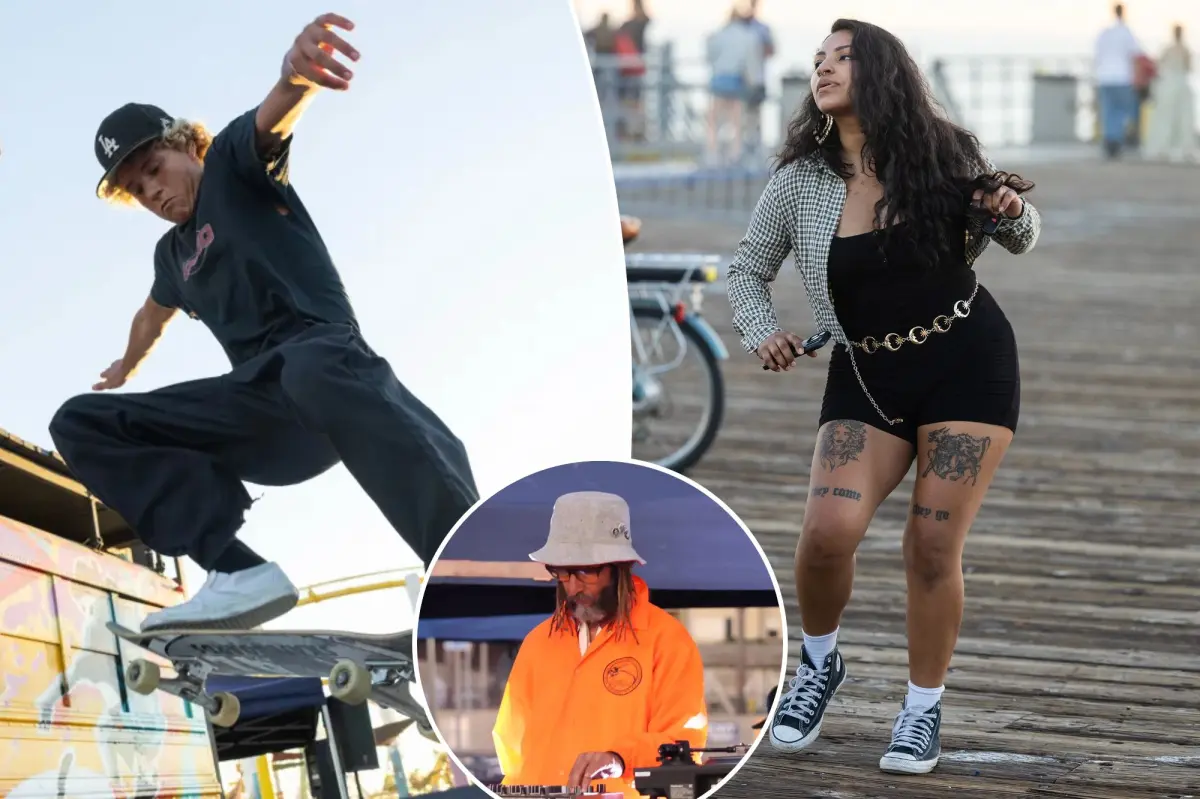
The night air on the Santa Monica Pier had a sticky, salt-touched warmth, and by late afternoon the pier was already alive with the sounds that have defined five decades of Southern California cool. Vintage cars with gleaming chrome and immaculate paint rolled up in a slow parade, their owners stepping out in denim and tattoos, while a portable skate ramp became a magnet for kids and old-timers alike. It was Locals’ Night, a monthly gathering created to celebrate the community built around this wooden landmark, but this particular evening felt different. It was a reunion, a history lesson, and a block party rolled into one. The occasion was the 50th anniversary of the Z-Boys, the legendary Dogtown skate team that grew out of Jeff Ho’s Zephyr surf shop in the mid-1970s, and whose members turned skateboarding from a sidewalk novelty into a global art form. As the sun sank behind the ocean, the pier became a living museum. Members of the Dogtown Car Club filled the deck with lovingly restored classics; fans leaned over barriers to watch skaters pump, carve, and ollie on a ramp nearby; and the smell of sunscreen mixed with sea air and exhaust. It was exactly the kind of evening where history doesn’t feel distant. It feels like something you can touch, hear, and maybe even ride. And at the center of it all was Tony Alva, the Z-Boys icon who grew up in the shadow of the pier and helped make Dogtown famous around the world. Alva, now an elder statesman of skateboarding, moved through the crowd with the easy confidence of someone who understands what he helped create—not just a sport, but a culture that still shapes how young people move through cities, beaches, and streets.
To understand why this night mattered so much, you have to go back to a moment when skateboarding was still a fringe hobby, dismissed by most people as a fad. In the mid-1970s, a group of young men from Dogtown—the local nickname for Santa Monica and the surrounding beach communities—began congregating at Jeff Ho’s Zephyr surf shop. They were street kids, surfers, and misfits who shared a hunger for speed and style. Jeff Ho gave them a place to belong, and from that shop came the Z-Boys, a twelve-member skate team that would change everything. Tony Alva was one of them, along with Jay Adams, Stacy Peralta, and others whose names became legend. What made the Z-Boys different was their background in surfing. They took the fluid, aggressive, low-to-the-ground moves they used on waves and transferred them to concrete, riding empty swimming pools, drainage ditches, and anything with a slope. They skated with an athleticism and attitude nobody had seen before. Their story later became the subject of the acclaimed 2002 documentary “Dogtown and Z-Boys” and the 2006 feature film “Legends of Dogtown,” which was screened on the pier Thursday night under the stars. The films captured not only their tricks, but the raw energy of a time when a handful of teenagers from a struggling beach town invented a new way of living. Fifty years later, the Z-Boys’ influence is everywhere—in skate parks, in fashion, in the language of cool, and in the way kids still drop into a bowl with their arms windmilling, channeling a spirit that started on the streets of Dogtown.
The evening unfolded in layers, like a long, happy afternoon that never wanted to end. Around 3:30 p.m., the Dogtown Car Club began pulling up to the pier in their beautifully maintained vintage cars. It was a rolling showcase of Americana, with fins, chrome, and paint jobs that glowed in the late-afternoon light. Fans wandered between the cars, taking photos and swapping stories, while nearby a lone skate ramp became a stage. Young skaters did ollies and kickturns, some of them barely old enough to hold a board, but already carrying the same posture that made the Z-Boys famous. Just after 6:30 p.m., Tony Alva appeared for a Dogtown trivia session and a live DJ set. The crowd pressed in, phones raised, as Alva laughed, told stories, and tested people’s knowledge of the culture he helped build. It was loose and unpretentious, like a family gathering where the eldest relative holds court. At 7:30 p.m., the pier’s big screen lit up with “Legends of Dogtown,” and the audience settled in to watch the story unfold against the real backdrop of the pier itself. After the film, the energy shifted as local thrash metal punk band Cycotic Youth took over, filling the night with loud guitars and raw vocals. The combination may sound chaotic—vintage cars, skateboarding, a documentary, and punk rock—but it made perfect sense. It was a history lesson and a party at the same time, a reminder that Dogtown culture was never neat or polished. It was loud, fast, gritty, and deeply alive.
Tony Alva is often described as the face of the Z-Boys, but on Thursday night he was quick to share the credit. “Jeff gave me an opportunity at a very young age. I couldn’t be on the surf team, but there was something about skateboarding that I was a natural at,” Alva said at the event. “He basically led a few guys on the team that were just street kids, and one of them was Jay Adams, and the other one was me.” There was a quiet gratitude in his voice, a recognition that his life could have gone a very different way if not for a surf shop owner who saw something in a restless kid. Jeff Ho gave that opportunity not just to Alva but to a generation of young people who needed an outlet. The Z-Boys were not rich kids; they were the sons of working-class families, and skateboarding gave them a way to express something they couldn’t put into words. Jim Harris, Executive Director and Historian of the Santa Monica Pier, captured the significance of the anniversary in a press release. “Fifty years later, the influence of Dogtown and the Z-Boys can still be seen in skateboarding and Southern California culture around the world,” Harris said. “Bringing Tony Alva to the Pier, putting a skate ramp on the deck and screening ‘Dogtown and Z-Boys’ under the stars gives us a special opportunity to celebrate that legacy right here on the Westside. It’s exactly the kind of history, culture and community that Locals’ Night was created to bring together.” His words echoed what many in the crowd felt: this was not just nostalgia, but a living thread connecting the past to the present.
But the night also had a bittersweet undertone, especially for those who have watched Santa Monica and nearby Venice change dramatically over the years. Jason Brown, a Santa Monica native and co-founder of Cycotic Youth and the Dogtown Car Club, stood on the pier and reflected on what the evening meant to him. “I grew up on this pier. Now I’m playing on this pier. So it means a lot to me,” said Brown, who remembers surfing with his dad as a kid and growing up in the shadow of the legendary Z-Boys. Brown ran a tattoo shop in Venice for twenty-five years before he was priced out and had to close. “Venice is now not how it used to be. Neither is Santa Monica,” he said. “They’re offering these old people that had these houses for 60 years millions of dollars, and their young kids are biting at it to make the money.” There was no anger in his voice, just a weary honesty. Gentrification has changed the landscape, pushed out the artists, surfers, and skaters who made the neighborhoods famous, and replaced them with luxury apartments and tech wealth. Yet even as he spoke, young people were still on the pier with skateboards under their arms, eager to be part of something older than they were. Jeff Ho, the man who started it all, seemed both philosophical and defiant. “There’s so many people that want to monetize surfing and skating and whatever, but some of them aren’t surfers and some of them aren’t skaters. I surf, I skate, I love it, and I’ll be doing this until the day I die,” he said. His words were a reminder that real culture cannot be bought or manufactured. It comes from people who live it, breathe it, and pass it on.
For all the changes, the pier still draws people who feel that pull. Jiggy Reed moved to Los Angeles four years ago from Texas, and he said Santa Monica’s skating culture is what made him stay. “It’s just crazy. You can walk out your door, and like all this culture, like all these things are just going on, and it’s a beautiful life,” Reed said. Standing near the ramp, watching skaters take their runs as the movie credits rolled, he embodied the future of a culture that refuses to die. The Z-Boys are older now, their hair gray or gone, their bodies carrying the scars of a thousand spills. But their spirit lives on in every kid who drops into a bowl, every artist who paints a board, every musician who plays too loud on a pier at night. The 50th anniversary celebration was not just about looking back. It was about honoring the people who built something from nothing, and about passing that something on to the next generation. On Thursday night, under the stars and the string lights, with the ocean crashing beneath them, the past and the present merged. Tony Alva walked through the crowd, Jeff Ho stood near the ramp, and a new generation of skaters rolled through the same air that had once carried the Z-Boys. The pier has changed, the neighborhoods have changed, but the feeling remains: a restless, joyful, defiant energy that says this is our place, and we will keep riding it until the day we die. That is the legacy of Dogtown, and on this night, fifty years in, it was still unmistakably alive.