

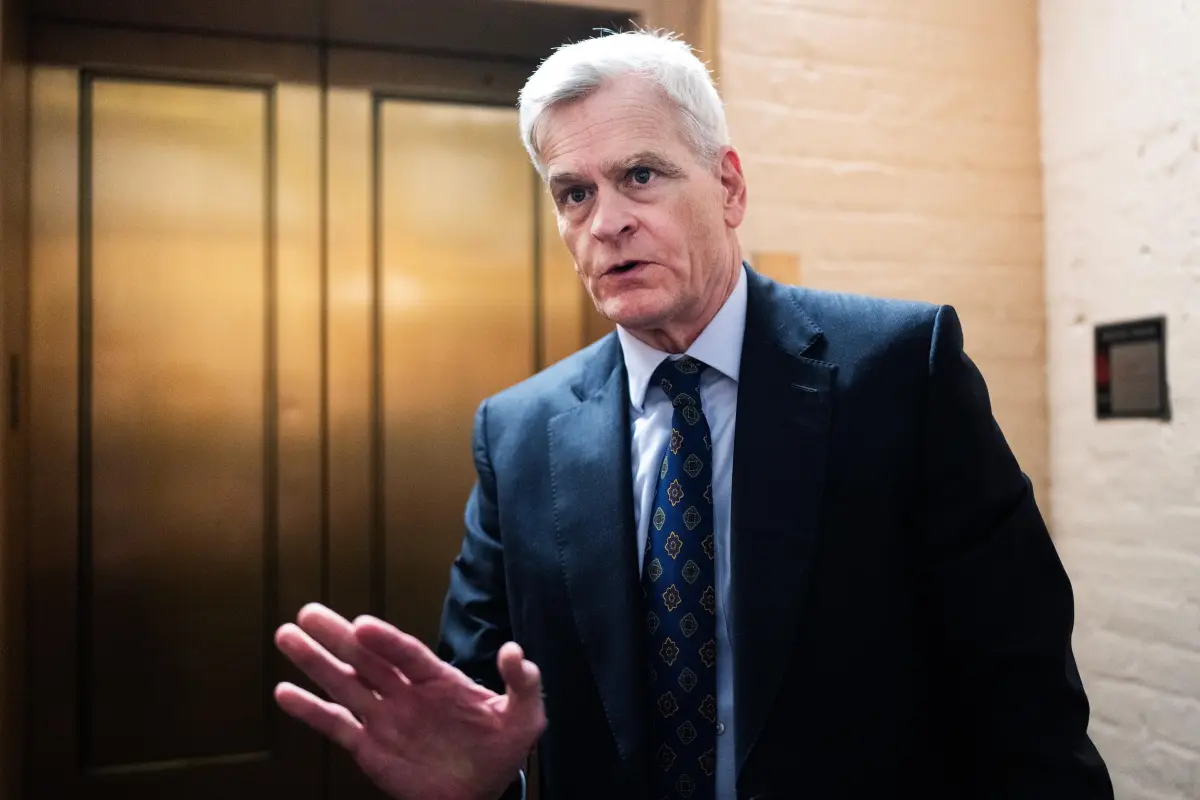
In the quiet, marble-lined corridors of the United States Senate, where political destiny is routinely decided by the narrowest of margins, Louisiana Republican Senator Bill Cassidy found himself carrying a burden of immense proportions on a recent Sunday. The vote to confirm Todd Blanche as the nation’s next Attorney General was not merely another routine legislative hurdle; it had rapidly devolved into a high-stakes drama of conscience, institutional loyalty, and systemic integrity. With Kentucky Senator Mitch McConnell absent as he recovered from a medical procedure, the Republican majority’s room for error had evaporated entirely, leaving the final outcome of the confirmation hanging on a razor-thin 50-49 margin. For Cassidy, a politician known for his pragmatic approach but increasingly alienated from the populist core of his party, this was a moment of profound personal and professional reckoning. As he sat down with CBS News’ Face the Nation host Margaret Brennan, Cassidy laid bare the raw anxiety of a decision that had pushed him to the absolute brink of voting “no” against his own party’s nominee. The weight of his single vote loomed large, representing the dividing line between a fully confirmed, Senate-vetted Attorney General and the chaotic uncertainty of an acting official who would lack the institutional authority to resist executive overreach. To understand Cassidy’s dilemma is to understand the fragile state of modern American governance, where individual lawmakers are forced to choose between the preservation of democratic norms and the relentless, unforgiving tides of partisan alignment.
At the absolute center of Cassidy’s agonizing internal debate was a highly controversial provision that struck at the very heart of the American legal philosophy: the foundational principle that all citizens are equal under the eyes of the law. During the confirmation process, it was revealed that Blanche had negotiated special Internal Revenue Service (IRS) protections designed specifically to narrow the scope of tax scrutiny for President Donald Trump, his children Donald Trump Jr. and Eric Trump, and the sweeping assets of the Trump Organization. For Cassidy, this was not a minor bureaucratic footnote; it was a fundamental betrayal of systemic fairness that would alienate ordinary taxpayers who live in fear of federal audits. “That’s totally wrong,” Cassidy declared during his television appearance, his voice carrying the quiet gravity of a man who still believes in the foundational myths of the republic. “No American should be targeted by the law, but no American should be above the law.” The idea of codifying a dual-track justice system—one that subjects ordinary citizens to the full, terrifying weight of federal oversight while insulating the first family in a protective bubble of immunity—troubled Cassidy deeply. Yet, his anxiety was compounded by a cold, clinical realism about the nature of the man returning to the Oval Office. Cassidy openly acknowledged that Donald Trump can be “unrelenting” in his demands, arguing that a Senate-confirmed Attorney General, armed with the legitimacy of congressional approval, would ultimately possess far more leverage to push back against unlawful executive orders than a vulnerable, temporary acting official who serves entirely at the president’s whim.
The moral complexity of the situation was further darkened by the specter of the “Anti-Weaponization Fund,” a staggering $1.8 billion program that had been quietly engineered through a settlement of a lawsuit Trump brought against the IRS and the Treasury Department. To critics across the political spectrum, this massive pot of money looked less like a standard legal remedy and more like a taxpayer-funded political war chest. The fear was palpable and deeply disturbing: that the fund would be utilized to compensate individuals who claimed they were politically targeted, potentially funneling millions of federal dollars to staunch Trump loyalists, including individuals who participated in the violent assault on the U.S. Capitol on January 6, 2021. This proposal sparked a rare and fierce bipartisan backlash, pushing even staunch conservative senators like John Cornyn of Texas and Thom Tillis of North Carolina to threaten a total blockade of Blanche’s nomination unless the fund was permanently dismantled. Under intense pressure to salvage his career and his nomination, Blanche was forced to make a significant concession, issuing a formal order that rescinded the fund entirely, declaring it to have “no force or effect,” and confirming that no taxpayer funds had been distributed. While this retreat placated some critics, it left lingering questions about the lengths to which the incoming administration was willing to go to reshape federal institutions to serve personal and political ends.
Faced with these national controversies, Cassidy sought clarity not in the echo chambers of Washington, but in the grounded, real-world experiences of the people who actually enforce the law in his home state of Louisiana. He reached out to federal prosecutors, U.S. attorneys, and local law enforcement leaders—individuals whose daily lives are spent prosecuting violent crime, dismantling human trafficking networks, combating drug cartels, and investigating complex healthcare fraud. To Cassidy’s surprise, these boots-on-the-ground prosecutors offered overwhelming praise for Blanche’s professional competence and his vision for a restructured Department of Justice. They spoke of a leader who promised to restore administrative accountability, provide much-needed support for major regional investigations, and refocus the agency’s vast resources on tangible threats to public safety rather than ideological crusades. This localized feedback provided Cassidy with a crucial bridge over his moral chasm, allowing him to view the confirmation not as a simplistic black-and-white choice, but as a complex “gradation of gray” where the practical necessity of stable, competent leadership at the DOJ had to be balanced against deeply troubling policy proposals. Ultimately, the promise of a functional, focused Justice Department led by a qualified professional outweighed Cassidy’s lingering anger over the tax provisions, guiding his hand toward the “yes” button.
This vote, however, came at a steep personal and political cost for Cassidy, a man who has increasingly found himself isolated within a party that demands absolute, unquestioning fealty to its leader. Having already lost his primary election earlier this year to a challenger aggressively backed by Donald Trump, Cassidy was acutely aware of his vulnerability and the inevitable backlash his vote would provoke from all sides of the political divide. “I’ll be criticized for this vote. What’s new?” he remarked with a mixture of weariness and defiance, embodying the spirit of a politician who has accepted that in today’s hyper-polarized environment, true independence is often rewarded with exile. Yet, he insisted that the voters of Louisiana could rest assured that he had done the hard, painful intellectual labor required to make an informed, conscientious decision rather than simply taking the path of least resistance. His lonely path stood in stark contrast to his fellow moderate Republicans, Senators Lisa Murkowski of Alaska and Susan Collins of Maine, who both held the line and voted “no,” refusing to look past the ethical compromises inherent in Blanche’s nomination. The split among these key moderate voices highlighted the deep, agonizing fractures within the remaining wing of the traditional Republican establishment, as each senator grappled with how best to navigate the looming shadow of a second Trump presidency.
As the dust settles on this historic and bruising confirmation battle, the nation is left to contemplate the future of an agency tasked with upholding the rule of law during one of the most turbulent chapters in modern American history. The White House, speaking through press secretary Karoline Leavitt, immediately celebrated the razor-thin victory as a “huge win for President Trump and our country,” praising Blanche’s “unwavering commitment to law and order” and promising that the American people would be well served by his leadership. This triumphalist rhetoric, however, stands in sharp contrast to the quiet, sober uncertainty expressed by Cassidy and other critics. Blanche’s rise to power came only after a chaotic game of political musical chairs, stepping into the role of acting Attorney General following Trump’s abrupt removal of Pam Bondi, who fell from grace amid growing executive frustration over her handling of the highly sensitive Jeffrey Epstein investigative files. When asked directly if he was genuinely confident that Blanche would protect the integrity of future elections and defend the United States Constitution against all enemies, foreign and domestic, Cassidy offered a remarkably candid, human response that cut through the usual talking points of Washington: “I cannot predict the future, and this is not a black or white decision. But I’m confident on that.” It was a fittingly cautious conclusion to a saga defined by compromise, a stark reminder that in the grand theater of American politics, the survival of democratic institutions often relies not on absolute certainties, but on the fragile, hopeful calculations of flawed human beings trying to navigate the gray areas of power.