





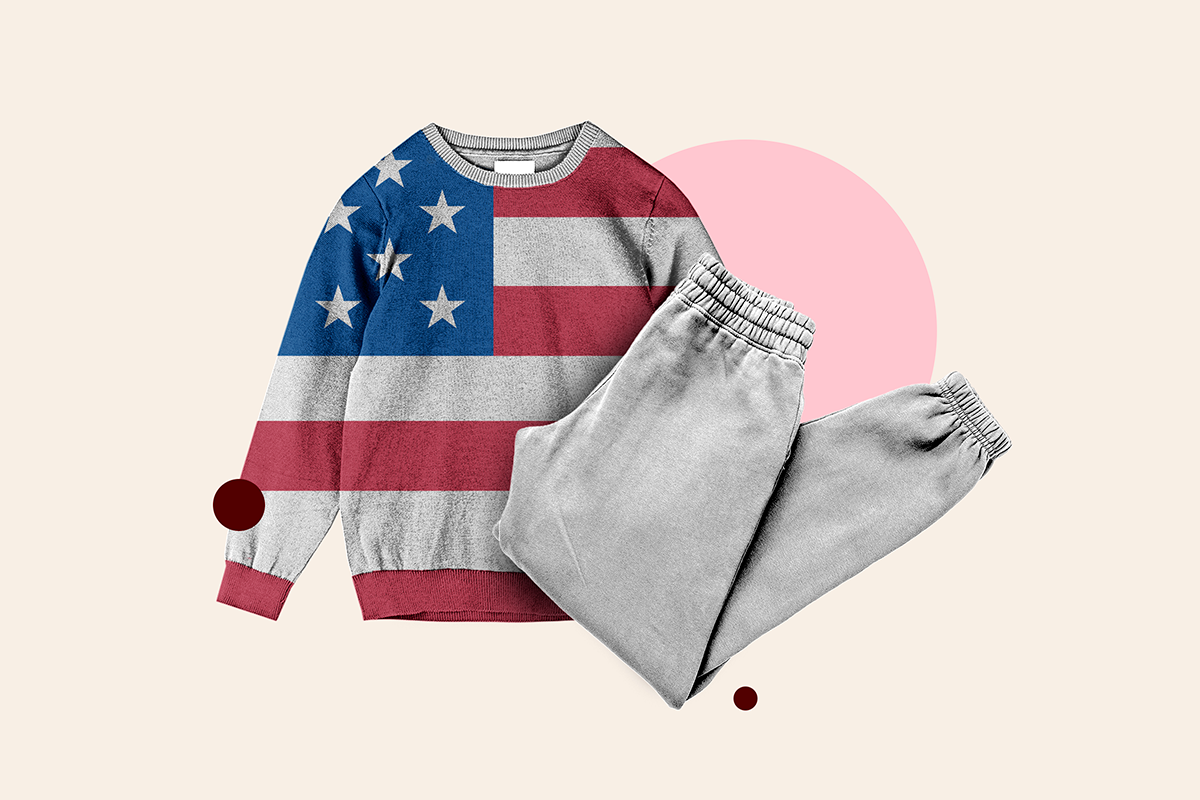
Not long ago, I sat down for a midweek lunch with a few friends, and we did what women have presumably been doing over lunch for centuries: we admired one another’s clothes. Nobody at the table was wearing anything flashy or conspicuously branded. We all looked polished, but there was something strange about the outfits around that table. I was wearing Gap. One friend was in Alo. Another had on Lululemon. The fabrics were different, and maybe the price points were too, but the formula was identical: elastic-waist pants paired with a top in the exact same color or print, and a collective understanding that these combinations counted as being properly dressed. Not that long ago, that kind of outfit would have been reserved for the gym, the couch, cooking dinner, or an errand you hoped nobody would see you running. Now it has become the uniform of ordinary American life. This is the quiet triumph of athleisure, a genre of clothing that has pulled off one of the most successful acts of cultural laundering in recent American life. Soft, stretchy, endlessly comfortable, these clothes did not merely become acceptable; they became aspirational. They moved from the margins of the wardrobe to its center, and in doing so, they quietly changed the threshold for what Americans consider proper for public life. I remember when wearing leggings outside the house felt like a small confession that you had given up. Now, wearing the right matching set feels like a statement of taste, even though the basic proposition is the same: a sweatsuit with better branding.
Ten years ago, the default uniform of ordinary American casual life was probably jeans and a T-shirt. Hardly formal, certainly not elegant, but still recognizably an outfit. Athleisure existed, of course. Leggings had already escaped the yoga studio, and sneakers were no longer just for Zumba. Lululemon’s success in the early to mid-2000s showed that Americans were willing to spend serious money on clothes ostensibly designed for exercise. But athleisure had not yet swallowed the wardrobe whole. Jeans and T-shirts still reigned supreme, and there was still a meaningful line between what you wore to run errands and what you wore to, say, a lunch with friends. Then COVID arrived, and that line dissolved. For months, millions of Americans lived at home, where getting properly dressed to move from the bedroom to the kitchen and then back to the bedroom seemed absurd, but remaining in pajamas until late afternoon seemed psychologically damaging. Athleisure solved the problem perfectly. It allowed us to perform the ritual of getting dressed without accepting most of the physical inconveniences traditionally associated with clothing. We could feel like we had gotten ready for the day while still feeling like we were wearing pajamas. The fashion industry understood the assignment immediately. Gap was already talking in 2020 about the accelerating casualization of style, and Athleta surpassed a billion dollars in annual sales. The pandemic did not invent America’s preference for casual clothes, but it dramatically accelerated a transformation that was already underway. What we once wore around the rest of life became what we wore for the rest of life.
And then the pandemic ended, but lo and behold, athleisure did not. Instead, the industry refined it. Softer cuts, cleaner branding, and the ultimate act of coordination: everything became about tasteful neutrals, and companies sold us the top and the bottom separately, performing the economic brilliance of turning a sweatsuit into a two-hundred-dollar outfit. I remember the old social meaning of leggings. They signaled either that you had stopped trying or that you were the Pilates mom in the Target parking lot at ten in the morning with an iced latte and somewhere much nicer to be. Lazy or rich, as one friend put it. Then brands changed the equation. They made the clothes neutral and fitted, put a little logo on the hip, and priced them like they meant something. Suddenly, two sweat-adjacent garments in different colors said, I gave up, or I don’t care. But make them the exact same shade of espresso, and suddenly they said, I have a point of view. The clothes themselves have also gotten better at disguising what they are. You can buy a stretch sweatpant that looks indistinguishable from an uncomfortable suit pant, and nobody can even tell. I have seen this transformation happen in business settings too. A decade ago, showing up to a client meeting without a suit and tie would have been unthinkable for many professionals. Now you can go to the same meeting in a button-down and jeans and be the most dressed-up person in the room. Gallup found in 2023 that just three percent of American workers regularly wore business-professional clothing, down from seven percent in 2019, while forty-one percent described their normal workwear as business casual. The broader casualization of American dress long predates COVID, but the pandemic gave it an extraordinary accelerant.
I should be honest here: I am not observing any of this from the dignified confines of a pencil skirt. I absolutely love athleisure. I buy the sets, and while I wait for them to be mailed out, I consider buying more. There is something genuinely lovely about clothes that feel like a hug, that move with you, that don’t dig into your waist or require constant adjusting. I understand the appeal on a deeply personal level. But I have slowly come to the conclusion that perhaps it is time we collectively move on and start wearing actual clothes again. This is not about athleisure being ugly, because it really isn’t. It’s also not about comfort being some sort of moral failure. Given the current state of affairs across the country, I understand needing a bit of respite, even if it comes in the form of elastic pants. The problem is that we have allowed this type of clothing to colonize practically every ordinary part of American life: school drop-off, airports, errands, coffee shops, lunch, working from home, and increasingly, actual workplaces. And that is almost the antithesis of what clothing is all about. Historically, what we wore helped create distinctions between different parts of life. You dressed for work, for dinner, for travel, and then you came home and changed into something comfortable. Those sartorial boundaries reinforced larger psychological ones. They marked the movement from private to public, from one version of ourselves to another. Athleisure has flattened all of that into one long, elastic-waisted present. The airport looks like the school run, which looks like the grocery store, which also looks like the couch, and sometimes the office.
Interestingly, not everyone thinks that is a bad thing. One woman I spoke with, who spent years working in recruiting and human resources, remembers the pandemic uniform as the Zoom mullet: nice top, sweatpants, slippers if nobody asked you to stand up. And the world kept spinning. She told me she doesn’t feel like she lost anything when athleisure took over. She feels like she finally found an outfit that keeps up with her. But even she preserves one sartorial boundary. At the end of the workday, she puts on a jacket before going out. The jacket is her clock-out. Once it’s on, she’s off. That little ritual gets at why any of this matters. Clothes have always done more than cover us. They tell us where we are and, to some extent, who we are supposed to be while we are there. When every part of life asks the same thing of our wardrobe, it is not surprising that so many parts of life have begun to feel indistinguishable from one another. The boundaries between online and real life are already collapsing in our own heads, and our clothes are not helping. We have lost the small but meaningful transition that comes from changing out of one outfit and into another. We have lost the sense that getting dressed is a way of showing up for something, whether it is a meeting, a dinner, or just the world outside our front door. I am not saying we need to return to corsets and cufflinks. I am saying that the elastic waistband has become a kind of trap, one that keeps us in a comfortable but strangely undifferentiated state.
COVID gave us an excellent reason to stop getting dressed. Six years later, the emergency is over, but the elastic waistband remains. I think we are all a little afraid to give it up, because it feels like giving up the last bit of softness we allowed ourselves during a very hard time. But we can keep the leggings and the matching sets. We don’t have to throw them away. We just need to remember that they are not the only thing in the closet. America, please, once in a while, put on some actual clothes. Wear a pair of pants with a zipper. Wear a shirt with buttons. Wear something that requires a small amount of effort and makes you feel like a slightly different version of yourself. It doesn’t have to be uncomfortable. It doesn’t have to be formal. It just has to be intentional. We survived buttons before. I’m pretty sure we can do it again. And when we do, I suspect we will rediscover something we lost without noticing: the quiet pleasure of dressing for a specific moment, of honoring the difference between being at home and being out in the world, of using our clothes to tell ourselves and everyone around us that this occasion matters, and so do we. The elastic waistband will always be there waiting for us at the end of the day. That is exactly where it belongs.