





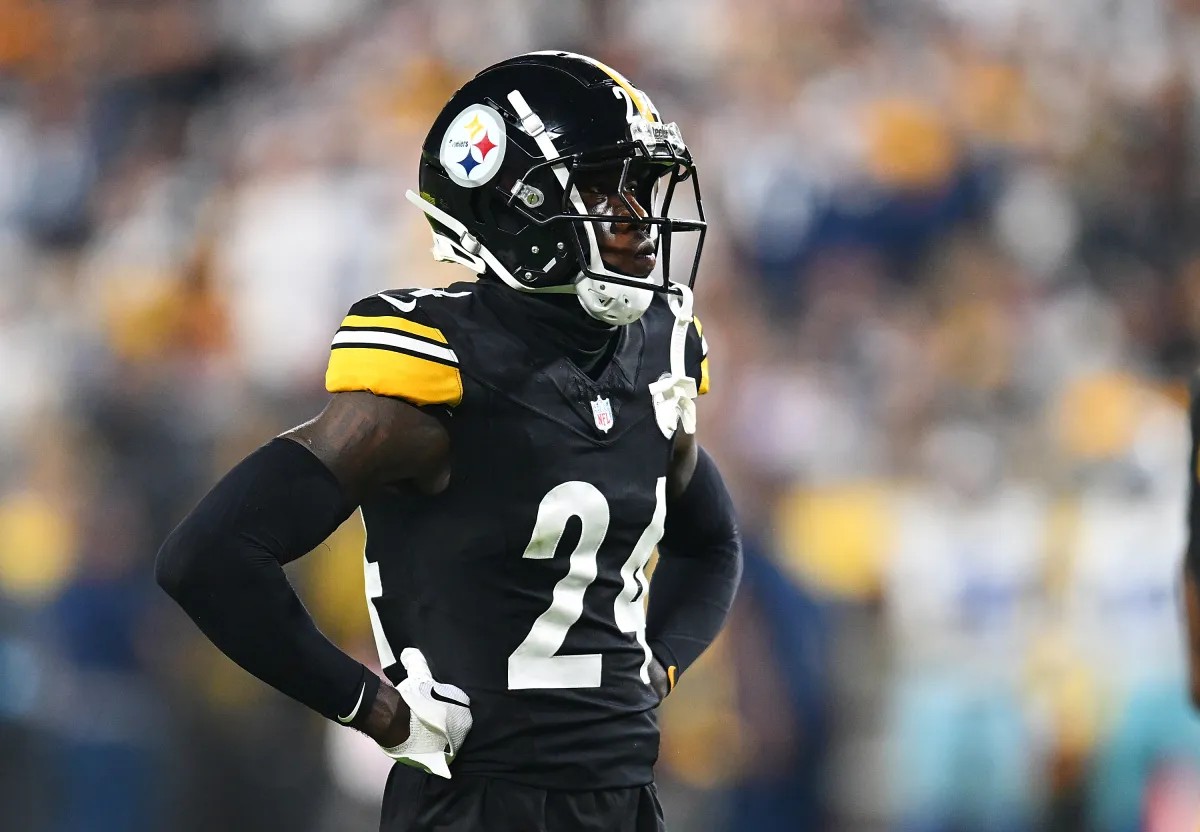
Imagine being Joey Porter Jr. on a Wednesday that started like any other workday in the NFL. You show up at the Steelers’ facility, go through meetings, get on the practice field, and do your best as a limited participant because your body is telling you something isn’t quite right. Your back is bothering you, or at least that’s the official story, alongside that strange, almost laughable designation of “non-injury related/conditioning.” You know what that really means, even if the team won’t say it out loud. It means there are other things going on, contract stuff, business stuff, the stuff that coaches and general managers prefer to hide behind injury reports. And then, hours later, your phone rings, your agent calls, and suddenly you’re not a Pittsburgh Steeler anymore. You’re a Dallas Cowboy. The Steelers had decided to move on, trading you to a team a thousand miles away in exchange for a 2028 second-round pick and a 2027 conditional sixth-round pick. No warning, no going-away party, no chance to clear out your locker with any real goodbye. That’s the human side of the NFL that fans rarely see: the sudden, ruthless, almost dizzying way a player’s life can flip upside down in a single day. And now, instead of preparing for another week in Pittsburgh, you’re expected to put on a new helmet, learn a new defense, and possibly play a football game in Houston just four days later. It sounds exciting and terrifying at the same time, and it’s exactly what Porter is going through this week.
The trade itself tells a story of urgency. Dallas didn’t give up a second-round pick for a player they plan to ease into things slowly. They need help, and they need it now. The Cowboys’ secondary has been banged up and, at times, exposed. In their Week 3 loss to the Baltimore Ravens, they got carved up in the closing moments, and everyone in the front office saw the same thing: a defense that couldn’t make one last stop. So they went out and traded for one of the more physically gifted young cornerbacks in the league, a player who was drafted to be a lockdown guy, a player with a famous football name and a chip on his shoulder. But football isn’t a video game. You can’t just plug a player into the lineup and expect him to know everything. Porter has to learn defensive coordinator Christian Parker’s playbook, build trust with new teammates, and figure out the speed of a new scheme in a matter of days. A league source told Newsweek that he is expected to play Sunday against the Texans, but whether he starts or how many snaps he gets remains unclear. It’s a lot to absorb for any human being. He has to think, not just react. He has to communicate, not just follow. And he has to do all of this in what many around the league consider a must-win game for Dallas. The Cowboys aren’t in a position to be patient. They didn’t make this trade to go 1-3. They made it because they believe they’re still alive, still fighting for the NFC East, still capable of turning a disappointing season into something memorable. That pressure doesn’t just fall on the coaches and the quarterback. It falls right on the young cornerback who barely knows where the locker room is.
There is, of course, the elephant in the room, or maybe the steer in the room. Multiple sources have suggested to Newsweek that Porter’s so-called back injury is closer to the kind of substance that slides out from a steer’s backside than an actual medical issue that would keep him off the field. In other words, a lot of people around league circles think the back issue was more about circumstance than discomfort. You don’t have to be a skeptic to understand how these things work. A player wants a new contract, or at least clarity about his future. A team wants to get value before losing a player for nothing. And so suddenly there’s a vague injury tag, a missed training camp, a three-game absence, and then a trade. It’s not a perfect system. It’s not even a fair system. But it’s the system. Porter missed the majority of training camp and the first three regular-season games for the Steelers while the sides sorted through a contract dispute that got tangled up with the back injury designation. For the people who love football, it’s tempting to judge from the outside. But think about what it must feel like to be the player caught in the middle. You’re young, talented, and right at the beginning of the career you always dreamed about, and suddenly you’re being discussed in whispers as a guy whose health is more about negotiations than medicine. That has to sting. It has to make you want to prove everyone wrong. But proving people wrong is a lot harder when you’re also trying to learn a new system and get your body right at the same time. The back injury may have been exaggerated, or it may have been real, or it may have been some complicated mixture of both. The truth, as usual, probably lives somewhere in the middle.
Meanwhile, there’s the other side of the field, and the Texans have every reason to be dangerous, and angry. Houston is 0-3, a record that feels heavier than it sounds for a team that was supposed to take the next step this season. Before the season, plenty of smart football people expected the Texans to make a serious playoff run. They added talent on both sides of the ball. They have a franchise quarterback in C.J. Stroud who can make every throw and every defense pay for even a split second of hesitation. And they’ve been desperate, in the best and worst ways, to find a win. On Sunday, they get a home game against their in-state rival, the Dallas Cowboys, and even in a season that hasn’t gone their way, that’s a game that still means something. It’s a matter of pride, of Texas bragging rights, of showing the rest of the league that they’re not dead yet. Wide receiver Nico Collins, who has been dealing with a hamstring injury, could be back on the field, and that would give Stroud another dangerous weapon against a Cowboys secondary that is suddenly being reshaped on the fly. For Houston, the math is simple, even if it’s harsh: an 0-4 start would crush their playoff hopes. It wouldn’t technically end everything, but it would feel like the end of a dream that was supposed to be just beginning. Teams in that position don’t roll over. They fight harder. They play with a kind of edge that can be terrifying to face. The Cowboys are walking into a building that will be loud, hostile, and full of desperation. And they are bringing a new cornerback who has never practiced with them for more than a day or two and who might not know every check and call. That’s a lot to ask of anyone.
For Dallas, the stakes are just as high. They’ve already stumbled to 1-2, and a loss on Sunday would drop them to 1-3, which is a dangerous place to be in any division, especially one with the Philadelphia Eagles looming. Yes, the Eagles lost badly on Monday Night Football, and yes, that gives the Cowboys a little breathing room in the NFC East. But they can’t count on Philadelphia stumbling forever. They have to win games, and they have to get healthier, and they have to somehow fix a secondary that has been leaking at the worst moments. The trade for Porter is, in many ways, a short-term marriage. It could be nothing more than a one-year loaner, a rental agreement between two sides with very different motivations. Dallas wants immediate help. Porter wants to play well enough to secure his future. He is still on the final year of his rookie contract, and he has every incentive in the world to put good tape out there before free agency arrives in the 2027 offseason. The Cowboys, for their part, are in no rush to offer him a contract extension. They want to see what he can do in their system, with their coaches, in their locker room. They want to see if he’s worth a long-term investment. And Porter, if he’s honest with himself, needs to show the entire league that he’s more than just an injury question mark or a contract story. He needs to be a shutdown cornerback again, the kind of player who can shadow a receiver and make a quarterback think twice. That kind of mutual need can be beautiful in football. Two parties using each other for exactly what they need, in public, on the biggest stage, with a whole city watching. It’s not romantic. It’s not sentimental. But it’s honest.
At the end of the day, this is a story about a human being trying to find his way in a business that doesn’t care much about feelings. Porter stood in front of reporters Thursday, wearing a new smile and a new jersey, and said all the right things. “I’m feeling good,” he told reporters, via the Cowboys’ website. “I’ll talk to the guys. I mean, I just got here today, so we’re just trying to take things day by day, and if everything looks good, then I should be out there.” There’s something almost humble about that. He didn’t promise to save the season. He didn’t guarantee a touchdown or a game-winning interception. He just said he wants to play, and he’s going to take things day by day. That’s all any of us can really do when our lives get upended. One day you’re a Steeler, the next you’re a Cowboy, and somewhere in between you have to find a way to be yourself. The back injury might have been a convenient excuse for a messy break-up. The conditioning issue might have been a polite way of saying things weren’t working out. But once the football thing starts, none of that matters. What matters is whether Porter can line up, trust his body, trust the playbook he barely knows, and make a play when his team needs one. The Texans will be waiting. The stadium will be loud. The season will hang in the balance. And a young cornerback, still trying to figure out where he fits, will have a chance to remind everyone why the Cowboys traded for him in the first place. That’s the beautiful, heartbreaking, unpredictable nature of the NFL. It’s never just a game. It’s always a story about people, with all their flaws, ambitions, fears, and hopes, trying to hold on to a dream for one more Sunday.