





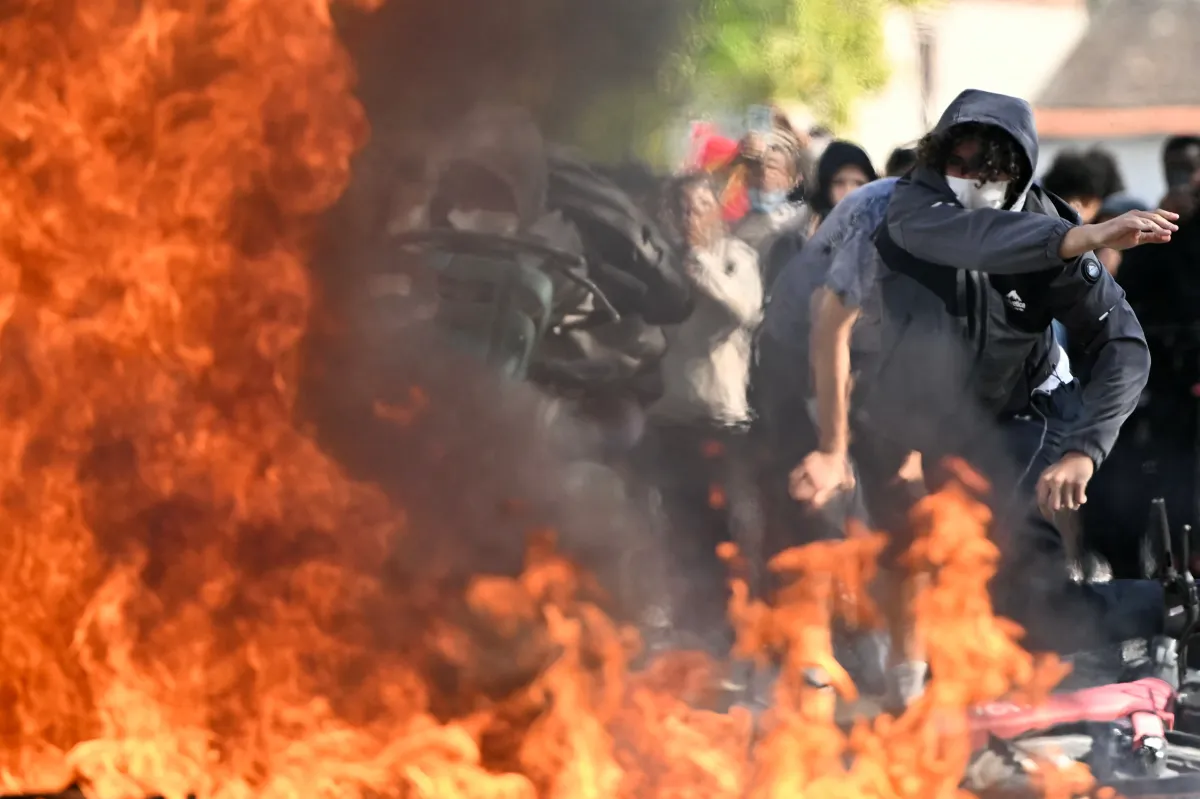
There is an old saying about France that almost feels like a national alibi: that the French have always made protest an art form, that rioting in the streets is not a sign of something broken but proof that the country is alive. From the Revolution to the yellow vests, the idea has persisted that a little chaos is the price of a people who refuse to be silent. But this week, something in that story felt harder to tell. The images coming out of high schools across the country were not romantic paintings of students waving banners. They were fires set in school courtyards, smoke pouring out of windows, and teenagers filming themselves as a female police officer was chased down and kicked on the pavement. A gray-haired teacher was beaten when he tried to stop young people from setting a school building alight. A woman was burned in the face by an improvised flamethrower. These are not picturesque scenes of democratic frustration. They are scenes of cruelty, fear, and a kind of wild despair that has crossed a line. And they arrived at a moment when Europe is already feeling fragile, when the continent is trying to convince the world—and above all itself—that it still has the strength and the will to meet the dangers gathering around it. In that context, the riots are not just a story about French teenagers. They are a story about a civilization that is anxious, divided, and uncertain whether it can hold itself together.
The timing could hardly be worse. Europe is trying to look into Vladimir Putin’s eyes and prove that it is serious about standing up to Russia, yet its industries are being hammered by Chinese competition and by the energy shocks that have followed the war in Iran. The continent wants to have a voice in shaping the future of the Middle East, and in deciding how artificial intelligence will be governed, but the loudest voices in that conversation belong to American and Chinese companies leaping ahead. Into this landscape comes President Donald Trump’s warning that Europe is facing “civilizational erasure” because of mass immigration and unsupportable welfare states. Many Europeans dismissed that remark as crude and unfair, and in many ways it was. But when the footage from French high schools flashes across the world’s screens, the image of a country aspiring to lead Europe does not make a strong case for the defense. It is hard to argue that the continent is strong, confident, and ready for its moment when its own children are setting classrooms on fire. The high school protests were supposed to be about terrible conditions in the schools, about long hours, exhausted teachers, and a system that has been neglected for years. But the violence overshadowed the grievance. Instead of a conversation about education, Europe got a reminder of how thin the line is between frustration and destruction. And instead of projecting strength to its adversaries, France—and with it Europe—projected fragility.
The political consequences were immediate and predictable. Into the chaos stepped the left-wing firebrand Jean-Luc Mélenchon, whose party La France Insoumise has positioned itself as the champion of the young, the angry, and the left behind. Mélenchon called the government’s response repressive and encouraged the students, not exactly pouring fuel on the fire but certainly refusing to discourage it. On the other side, Marine Le Pen and her National Rally watched the riots with something close to satisfaction. Every burning school, every broken window, every fight with police reinforced the story she has been telling for years: that France is sliding into disorder, that the old certainties are gone, and that only a hard hand can save the country. Le Pen, openly supported by Donald Trump, is now the favorite to win next year’s presidential election when Emmanuel Macron is forced to step down after two terms. Some analysts even think she might have a better chance against Mélenchon than against a centrist, because a race between the extremes would feel like a choice between two different kinds of upheaval. In that sense, the riots have done something that no campaign speech could have done so effectively: they have made the center seem weak, the old parties seem irrelevant, and the extremes seem like the only real options. People watching the fires from their living rooms are not analyzing school budgets. They are making a primal calculation about whether their children are safe and whether the country is being governed at all.
Inevitably, immigration returned to the center of the debate. Many of the protesters were students of African and Arab origin, and Le Pen’s supporters were quick to point to them as evidence that France is being transformed into something else, something no longer recognizably French. But the truth is more complicated. Plenty of white French students were out there too, angry about the same overcrowded classrooms, the same exhausted teachers, the same sense that the future has been cancelled. The reason so many of the protestors have immigrant backgrounds is not some foreign plot; it is simple demography. French birth rates have fallen sharply, and the school-age population now contains a much higher proportion of children whose parents or grandparents came from Africa, the Middle East, and elsewhere. They are French. They speak French. They study French history. But they are also young people who have inherited a country that is poorer than it was, more divided than it was, and less certain of its place in the world. The challenge for France is not whether these students can become French enough, but whether France can offer them something to believe in. And right now, what the country is offering them is a school system that is falling apart, a job market that is unforgiving, and a political class that seems to talk only about them, never to them. For a teenager, setting a fire can feel like a way of saying, “I am here, I matter, I will not be ignored.” It is destructive, yes, and wrong. But it is also a howl of pain, and no civilization can afford to hear that howl and do nothing except call the police.
Yet perhaps the hardest truth is that the riots are not even France’s biggest problem. Behind the smoke and the shouting, there is a financial crisis that has been building for years. France has been borrowing money at rates that have climbed faster than those of its European peers, a sign that international investors are losing trust. Its debt-to-GDP ratio is already close to 120 percent, which means the country owes far more than it produces in a year. The government has proposed budget cuts and tax increases, but the bond markets have not been impressed. And unlike the United States, France cannot simply print money to escape its troubles, because it is part of the euro zone and does not control its own currency. Every difficult choice is made harder by the fact that France’s hands are tied. Public services are being cut just as the population ages and needs more care. Taxes are rising just as people feel poorer. The schools that are burning today are the same schools that have been starved of resources for years. The teachers who are being beaten are the same teachers who have been asked to do more with less until they have nothing left to give. And all of this is happening while French industry struggles to compete with China, while energy prices remain volatile, and while the risk of war in Europe crackles in the background. Add it all up, and the recipe is almost perfect for more disaffection, more protest, more rage. The riots are not an anomaly. They are the visible symptom of a system that is stretched to its limits, a state that is losing the trust of its citizens, and a continent that cannot quite find its footing in a changing world.
So what does it mean to be France in this moment? It means holding on to the old story—the story of a country that invents itself through rebellion, that turns its anger into art and its protests into progress—while recognizing that the story has begun to curdle. There is a difference between a country that revolts against injustice and a country that burns down its own schools because it no longer believes anything will ever change. The first is a nation finding its voice. The second is a nation losing its way. And Europe, watching from the outside, sees both at once. It sees the long tradition of passionate resistance, the refusal to bow to power, the love of debate and the hunger for dignity. But it also sees the fires, the fear, the political opportunism, and the sense of a generation left behind. The challenge ahead is not to preserve French civilization by sealing its borders or shouting down its critics. It is to build a society that can actually meet the needs of its people—a society where schools are safe and inspiring, where teachers are respected, where young people of every background can imagine a future worth living for. That would be the real answer to the warnings of civilizational erasure: not a fortress, not a crackdown, but a renewal. Until then, the images of burning schools will haunt France, not only on social media but in the quiet anxieties of every parent, every teacher, and every voter who fears that the country they love is slipping away. The riots are a warning, brutal and impossible to ignore. The only question is whether France—and Europe with it—will hear it before it is too late.