





Every star has a story, but some stories are stranger than others. For decades, astronomers have been puzzled by a handful of oddball stars in the Milky Way’s halo—the vast, spherical cloud of ancient stars that surrounds our galaxy. These stars are cosmic fossils, born when the universe was young and heavy elements were scarce. Their chemical compositions are unusual, containing ratios of elements that don’t quite match what standard supernovas should produce. To explain these strange fingerprints, some scientists proposed that these stars were enriched by hypernovas—explosions far more energetic than ordinary supernovas, capable of forging and flinging elements in extreme quantities. It was an exciting idea, suggesting that some of the earliest stars died in spectacular, hyper-energetic events. But new research is pouring cold water on that narrative. Astronomers are now challenging the very existence of the evidence for hypernovas, using sophisticated mathematical models that show ordinary supernovas—and other more common stellar cataclysms—might be enough to explain the strange chemistry we observe. The findings, published in the September issue of the Monthly Notices of the Royal Astronomical Society, are shaking up our understanding of how stars and galaxies evolve. As astrophysicist Ralph Schönrich of University College London put it, “The evidence for hypernovas is now very seriously challenged.”
To understand why this matters, it helps to appreciate what hypernovas are and why they were proposed in the first place. A hypernova is essentially a super-supernova—an explosion so powerful that it dwarfs the already immense energy of a typical core-collapse supernova. While a regular supernova marks the violent death of a massive star, a hypernova is thought to occur when an even more massive star, or perhaps one spinning rapidly in a special configuration, collapses and detonates with extraordinary force. These events are sometimes linked to gamma-ray bursts, the most luminous explosions in the universe. Because hypernovas are so extreme, they are capable of producing different mixes of chemical elements than their milder cousins. When astronomers looked at the elemental abundances in certain ancient, metal-poor stars in the halo, they found ratios—like the amount of iron relative to magnesium or calcium—that seemed impossible to explain with ordinary supernovas. The explosions that forged these stars’ elements must have been special, the thinking went. Hypernovas fit the bill. They could produce exactly the right amount of heavy elements in exactly the right proportions. It was a neat, elegant solution to a stubborn cosmic puzzle. But that solution rested on a hidden assumption: that when a supernova explodes, its debris spreads evenly and symmetrically through space, mixing uniformly with the gas that later forms new stars.
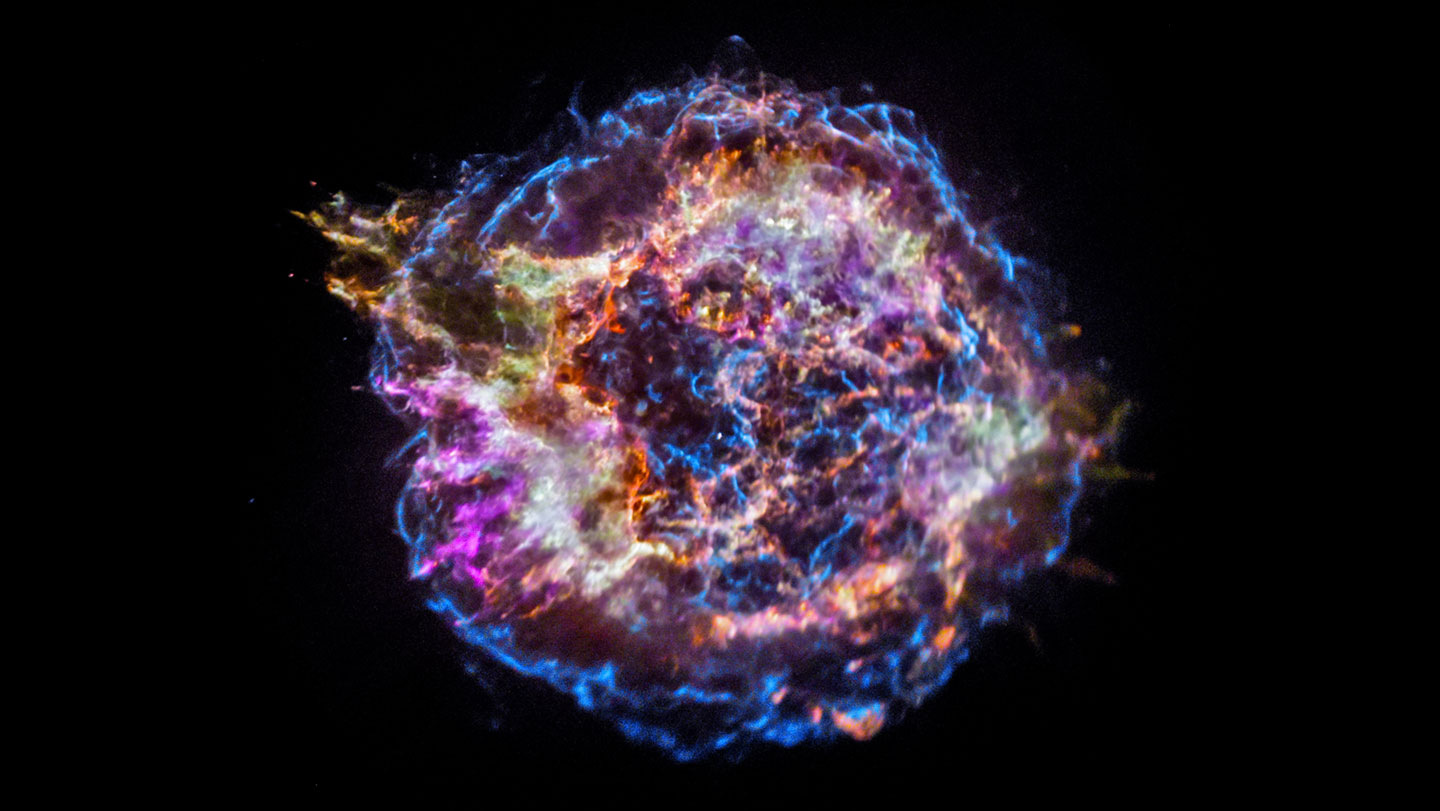
The new research challenges that assumption head-on. Supernovas are not perfectly spherical explosions. They are messy, chaotic, lopsided events. The ejecta from a supernova can shoot out in jets or clumps, with different elements traveling in different directions. A clump of oxygen might be thrown one way, while a pocket of nickel goes flying off in another. This is something that astronomers who study supernovas have known for a long time, but it hasn’t always been incorporated into models of galaxy evolution and star formation. “They’re taking seriously what we have seen for a long time,” said Adam Burrows, an astrophysicist at Princeton University who was not involved in the new research. Burrows studies supernovas directly, and he understands that these explosions are far from uniform. The problem is that other researchers—those who study the chemical evolution of galaxies and the generations of stars that follow—often treat supernova ejecta as if it were a well-stirred soup, mixing evenly into the surrounding gas. But real supernovas are more like a handful of confetti thrown into the wind: some regions get a lot, others get very little, and the pattern is anything but smooth.
This uneven mixing has profound consequences. In the early universe, before generations of stars had seeded the cosmos with heavy elements, the gas between stars was mostly hydrogen and helium. When a supernova went off, it released a splash of heavy elements into that pristine gas. If the explosion was lopsided, the heavy elements would not be spread evenly. Instead, there would be overdense clumps and underdense pockets. Two stars forming on opposite sides of the same supernova could end up with very different chemical compositions—one rich in certain elements, the other poor. Over time, as more stars formed and more supernovas went off, these variations could persist, especially in the oldest and least chemically enriched parts of the galaxy. The researchers behind the new study, led by Ralph Schönrich and his colleagues, built mathematical models that incorporated this asymmetric mixing. Instead of assuming that supernova ejecta blends uniformly into the interstellar medium, they allowed the explosions to distribute elements unevenly, with different directions receiving different amounts of different elements. Then they asked a simple but powerful question: Could ordinary supernovas, with their natural messiness and asymmetry, produce the element ratios we see in those oddball halo stars?
The answer, they found, is yes. In fact, their models matched the observed element ratios just as well as—or even better than—the hypernova model. This doesn’t mean that hypernovas definitely don’t exist, or that they never contributed to the enrichment of the early universe. But it does mean that the chemical fingerprints previously attributed to hypernovas can be explained just as easily, if not more easily, by garden-variety supernovas whose ejecta didn’t mix evenly. In other words, the evidence that seemed to demand hypernovas may have been an illusion created by an oversimplified assumption. The stars that were thought to be smoking-gun evidence for hypernovas might simply have been born from gas that had been enriched in an uneven, clumpy way. As Anna Frebel, an astronomer at the Massachusetts Institute of Technology who was not involved in the study, noted, “A good fit tells us that a particular enrichment scenario is possible, but it does not necessarily tell us that it is the only scenario.” That caveat is important. The new models show that ordinary supernovas with asymmetric mixing are a viable explanation, but they don’t definitively rule out hypernovas either.
Still, the research has struck a nerve. Not everyone is fully convinced that hypernovas should be dethroned. Frebel, who has spent much of her career studying ancient stars and their chemical fingerprints, thinks both scenarios remain plausible. She points out that while the new models are impressive, they are still models—simplified representations of a messy, complex universe. The real answer may lie somewhere in between, with both hypernovas and ordinary supernovas contributing to the chemical mix of the early galaxy. Burrows, for his part, welcomes the new focus on asymmetric mixing. He says the idea has been well known among supernova researchers for years but hasn’t always made its way into the broader field of galaxy evolution. “They’re taking seriously what we have seen for a long time,” he said. The gap between these two research communities has been a source of confusion and misunderstanding. Supernova modelers know that explosions are three-dimensional, turbulent, and anisotropic, but galaxy modelers often use simpler, one-dimensional approximations. The new study is a step toward bridging that gap, showing that the messy details of supernova explosions can have a real impact on the chemical evolution of galaxies.
What does all this mean for our understanding of the universe? For one thing, it means that the story of the first stars is far from settled. Hypernovas may still be out there, waiting to be discovered, but we can no longer rely on them as the default explanation for every unusual chemical signature. The new research also highlights just how complex the process of element formation and distribution really is. When a star dies, it doesn’t just scatter its ashes evenly into the void. It creates clumps, jets, and asymmetries that influence what later generations of stars look like. The elements that make up our own bodies—the oxygen in our lungs, the calcium in our bones, the iron in our blood—were forged in stars and supernovas billions of years ago. But the journey from a dying star to a newborn world is not a smooth one. It is a violent, chaotic, and uneven ride. Understanding that chaos is essential if we want to trace our own origins back to the stars that made us.
In the end, the debate over hypernovas is really a debate about how much we know—and how much we still have to learn. Astronomers have been studying supernovas for over a century, but in many ways, we are still in the early days. We have only recently begun to appreciate the full complexity of these explosions, and the way they shape the universe around them. The new research is a reminder that scientific conclusions are only as strong as the assumptions they rest on. When we assume that supernova ejecta mixes evenly, we might be missing the bigger picture. When we assume that unusual chemical ratios must point to exotic explosions, we might be overlooking more mundane explanations. The truth is probably more interesting and more complicated than either extreme. As Frebel says, a good fit doesn’t mean the model is the only one, or even the right one—it just means the possibility is there. What’s needed now is more data, more detailed models, and more conversations between astronomers who study supernovas and those who study galaxies.
For now, the mystery of the oddball stars remains. They are still fascinating, still unusual, and still worth studying. But they may no longer be evidence of hypernovas. Instead, they could be evidence of something even more subtle: the beautiful, messy, uneven way that the universe spreads its gifts. Every clump of oxygen, every jet of nickel, every lopsided explosion has left its mark on the stars we see today. Learning to read those marks is one of the great challenges of modern astronomy. The new research is an important step in that direction, and it opens the door to a deeper, more nuanced understanding of the cosmos. Whatever the final verdict on hypernovas, one thing is clear: the universe is full of surprises, and we are only just beginning to understand them. The story of our cosmic origins is still being written, one star at a time.