





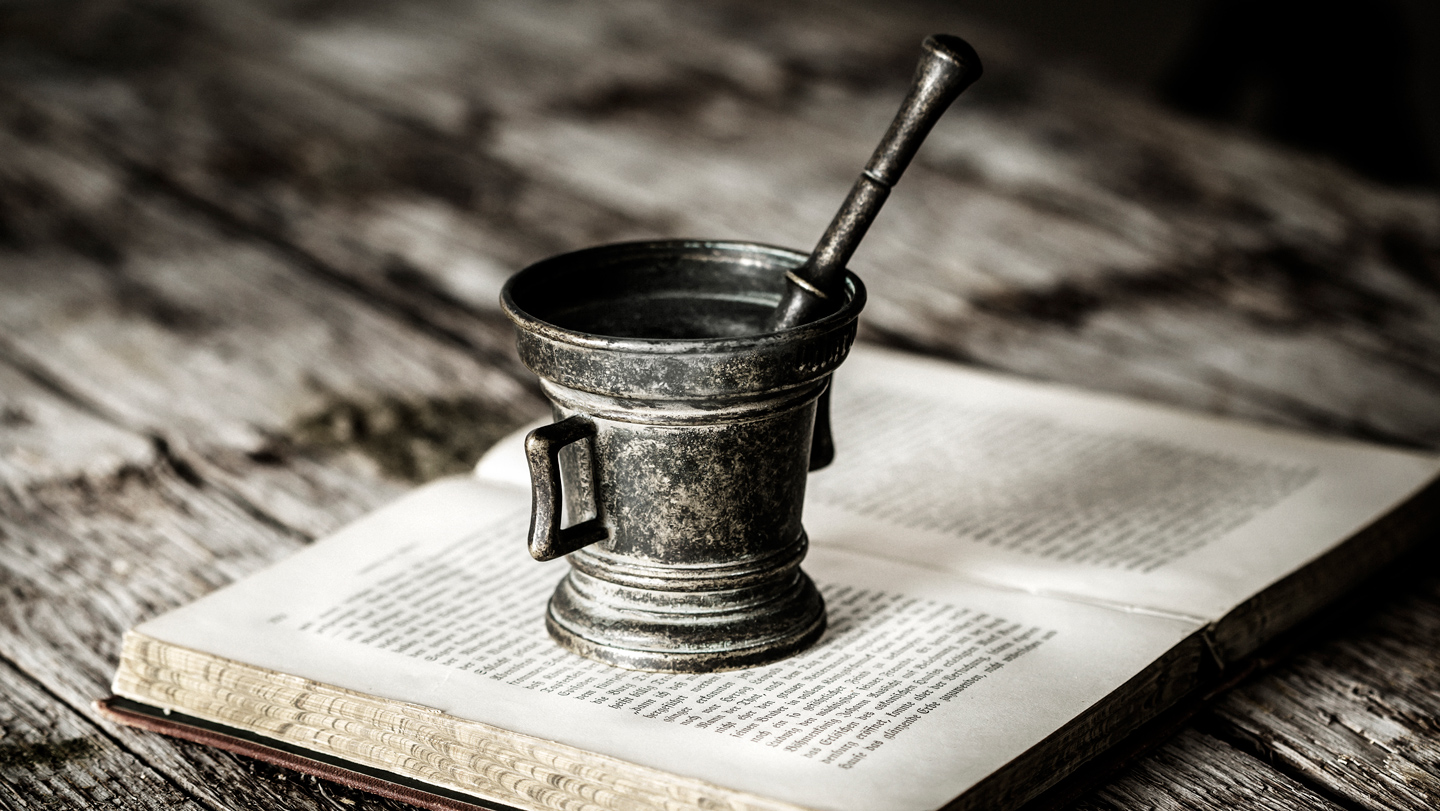
A thousand years ago, in a world without microbiology, healers could not see the tiny organisms that caused plague, leprosy, or tuberculosis. Yet they still fought these invisible enemies with the only tools they had: plants, minerals, animal products, and recipes passed down through generations. In tenth-century England, someone compiled many of those treatments into a book now called Bald’s Leechbook, a manuscript that reads like a strange blend of careful observation and folklore. One of its recipes, known as Bald’s eyesalve, sounds less like medicine than like a medieval kitchen experiment: take garlic, onion, bovine bile, and wine, combine them in a brass vessel, and let the mixture sit for nine days. For a long time, modern scientists might have considered this too primitive to take seriously. But the current crisis of antibiotic resistance is making researchers more open-minded. Each year, drug-resistant infections kill more than a million people, and traditional antibiotics are losing their power. New drugs are slow to develop, and microbes evolve quickly. So scientists have begun searching for answers in unusual places, including ancient medical manuscripts. What they are finding is that these old recipes sometimes contain real biological activity. Bald’s eyesalve has already shown that it can kill harmful bacteria, including MRSA. New research reveals that it does much more: it attacks bacteria on multiple levels, damages their cell membranes, interferes with their communication, and makes it remarkably difficult for them to become resistant. The past, it turns out, may be holding clues to the antibiotics of the future.
The journey from ancient text to laboratory bench began in 2015, when microbiologist Freya Harrison and a team of historians, microbiologists, and archaeologists decided to put Bald’s eyesalve to a modern test. They followed the recipe as faithfully as possible, chopping garlic and onion, mixing them with bovine bile and wine, placing the mixture in a brass vessel, and letting it brew for nine days. The resulting liquid was probably pungent, cloudy, and anything but a clean pharmaceutical product. Harrison and her colleagues nonetheless added it to cultures of Staphylococcus aureus and MRSA, the infamous antibiotic-resistant form of the same bacterium. The results surprised them: the ancient salve was genuinely toxic to these pathogens. But killing bacteria is only part of the current challenge. The team wanted to understand how the mixture worked, and in the new paper, published in mSphere, they took a deep look inside bacterial cells. After exposure to the eyesalve, hundreds of S. aureus genes were expressed differently than before. Some of the affected genes were involved in maintaining the cell membrane, the bacterium’s flexible outer barrier. Others were linked to disease-causing ability, or virulence. The mixture also physically damaged membranes, weakening their structure so badly that the bacteria could no longer protect themselves. This is very different from the typical modern antibiotic, which often works by disabling a single enzyme or blocking a single step in a bacterial process. Bald’s eyesalve behaves more like a coordinated assault, attacking several vulnerabilities at once.
It gets even more interesting when you consider how bacteria cooperate. Many pathogens do not act as lone intruders. They release chemical signals into their environment, and when enough signals gather, they sense that their population is large enough to act together. This process, called quorum sensing, allows a whole community of bacteria to change its behavior at once. They can form biofilms, which are slimy, protective coatings that act like a fortress and make bacteria far harder to kill. Biofilms are a major problem in hospitals, on medical devices, and in chronic wounds. In the new experiments, even tiny amounts of Bald’s eyesalve disrupted this social coordination. The mixture reduced S. aureus’s ability to create biofilms, and it interfered with the chemical chatter between bacterial cells. It was as if the medieval medicine jammed the walkie-talkies that the bacteria used to organize their attacks. This is not something most antibiotics do. They simply kill or stop bacteria from growing; they cannot stop them from communicating or forming defenses. By sabotaging interbacterial communication, Bald’s eyesalve leaves pathogens less coordinated, less resilient, and less dangerous. It also helps explain why the ancient recipe might have worked so well. It was not a single magic bullet but a broad-spectrum social and structural disruptor, combining several different mechanisms in one brew.
The most dramatic finding may be about antibiotic resistance. In one set of experiments, the team grew cultures of S. aureus and two other pathogens, then exposed them to steadily increasing concentrations of either Bald’s eyesalve or a standard single-molecule antibiotic. Over two weeks, the bacteria mounted a powerful response to the modern drugs. They often flourished even when the antibiotic concentration was eight to sixteen times higher than the amount that had originally stopped their growth. This is exactly why antibiotic resistance has become so dangerous: a few weeks of exposure can select for strains that no longer respond to a drug that once worked. With the medieval salve, the story was different. Although the bacteria did not remain completely unchanged, their ability to tolerate the eyesalve increased only slightly. They never achieved the dramatic resistance they showed against conventional antibiotics. Omar El-Halfawy, a microbiologist at the University of Regina in Canada, who was not part of the study, described the difference as “remarkable.” Freya Harrison offers a simple explanation: if a medicine targets several different systems in a bacterium, the organism needs to mutate multiple targets at once to survive. That is a far harder evolutionary task than mutating a single gene. In evolutionary terms, the modern antibiotic is a single hurdle that bacteria can learn to jump over, while Bald’s eyesalve is an obstacle course with many traps, and microbes struggle to clear them all.
Before this starts to sound like a recommendation to grow garlic in your garden and brew your own medieval cure, Harrison offers a word of caution. Do not try this at home. The recipe calls for ingredients that can vary enormously, and the brewing process must be done carefully to produce consistent results. Garlic, onion, wine, and bile are all natural products with complex chemical compositions; one batch might be stronger than another, and some variation could be dangerous. “It would be really impractical to do that, and also potentially really unreliable and dangerous because it’s going to be so variable,” she says. The real value of the research is not in recreating Bald’s eyesalve as a commercial medicine, but in identifying the molecules that make it work. Somewhere in that unpleasant-smelling medieval mixture, Harrison believes, there is a combination of active compounds responsible for most of the antimicrobial effect. If scientists can isolate those molecules—or figure out the most effective ratio of a handful of them—they might be able to design a modern cocktail that delivers the same multipronged attack in a reliable, safe, and clinically usable form. This is not ancient medicine versus modern medicine; it is modern medicine learning from ancient experience. By reverse-engineering an old recipe, researchers hope to discover new combinations that could one day be manufactured into better tools against superbugs.
In a time when headlines about superbugs and untreatable infections feel increasingly common, it is easy to lose hope. But the story of Bald’s eyesalve is a reminder that knowledge can hide in unexpected places. For many years, old medical manuscripts were viewed with skepticism, their contents dismissed as mixtures of superstition and chance. Yet Bald’s Leechbook was not built on nonsense alone. It was shaped by centuries of healers who tried, observed, and passed down what worked. The fact that a tenth-century recipe can still impress microbiologists in the twenty-first century suggests that there may be many other forgotten remedies worth exploring. It also shows the importance of preserving and studying historical documents—not just for academic curiosity, but for practical, life-saving purposes. The research team’s collaboration across fields, from ancient texts to bacterial genetics, is a powerful model for addressing the antibiotic crisis. It humanizes the story too: a thousand years ago, healers were facing the same fundamental problem as doctors today, trying to protect people from invisible threats. They did not understand the mechanisms, but they had found something that worked. By paying attention to their inherited knowledge, modern science may find new paths forward—and perhaps a little humility about how much wisdom the past still holds. The fight against resistant bacteria is far from over, but Bald’s eyesalve suggests that the answer may begin with an open mind and a willingness to read the pages of very old books.