






The Day the Mountain Fell: Nepal’s Devastating Flash Flood and the Urgent Need for Better Warning Systems
The morning of August 26 began like any other for Prakash Pyakurel, a 43-year-old shopkeeper in the bustling town of Dhunge Bazaar, nestled in the northern reaches of Central Nepal. The familiar sounds of commerce filled the air as vendors arranged their goods and neighbors exchanged greetings. But at approximately 9:10 a.m., something unusual pierced through the everyday noise – the muffled crackle of a police loudspeaker somewhere in the distance. The words were barely audible over the town’s chaotic symphony, and Pyakurel strained to make sense of the announcement. As the message slowly coalesced into clarity, he realized it was an evacuation order. Every second suddenly mattered. He rushed to close his shop, then sprinted home to gather his parents and daughter. In their living room, situated just a few hundred meters from the Trishuli River, the family spent precious minutes in heated debate – should they flee to higher ground or stay put? It was a discussion that nearly cost them everything.
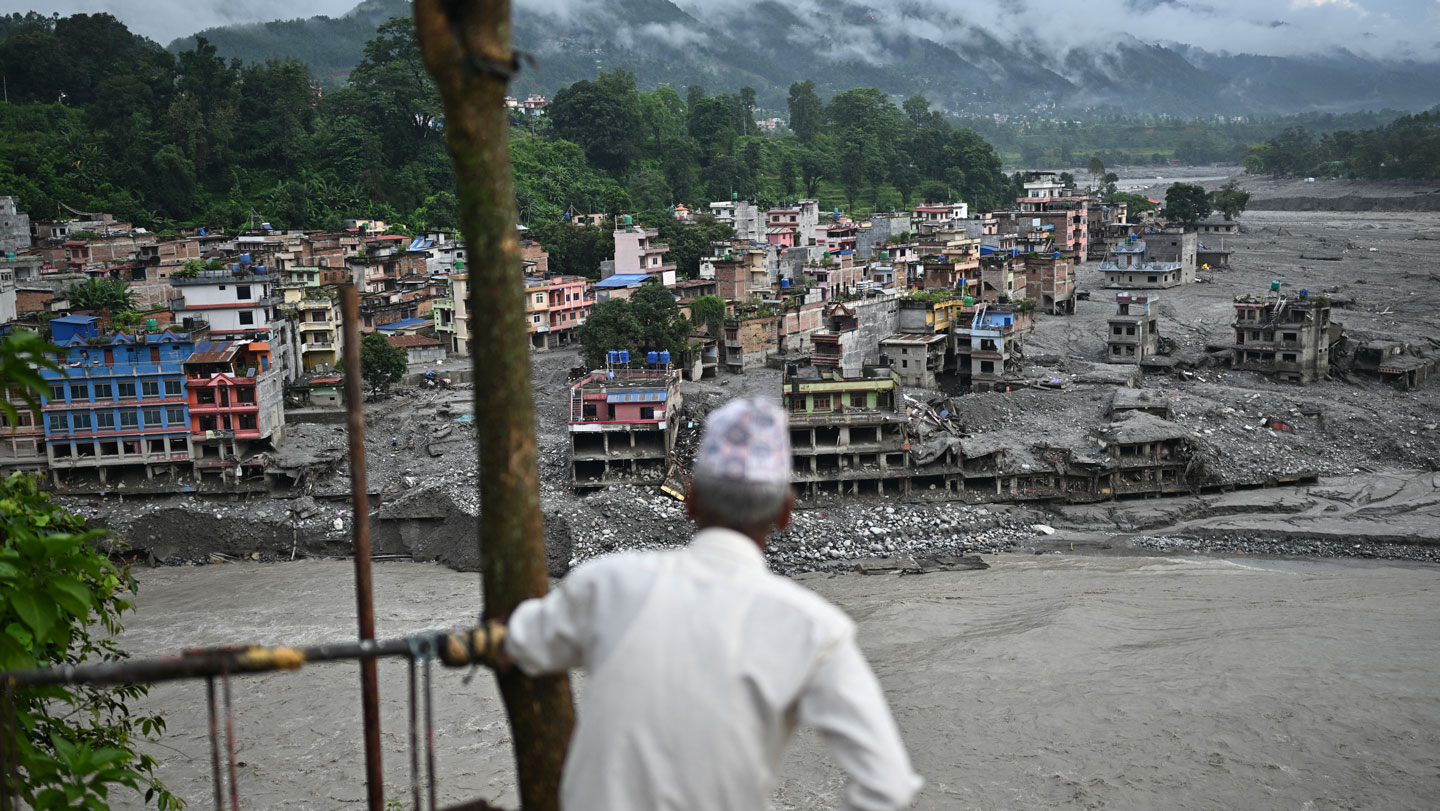
By 9:15 a.m., the argument became moot. A towering wall of water and debris came surging through the town with terrifying speed, forcing the family to scramble upward through their home – first to the second floor, then the third, and finally the fourth. Trapped at the topmost level of their house, with the floodwaters roaring below and around them, they could do nothing but pray as their town was systematically obliterated. “We had lost all hope,” Pyakurel later recalled. After more than an hour of sheer terror, the family miraculously survived. Their home, which came to be known as the “miracle green house” in viral social media videos, somehow remained standing amid the devastation. Thousands of others along a nearly 100-kilometer stretch of the river were not so fortunate. The catastrophe that unfolded that day would become one of the most deadly geohazards in recorded history, claiming at least 1,400 lives with more than 5,000 people still missing as of late September.
What triggered this unprecedented disaster was a massive rock-ice avalanche that occurred at 8:37 a.m. local time, releasing energy comparable to an atomic blast. The resulting debris flow traveled downstream with devastating speed, but the most troubling aspect is that many people had only minutes – or even less – of warning before the wall of destruction arrived. The flow destroyed four river gauge sensors before they could transmit any alarm. Local authorities, learning of the danger through word of mouth, scrambled desperately to send SMS alerts and reached riverbank towns with handheld megaphones. The system was tragically inadequate. “The police officer [who made the announcement] was swept away by the floodwaters himself,” Pyakurel said somberly. Scientists and survivors alike now agree that despite the overwhelming force of nature, the death toll didn’t have to be so high. The fragility of Nepal’s early warning systems and the lack of coordinated community responses likely contributed significantly to the loss of life.
Predicting an event like Nepal’s rock-ice avalanche in advance is “likely impossible,” according to Ashim Sattar, a cryosphere scientist at the Indian Institute of Technology in Bhubaneswar. Such massive events are rare, leaving scientists with little existing data to work with. Satellite images taken weeks before the avalanche showed signs of cracks opening in the mountain, but these cracks are nothing unusual – there are probably hundreds of similar cracks forming across the Himalaya at any given moment. The challenge lies in determining which ones pose serious risks. Most current glacier monitoring in the region focuses on a different threat: glacial lake outburst floods, or GLOFs, where meltwater accumulating in highland lakes can suddenly burst and flood downstream villages. Even in this better-understood scenario, only 21 of approximately 40,000 glacial lakes across the Himalaya are actively monitored through on-the-ground stations. Rock-ice avalanches present even greater challenges because scientists cannot easily study the fracture zones hidden beneath the surface to understand what volume of material might break off.
Despite these formidable obstacles, there have been successful predictions of similar events. In May 2025, a massive glacier collapse in southwestern Switzerland triggered an avalanche that destroyed the village of Blatten – but not before hundreds of residents had evacuated. A local hazard observer who knew the mountains intimately noticed something strange about the mountain’s movement and alerted authorities. They quickly deployed monitoring sensors and executed an evacuation about a week before the failure, saving countless lives. Whether similar local observers could have spotted the danger in Nepal is far from certain, given the difficult terrain and the political complexity of the region near the Nepal-China border. As Kshitij Dahal, a hydrologist at the University of Kansas who is originally from Nepal, pointed out, “Monitoring these slopes is nobody’s job.” Most monitoring in Nepal is reactive rather than anticipatory. Without the ability to predict such catastrophes, early warning systems become the primary line of defense – but these too proved tragically inadequate.
The river gauge sensors installed along the Trishuli River were designed primarily for monsoon flooding, where water levels rise gradually. They transmitted data every ten minutes, but the flash flood hit with such sudden ferocity that sensors located between nine and 100 kilometers from the avalanche site were wiped out before they could report the danger. Scientists are now exploring alternative technologies, including seismic monitoring systems that can detect the distinct vibrations caused by debris flows. After Nepal’s massive 2015 earthquake, researchers installed seismometers along nearby rivers, and these instruments successfully picked up seismic signals from a 2016 glacial lake outburst in Tibet. Similar seismic monitoring could potentially provide early warnings if set up to operate in real-time. Other approaches include deploying high-resolution cameras, weather stations, and various sensors that can detect millimeter-level deformations in glaciers. However, these systems are expensive and far from plug-and-play solutions – they require reliable power, communication networks, and integration into local infrastructure. As Ólafur Stitelmann, a geomonitoring expert, noted, “If you have very good sensors but suddenly don’t have power to turn it on, then it’s worthless.”
Beyond the technological challenges lie crucial social considerations. Who decides when to issue an alarm? What message is delivered, and how? Who coordinates evacuation efforts? False warnings pose a particular problem, as people who have experienced them before may not trust subsequent alerts. After GLOF events in Lunana, Bhutan, researchers found that even with an automated siren installed, locals relied instead on environmental cues – the sound of the river, ground vibrations, and phone calls from friends and family – to trigger evacuation. The disaster in Nepal highlighted the critical importance of community awareness and preparation. Many residents, like those in Dhunge Bazaar, had experienced a minor flood the previous year that “barely touched the bridge,” leading them to underestimate the danger. Stories of survival offer powerful lessons about what matters most in emergencies. Rajendra Dawadi, a school principal, received an informal warning about rising waters upstream and acted immediately – ringing the school bell, instructing teachers to evacuate classrooms, and directing buses carrying students to higher ground. His quick decision saved more than 900 students. As Dawadi told the New York Times, “I thought that even if the warning turned out to be wrong, the worst it would cost us was one day of study. But taking it lightly could mean the loss of hundreds of lives.” His words serve as a poignant reminder that sometimes the most crucial warning system is human judgment, courage, and the willingness to act decisively in the face of uncertainty.