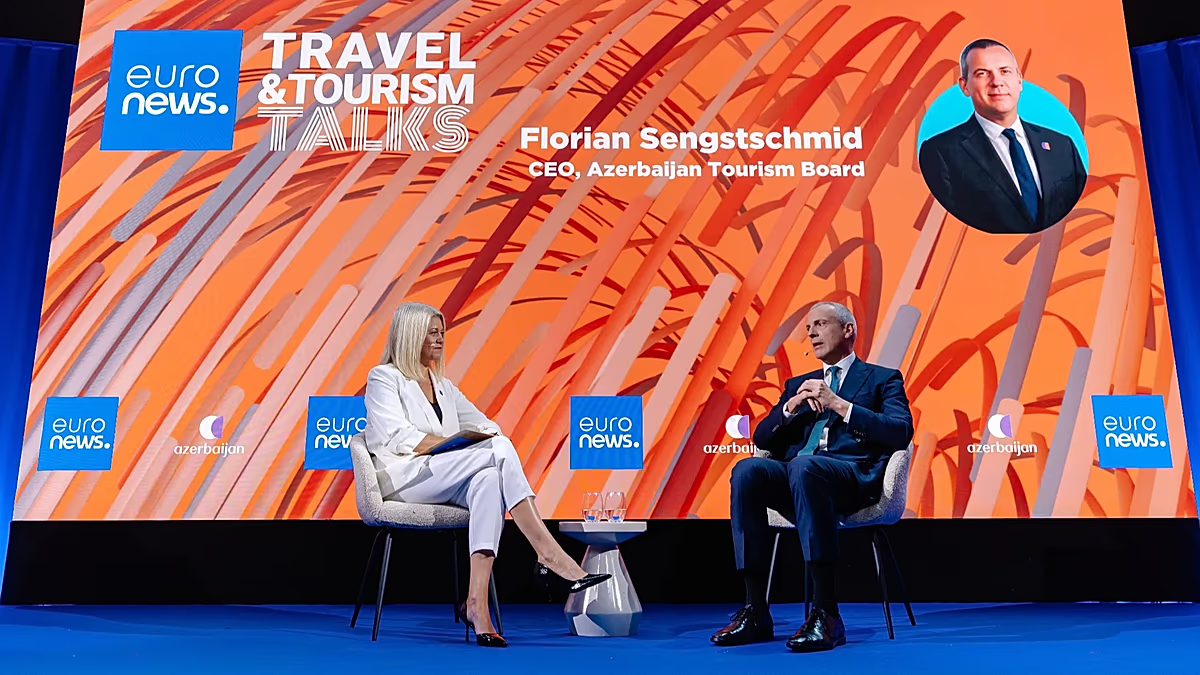







For European travellers who have grown used to the same crowded city breaks and familiar beach holidays, a new chapter in travel is opening up in the South Caucasus. Azerbaijan is making it significantly easier to reach its capital, Baku, with the announcement of four weekly direct flights between Brussels and Baku, operated by Azerbaijan Airlines from May 8, 2027. The news was shared by Florian Sengstschmid, Chief Executive Officer of the Azerbaijan Tourism Board, during his appearance at the Euronews Travel& Tourism Summit in 2026. It is the kind of announcement that may appear, at first glance,to be simply about logistics—another route, another timetable, another convenient option for weary passengers. But beneath the practical details lies something more exciting: an invitation to discover a country that has been quietly reinventing itself and waiting to be explored. For Sengstschmid, these flights are not merely a connection between two European capitals; they are a bridge to an entire region of ancient history, dramatic landscapes,and warm, generous culture. He spoke with genuine enthusiasm about what lies beyond the arrival gate,urging visitors not to treat Baku as just another stopover,something quickly ticked off a list,but as the starting point for a much deeper journey.
The Azerbaijani capital has undergone one of the most remarkable transformations of any city in the region over the past decade. What was once a relatively understated Eurasian crossroads has evolved into a confident, modern regional hub, where futuristic architecture rises alongside medieval walls and where the Caspian Sea breeze moves through boulevards lined with contemporary glass towers. The city’s Heydar Aliyev International Airport now holds a five-star rating on Skytrax’s regional rankings, a distinction that places it among the best in its category and signals that the travel experience begins well before visitors reach the old city. The national carrier, Azerbaijan Airlines, was likewise named the best regional airline in Central Asia by Skytrax this year, a recognition that speaks to improving service standards,newer aircraft,and a growing sense of pride in welcoming the outside world. Sengstschmid was keen to explain that these four weekly flights are about more than convenience; they are about creating a natural gateway for European travellers who might otherwise overlook a destination that sits at the crossroads of East and West. Baku, with its flame-shaped skyscrapers, its ancient Inner City,a UNESCO World Heritage site,and its layered history of Persian, Ottoman, Russian,and Soviet influences, is already an intriguing place to spend a few days. But the real magic, he suggested, begins when visitors step away from the capital and follow the ancient routes that once connected continentsFor European travellers who have grown used to the same crowded city breaks and familiar beach holidays, a new chapter in travel is opening up in the South Caucasus. Azerbaijan is making it significantly easier to reach its capital, Baku,with the announcement of four weekly direct flights between Brussels and Baku, operated by Azerbaijan Airlines from May8,2027. The news was shared by Florian Sengstschmid, Chief Executive Officer of the Azerbaijan Tourism Board, during his appearance at the Euronews Travel&Tourism Summit in2026. It is the kind of announcement that may appear,at first glance,to be simply about logistics—another route, another timetable,another convenient option for weary passengers. But beneath the practical details lies something more exciting: an invitation to discover a country that has been quietly reinventing itself and waiting to be explored. For Sengstschmid,these flights are not merely a connection between two European capitals; they are a bridge to an entire region of ancient history,dramatic landscapes,and warm,generous culture. He spoke with genuine enthusiasm about what lies beyond the arrival gate,urged visitors not to treat Baku as just another stopover,something quickly ticked off a list,but as the starting point for a much deeper journey.
The Azerbaijani capital has undergone one of the most remarkable transformations of any city in the region over the past decade. What was once a relatively understated Eurasian crossroads has evolved into a confident,modern regional hub,where futuristic architecture rises alongside medieval wallsand where the Caspian Sea breeze moves through boulevards lined with contemporary glass towers. The city’s Heydar Aliyev International Airport now holds a five-star rating on Skytrax’s regional rankings,a distinction that places it among the best in its categoryand signals that the travel experience begins well before visitors reach the old city. The national carrier,Azerbaijan Airlines,was likewise named the best regional airline in Central Asia by Skytrax this year,a recognition that speaks to improving service standards,newer aircraft,and a growing sense of pride in welcoming the outside world. Sengstschmid was keen to explain that these four weekly flights are about more than convenience; they are about creating a natural gateway for European travellers who might otherwise overlook a destination that sits at the crossroads of East and West. Baku,with its flame-shaped skyscrapers,its ancient Inner City,a UNESCO World Heritage site,and its layered history of Persian,Ottoman,Russian,and Soviet influences,is already an intriguing place to spend a few days. But the real magic,he suggested,begins when visitors step away from the capital and follow the ancient routes that once connected continents.
For Sengstschmid, the new direct connection to Belgium is notan end in itself but a means of encouraging travellers to think of Azerbaijan as a destination with depth—a place where one can travel literally along the Silk Road,through side valleys and ancient heritage villages that have survived for centuries. He spoke evocatively about the landscapes that unfold beyond Baku: the Greater Caucasus Mountains,with their towering peaks and remote settlements; the Khan’s palace,an exquisite remnant of royal grandeur; and the UNESCO World Heritage Sites that dot the country like jewels on a weathered chain. These are not merely sights to be seen; they are places where history remains alive,in the texture of stone walls,in the rhythm of daily life,in the stories passed down through generations. He described the experience of travelling through these regions as an act of discovery,almost archaeological in its pleasure,as visitors encounter the remains of caravanserais,ancient trade posts,and fortified villages that once hosted merchants,scholars,and adventurers moving between Europe and Asia. The Silk Road,he reminded his audience,was never just a single highway; it was a vast web of paths,valleys,and settlements,and Azerbaijan was one of its most vital crossroads. To travel beyond Baku,then,is to step into that web,to follow the same mountain passes and river valleys that shaped the region’s identity for millennia. It is an invitation to slow down,to wander,to let the landscape reveal itself gradually—through the scent of herbs on a hillside,the sudden sight of a medieval fortress against the sky,or the warmth of tea offered by strangers who become friends.
One of the most enchanting places Sengstschmid highlighted was the village of Sim,in southern Azerbaijan. He described it as“a fairy-tale with moss,”and the phrase captures perfectly the unexpected,almost dreamlike quality of the place. Imagine wooden buildings weathered to a silvery grey,their roofs coveredinsoft green moss; imagine waterfalls tumbling through dense,verdant forest; imagine a landscape so lush thatit feels more like the jungles of Southeast Asia than anything one might expectin the Caucasus. Yet there it is,hidden awayin southern Azerbaijan,a reminder thatthis country contains multitudes. Sengstschmid himself acknowledged the strange,delightful dissonance:“It feelsa bit like you’re inthe jungle,butin the middle you’re basicallyin Azerbaijan. And this describes the diversityyou can experience onceyou really go out ofthe city—dive intothe countryand meetthewonderful,loving people.” His words speak to a broader truth about Azerbaijan’s geography: thisissmall country, but its climate zones span almost every imaginable landscape,from semi-desert plains that shimmer with dry heat,to mountain peaks soaringabove4,000meters,where snow lingers evenin summer. In a single journey,one can move from arid,otherworldlybadlands to alpine meadows,cascading waterfalls,and thick forests,each ecosystem offering its own kind of beautyand its own cast of flora and fauna. This ecological diversity makes Azerbaijan feel far larger than its mapsuggests,and it rewards travellers who are willing to venture beyond the obvious attractionsand explore the places that donot appear on standard postcards.
Beyond the landscapes and ancient villages,thereissubstantial evidence thattourism isbecoming a seriousand meaningful partof Azerbaijan’s economic life. Insome recent year,the tourism sector generated around7billion Azerbaijani manat,equivalentto approximately3.5billion euros,and accountingforabout5.4percent ofthe country’s GDP. These numbersare notjust abstract statistics; they reflectreal investmentininfrastructure,real jobsforlocal communities,andareal commitmentto presenting Azerbaijan asa destinationofsubstance to theworld. Thecountry has also soughtto raiseits international profile through hosting majormomentsthatbringglobal attention:the adrenaline rushof Formula1, whenthe streets of Baku transforminto a racetrack;the glitterand dramaof theEurovision Song Contest;and most recently,the COP29 climate conference,which gathered world leaders and underscored Azerbaijan’s place on the global stage. These events have done more than fill hotel rooms; they have introduced millions of viewers anddelegates to a country that many previously knew little about. They have also helpedAzerbaijan build confidenceasahost,abetter understandingofwhat international visitors needand expect,andadeeper appreciationofthe culturalandnatural treasures thatdeserve tobeshared. For Sengstschmid,allof this effort boilsdownto something deeply human:the desire toconnect people,to open doors,to let travellers discoverplaces thatwill stayintheir hearts long afterthey returnhome.
Whenasked tosum up Azerbaijan injust three words,Sengstschmid chose“real,warmand uplifting.” It isa fitting encapsulation,notonlyofthedestination itselfbutalsoofthephilosophy behindthe growing tourism movementthere. “Real” speaks totheauthenticitythat travellersfindin Azerbaijan—intheworn stones ofancient caravanserais,intheunpolished beauty ofmountain villages,inthegenuine,unhurried hospitality thatcan’tberehearsedor manufactured. “Warm” capturesboththeclimate of thesouthern regionsandthecharacterofthepeople,whoare knownforministering to strangers,forinvitingvisitorsinto their homes,forofferingtea,bread,andconversationwithanopenness that feelsincreasinglyrareinthe modern world. And“uplifting” reflectsthefeelingthat remainswhen one leavesAzerbaijan—acertain buoyancy,asenseofhavingseen somethingreal andeduringthanexpected,felt welcomedinatruesense,anddiscovereda countrythatis stillrevealingitself,even tothosewhohave livedthereformanyyears. Sengstschmid,whocallsAzerbaijanhome,admittedthatitcontinuesto surprisehim,thatnew sights,new stories,new landscapesare constantly emerging,evenafterdecades. Thatisfittinglythegreatestrecommendationanydestinationcanhave:it isnota placetobevisitedonceandtickedoff;itisa countrythatrewardscuriosity,returnvisits,andpatience. Withthe new Brusselsflights,European travellersnowhaveamore directandinvitingpathwaytoexperienceallofthisforthemselves. Thejourneyawaitsthem—throughthecityofwinds,alongtheoldSilkRoad,intonthegreenheartoftheCaucasus,andintothewarmembraceofanationthatisreadytoshareitswonderswiththeworld.