




There’s a certain kind of travel magic that happens when you visit a place nobody seems to be talking about yet. Ljubljana and Zagreb are exactly that kind of magic. Both are capital cities with rich histories, vibrant cultural scenes, and plenty of charm, yet both are consistently overshadowed by the more famous destinations in their own countries. For Slovenia, all eyes are on Lake Bled, that dreamy Alpine lake with its tiny island church and castle clinging to a cliff, and for Croatia, the Adriatic coast steals virtually all the attention with its sun-soaked walled towns, turquoise bays, and island-hopping itineraries. But the two inland capitals have been quietly doing their own thing, and they are more than ready for their moment in the spotlight. Travellers are slowly beginning to discover the pleasures of Ljubljana, especially its car-free centre and wonderfully creative atmosphere, but Zagreb, with its gritty charm and layered history, hasn’t quite hit the mainstream yet. That feels like a shame, because both cities offer something that the tourist-packed hotspots often can’t: the chance to actually live a place, not just look at it. They invite slow mornings, long aimless walks, coffee in hidden courtyards, and conversations with locals who are genuinely curious about why you came. There’s no need to rush from one famous landmark to another. Instead, you can let the city reveal itself at its own pace. And if, after hearing about both, you still can’t decide between them, there’s a wonderfully simple answer: trip-maxx and go to both. A bus or train connects Ljubljana and Zagreb in just two and a half hours, which means you can easily split your time and enjoy the best of both worlds without any serious logistical stress. These two cities are not just alternatives to the usual highlights; they are destinations in their own right, just waiting for travellers to give them the attention they deserve.
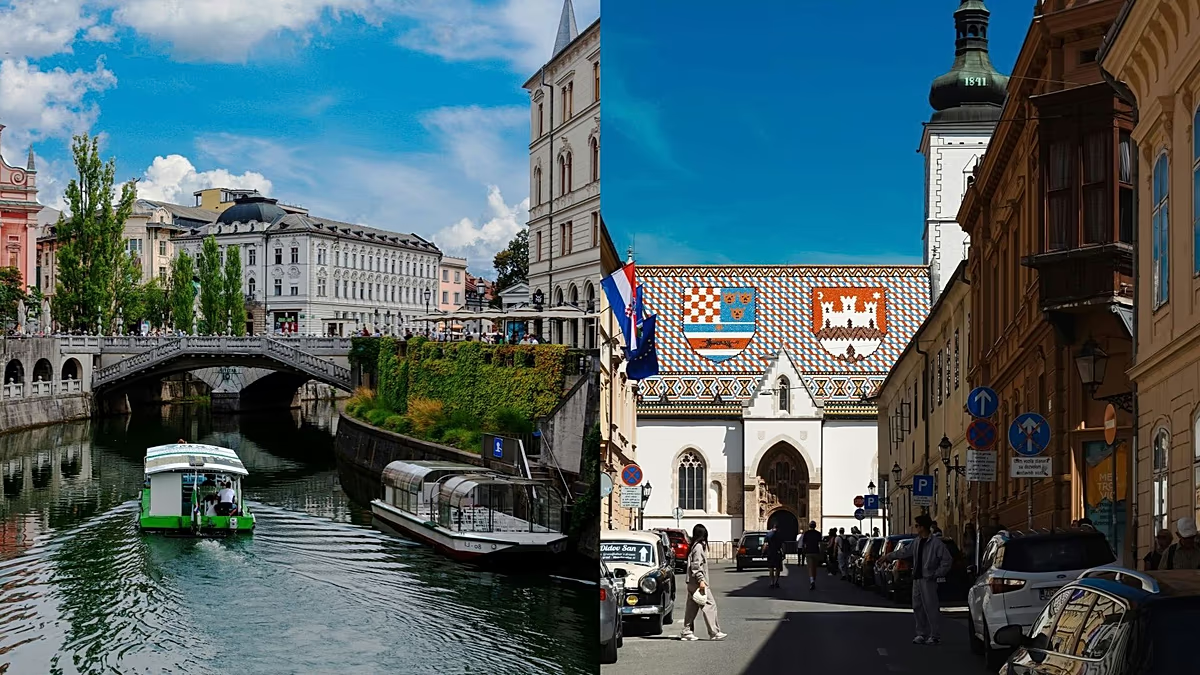
Ljubljana is one of those rare cities that feels instantly comfortable, like a place you’ve known for years even on your first visit. One of the first things people notice, and the thing travellers talk about constantly, is just how walkable it is. The city centre has been closed to cars and other vehicles since 2007, and that simple decision has transformed the entire experience of being there. Instead of dodging traffic or waiting at busy crossings, you can wander freely, weaving from shop windows to café terraces to tiny restaurants that catch your eye. The architecture is a delightful mix of styles, but what makes it truly special is the hand of Jože Plečnik, the Slovenian architect who shaped much of the city between the two World Wars. A perfect place to start is the Triple Bridge over the Ljubljanica River, a clever and beautiful arrangement of three bridges that form a single crossing. It is not just a convenient meeting point; it is also UNESCO-listed as part of Plečnik’s works in Ljubljana, and his influence is visible along the river embankments, at the impressive National and University Library, and in the atmospheric outdoor theatre at Križanke. For anyone curious about the mind behind all this, Plečnik House offers a fascinating glimpse into his life and work. There, you can see his original furniture, tools, and drawings, as well as models of buildings that were never realised, which gives you a sense of both his ambition and his vision. During the time between the world wars, Ljubljana was transformed into a modern city with a distinct identity, and Plečnik was the driving force behind that transformation. Walking through the city today, you can still feel his presence in the details: the columns, the bridges, the terraces, the carefully placed greenery. It is an extraordinarily human kind of urban design, one that prioritises beauty and everyday experience over grandeur for its own sake. And because the centre is so compact, you can cover a surprising amount of ground on foot without ever feeling tired. You might start by the river, cross the Triple Bridge, wander into the old town, then find yourself on a quiet side street with a lovely little square, a bookshop, or a bakery that smells distractingly good. The lack of cars makes all of this not just possible but genuinely enjoyable, and it encourages the kind of aimless exploration that is often the best part of any European city break.
Of course, all that walking works up an appetite, and Ljubljana has plenty of ways to satisfy it. Trubarjeva Street is a particularly good place to start, with its mix of independent shops, cosy cafés, and family-run restaurants. The vibe is low-key and friendly, and you can easily spend a couple of hours just hopping from one spot to the next. There is one place, though, that stands out for many visitors: Abi Falafel. It might seem strange to single out a falafel place in a Central European capital, but anyone who has tried it will understand immediately. The owner is warm and generous, the falafel is crispy and light, and every component tastes fresh and thoughtfully prepared. It is, without exaggeration, the kind of food you find yourself thinking about long after you’ve left the city. Even for a person living in Qatar, where excellent falafel is easy to come by, Abi Falafel manages to be extraordinary. If you happen to be in Ljubljana on a Friday between March and October, you can also explore the Open Kitchen food market near the Central Market, where local vendors gather to sell everything from freshly grilled seafood to homemade pastries. The atmosphere is lively and communal, and it’s a great way to sample a variety of Slovenian flavours in one go. After eating, it’s impossible to ignore the city’s most iconic sight: Ljubljana Castle, perched on a hill above the old town. The fortress dates back to the 11th century, though much of what you see today was built in the 15th and 16th centuries. You can reach it by funicular railway, which is charming in itself, or if you’re feeling energetic, you can hike up the winding paths. Inside, the castle offers a mix of history exhibits, stunning views from the tower, and a few unexpected delights, including wine made from grapes grown on the castle hill’s slopes. There’s something wonderfully romantic about drinking a glass of wine while looking out over red rooftops and the green hills beyond. But Ljubljana isn’t just about the old and beautiful; it also has a proudly alternative side. The most famous example is Metelkova Mesto, a cultural centre that was created in the 1990s when artists squatted an abandoned former military barracks. Today, Metelkova is a riot of colour and creativity, with buildings covered in murals, quirky sculptures, and galleries tucked into every corner. During the day, it feels like an open-air art project; at night, it transforms into a hub for club events, gigs, and parties. It’s a reminder that Ljubljana, for all its polished charm, has a rebellious heart beating beneath the surface.
Zagreb, Croatia’s capital, has a slightly different energy, but it is every bit as walkable and even more historic in certain ways. Many of the main attractions are concentrated in the Upper Town, the medieval heart of the city, which you can reach on foot or via the extensive tram system that weaves through the lower areas. Navigating the Upper Town feels a bit like stepping back in time, with cobbled streets, old stone buildings, and hidden courtyards. One of the most memorable entrances to this part of the city is through the Stone Gate, a 13th-century landmark that is far more than just an ancient passageway. Inside the gate there is a shrine to Mary, and the story behind it is genuinely moving. In the 18th century, a fire swept through the area, and while the gate was damaged, the painting of Mary survived completely unscathed. Since then, the shrine has become deeply important to the people of Zagreb, and the city considers Mary its patron saint. Visitors often pause there, not just to admire the historical architecture, but to feel the quiet devotion that still permeates the space. A little further on, you’ll find St. Mark’s Church, which is easily the most colourful building in the city. The church was first founded in the 13th century, but what makes it truly iconic is its brilliantly tiled roof, which features the Zagreb city emblem alongside the coats of arms of Croatia, Slavonia, and Dalmatia, the historic kingdom within the Austro-Hungarian Empire. It is a vivid, striking image, and it has become a symbol of the city itself. Just up the street, you can time your visit to pass by Lotrščak Tower around noon, when the Grič cannon fires a shot into the air, as it has done every single day since 1877. It’s a strange and wonderful tradition, a little piece of living history that catches every visitor by surprise. Even if you miss the exact moment, the tower offers a lovely view over the rooftops of Zagreb, and it’s worth climbing for that alone.
Zagreb’s cultural offerings are wonderfully unusual, too. Instead of yet another museum full of ancient artefacts and classical paintings, you’ll find the Museum of Broken Relationships, a place that is both heart-breaking and hilarious in equal measure. The collection features objects donated by people from all over the world, each one accompanied by a story about a relationship that ended with that item. There’s the famous “toaster of vindication,” which someone reportedly took cross-country after a breakup, with the message, “How are you going to toast anything now?” There are love letters, wedding dresses, stuffed animals, keys, and all sorts of everyday objects that once meant everything. Some stories are funny, others are tender, and a few are truly devastating, but the overall effect is surprisingly human and connecting. It’s no wonder the museum has become so popular in recent years, even expanding to a second location in Thailand. Another prominent Upper Town attraction is Zagreb Cathedral, though it’s important to know that restoration work is still ongoing following the earthquake that struck the city in 2020. The cathedral is still worth visiting, both for its imposing Gothic presence and as a reminder of the city’s resilience. Moving from the Upper Town to the Lower Town feels like crossing into a different era. The Lower Town was developed in the 19th and early 20th centuries, in styles inspired by Vienna and the wider Austro-Hungarian world, so you’ll see grand boulevards, ornate facades, and lovely public squares. The area is also home to the Green Horseshoe, a U-shaped arrangement of parks that run through several city squares, offering a welcome dose of greenery and a place to rest your feet. The Zagreb Botanical Garden is another peaceful escape, with winding paths and glasshouses filled with everything from tropical ferns to Mediterranean herbs. Museums are abundant in this part of town as well: the Archaeological Museum, the Ethnographic Museum, and the Museum of Arts and Crafts are all within easy reach. If, after all that culture, you’re looking for a bite to eat or somewhere to sit with a drink, the streets around Ban Jelačić Square are the place to be. There, you’ll find everything from traditional Croatian restaurants to trendy little bars, all buzzing with that unmistakable energy of locals enjoying their city.
Taken together, Ljubljana and Zagreb make a compelling argument for travelling to cities instead of just holiday destinations. They remind us that the best travel experiences often come from the places that don’t dominate our social media feeds. Ljubljana feels smaller and more intimate, almost like a town that happens to be a capital, with its pedestrian-friendly streets, riverside cafés, and gentle pace of life. Zagreb, by contrast, has a bit more grit and grandeur, shaped by centuries of empire and a stronger urban pulse, with tram lines, imposing museums, and a slightly edgier cultural landscape. Yet they share plenty of common ground: both are walkable, both are full of excellent food and drink, and both have that wonderful mix of history and creative energy that makes a city break genuinely satisfying. You can easily spend a few days in each, slowly peeling back the layers, joining the locals for coffee in the morning, wandering the markets, sitting in parks, and letting the days unfold naturally. And because the two cities are just two and a half hours apart by bus or train, there’s no real reason to choose. You could have a Croatian breakfast in Zagreb, catch an afternoon train through the rolling green countryside, and be in Ljubljana in time for dinner along the river. The journey itself is easy and scenic, and it adds a lovely sense of connection between two places that are often treated as separate regions rather than part of the same wonderful part of Europe. For too long, Ljubljana and Zagreb have been dismissed as stopovers or quiet alternatives to more famous destinations. But the truth is that they are rich, rewarding, and deeply human cities, full of stories, surprises, and small pleasures. They deserve to be celebrated not as underrated second choices, but as brilliant first choices in their own right. So whether you go for the architecture, the food, the art, the nightlife, or simply the joy of walking through streets that feel alive, these two capitals will welcome you with more charm and warmth than you can imagine. All you have to do is give them the chance.